Getting Buy-In for Your AI Initiatives: Where Technology Supports Human Decisions in Hiring
BY Emily McCrary-Ruiz-Esparza
|
June 16, 2026

For HR organizations eager to introduce AI into the hiring processes, the question is: Where to begin?
Most companies can’t buy a product off the shelf and roll it out—that’s true even if it doesn’t employ artificial intelligence. There are legal implications, security risks, and feasibility questions to be addressed. There’s also the matter of buy-in from business leaders who hold the purse strings and from the employees expected to use it.
“Everybody’s on a different spectrum, from highly regulated to wildly experimental,” said Brenna Lenoir, SVP of marketing and strategy at AI-native skills platform CodeSignal. “When you want to start experimenting with something or conducting a vendor search, first understand legal’s comfort level with risk.” Most legal teams, she says, will raise concerns about ingesting third-party data that hasn’t been validated or checked for quality, disclosure to those interacting with the tools, and the degree of human oversight.
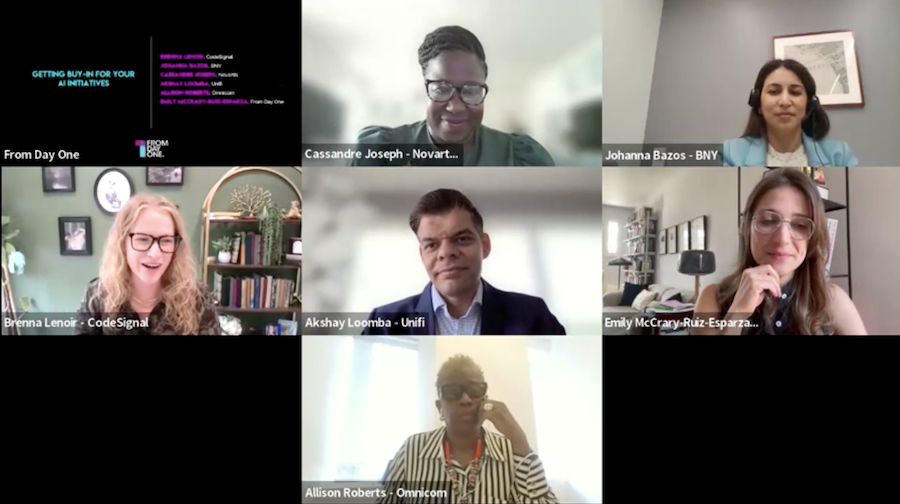
When it comes to AI in hiring, “it’s about responsibility, trust, and downstream impact on the talent we bring into the organization,” said Cassandre Joseph, the global head of TA at global pharmaceutical firm Novartis, during a From Day One webinar on how HR can earn buy-in on AI initiatives. To introduce AI, she worked closely with legal and risk partners to ensure “every use case now is evaluated for things like bias, data privacy, and fairness before it scales, ensuring we’re not just moving fast, but that we’re moving responsibly.”
Across organizations, business leaders have loved the cost savings that AI affords hiring teams.
For instance, Novartis started with high-impact, low-risk experiments, like drafting job descriptions and outreach messages and scheduling interviews. “Very quick wins that you can go back to with the business,” said Joseph.
At multinational media company Omnicom, the senior director of HR Allison Roberts said she’s most interested in “efficiency and reduction of the transactional work that recruiters have to do, to help them be more responsive and supportive, and have that custom customer service element improved.”
At Unifi, which employs the airport ground employees that load bags and push wheelchairs and refuel aircraft, the business wanted speed and capacity. The company sees more than 100,000 applications and hires tens of thousands of workers every year. And thanks to AI-powered automation that standardizes workflows and evaluation criteria, it now does this with a team of just 18 people.
Yet despite heavy automation, “every step is auditable, every step is reportable, and bias mitigation is done on a weekly and monthly basis,” said talent acquisition VP Akshay Loomba. “We don’t leave it as a one-time exercise. There are dedicated team members who are looking at it. We have a dedicated member from the legal team who’s looking at emerging state laws.”
But AI isn’t effective as an accessory. “We realized quickly that the access to the AI tools alone doesn’t immediately create the transformation we’re looking for,” said Johanna Bazos, who leads executive recruitment at financial institution BNY. “The real challenge is understanding the workflow integration from a day-to-day perspective and the culture change that needs to happen in order for AI to have an impact.”
Recruiters at BNY are spending upwards of 20 hours in AI bootcamps, and “we’re in the process of launching an AI buddy program pairing individuals in the TA organization who are more advanced” to teach skills around prompting and agent creation. Bazos herself is about to begin a 40-hour course on building agents.
Once TA teams actually get their hands on these tools, it hasn’t been difficult to get buy-in from the recruiters themselves, said Roberts. “Epecially for the efficiency and the opportunity to fill all of the critical metrics they’re measured on—they’re excited to have a resource to help them meet those objectives.”
Editor’s note: From Day One thanks our partner, CodeSignal, for sponsoring this webinar.
Emily McCrary-Ruiz-Esparza is an independent journalist and From Day One contributing editor who writes about business and the world of work. Her work has appeared in the Economist, the BBC, The Washington Post, Inc., and Business Insider, among others. She is the recipient of a Virginia Press Association award for business and financial journalism. She is the host of How to Be Anything, the podcast about people with unusual jobs.
(Photo by tanit boonruen/iStock)