The Evolving Benefits Landscape: Personalization, AI, and the New Era of Employee-Centered Strategy
BY Jessica Swenson
|
June 18, 2026

Many employers responded to increasingly diverse workforces and the pandemic-era talent landscape by adding niche benefits, only to find that employees either don’t know about them or aren’t using them. Amid continuously mounting financial pressures, those same organizations are now facing a renewed focus on the cost of benefits packages and their administration.
“There is more focus from business leaders asking, ‘Do we need to be spending this extra money in these extra ways? Is this the right thing to do for our people?’” said Amy Waickman, global head of benefits at Arup.
She suggests evaluating each benefit individually to determine whether it serves a clear purpose, is well-communicated, and is being used. “Because if it’s not, then what’s the value of having it out there?”
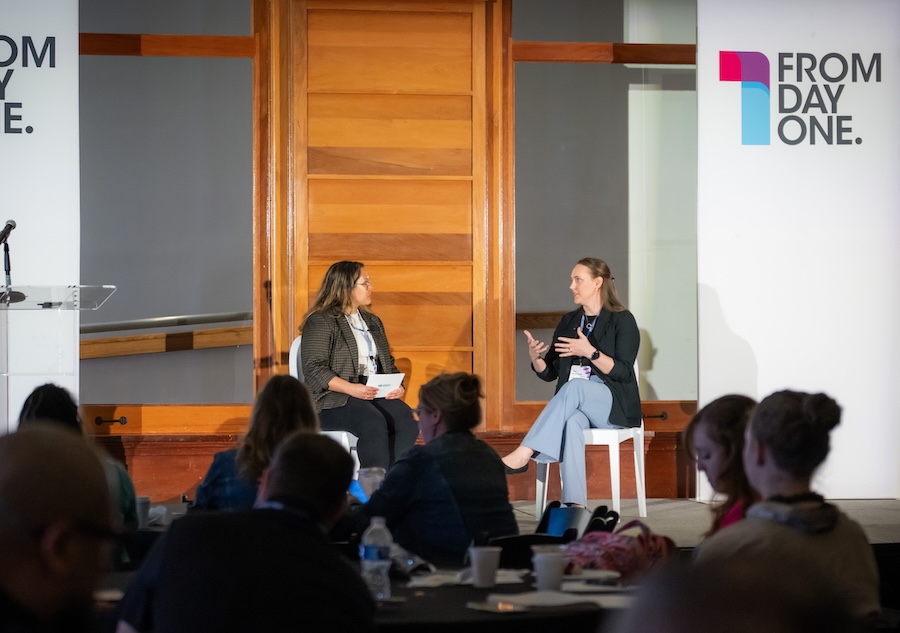
In conversation with HR Brew reporter Mikaela Cohen at From Day One’s half-day Chicago benefits conference, Waickman discussed strategies to balance budget requirements with an optimized employee benefits experience.
Growing legislation regarding pay transparency means that employees can more easily learn about and compare compensation with their peers. As a result, said Waickman, “benefits are going to become an increasing differentiator in total rewards packages.”
While budget constraints can force difficult benefits decisions for employers, she recommends taking a structured, cautious approach rather than abruptly pausing or cancelling offerings. Organizations need to know why they’re pausing a benefit and what outcomes they need to see to make a go-forward decision. Communication is also key to keeping employees informed and maintaining trust.
Employers can optimize access to existing benefit programs by helping their teams better navigate their options, she says, especially during times of crisis. The ability to meet employees where they are and fulfill their unique needs simplifies the experience and helps reduce their anxiety.
However, she shared that the old model of reaching out to an HR contact for guidance is shifting, as companies are now exploring AI to offer true personalization. She expects it to change how employees interact with their company’s benefits ecosystem—possibly within the next six-to-twelve months.
“There’s a change now. In the past, it’s been really difficult to communicate and navigate well at a personal level. Now, with AI, I think there’s going to be an opportunity to help employees navigate that on a personalized, individual basis based on their circumstances,” she said.
While AI has transformed the benefits landscape significantly, Waickman noted that it happened a little slower than the industry expected—which she thinks is a good thing. Her HR and benefits team has improved efficiency in some administrative and operational tasks by using AI to compare year-over-year plan documents, automate surface-level invoice checks, or translate foreign-language policies and handbooks.
But an element of caution is also warranted. One area of focus for Arup’s leadership team is vendor AI practices. At each contract renewal, the company inquires how employee data is used in vendor systems to determine whether contractual guardrails are needed. “I think there is a danger there of not protecting our employees, and making sure that we’re getting the best outcomes for our people. We don’t want our vendors to be using AI or using data in a way that would inhibit that.”
One challenge of integrating AI into HR operations is identifying and measuring ROI. In the planning stages, Waickman quantifies its value through time saved, but in later phases it can be difficult to retroactively confirm those projections.
“We can say we’re freeing up X amount of time from our benefit professionals to do these other sorts of activities and things, but is there going to be a way to look back and say actually we did free up [a specific] amount of time, and what does that look like compared to what we expected?”
To offset employee uncertainty about the advent of AI and job security, she takes an approach that shows how AI can support and elevate them. “All we can do as leaders is make sure that we are demonstrating clearly the ways that AI can help them become more efficient,” she said, “and then continually give them other opportunities to expand, so that they feel confident around their job security.”
Jessica Swenson is a freelance writer and proofreader based in the Midwest. Learn more about her at jmswensonllc.com.
(Photos by Josh Larson for From Day One)