Finding True North: How to Lead Organizations Authentically and With Moral Clarity
BY Katie Chambers
|
June 08, 2026

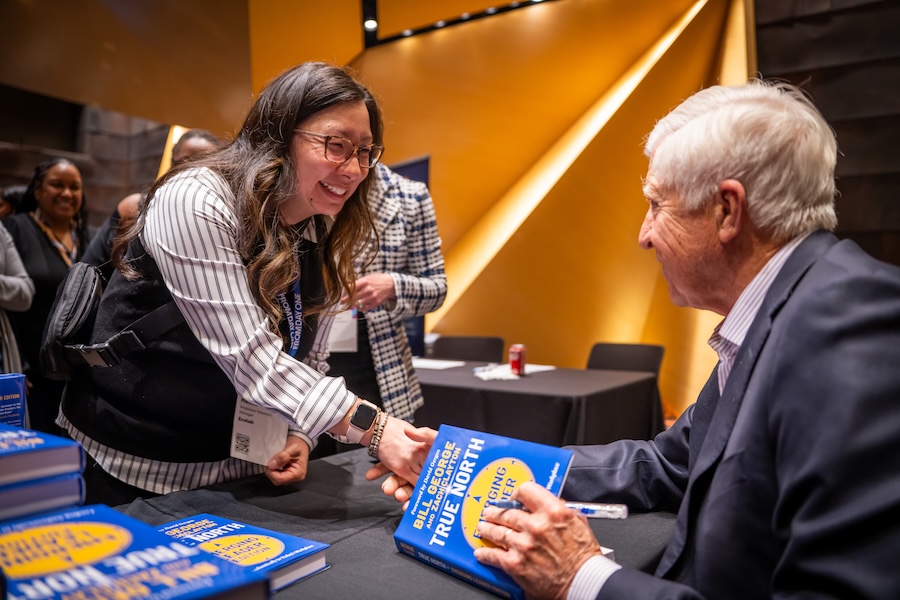
What does it mean to be an authentic leader? “I’ve always wondered why that’s a hard question,” said Bill George, author of True North: Leading Authentically in Today’s Workplace, Emerging Leader Edition, and former CEO of Medtronic, during a fireside chat at From Day One’s Minneapolis conference. “I think a lot of people are afraid. They feel like they have to go into the workplace and wear a mask. Being authentic is being genuine; it’s being who you are. You [should] actually constantly grow as a leader. You’re adapting to a situation.”
During the session moderated by Kristen Painter, business editor at the Minnesota Star Tribune, George shared practical strategies and techniques for navigating today’s complex world, including advice on personal values, crisis leadership, and self-awareness.
What Is a Leader’s True North?
In his book, George defines the new true north as a call for leaders to step up in an era of intersecting crises. “It’s easy to follow your true north, follow your values, your purpose, until you get under pressure, and you have to decide between two options,” George said. “And that’s the real test. Where there may be sacrifices you have to make, do you have the moral courage to step up and follow what you believe, or do you back down?”
Painter noted one recent crisis: the sudden rollback on corporate DEI pledges. “Do you think moral courage is actually in decline, or has the cost of exercising it simply gone up for leaders?” she asked. George does think leaders are afraid of the current government, so even though they might quietly continue all DEI practices personally within the company, they don’t want it explicitly stated. He cites Costco leader Ron Backer as an ideal example of a leader who stood up for his beliefs in the face of DEI backlash and received an overwhelming 98% vote of support from his shareholders.
It’s these moments that matter for an organization. “Do you stand up and be counted? Everyone’s watching you inside the company and outside the company, and they frankly don’t believe anything you say if you don’t stand up under pressure,” George said. Contrary to some belief, having a moral center is actually good for business. “You have to act. Everyone’s so worried about short-term earnings. You better worry about long-term building your organization with the right people.”
A leader’s primary obligation, George says, is always to their employees. “Without employees, there’s no support for your customers.” One recent practical, and harrowing, example: Operation Metro Surge, the ICE invasion on Minneapolis. George advised companies to issue statements to their employees.
“Our employees’ welfare is the number one thing we have to do, and we have,” he said. “We’ll provide a safe workplace, we’ll provide for your security, and we will do everything to provide for your well-being. And if there are any issues, we will send in our security teams and our lawyers to support you and to help you,” he said. He would have issued a blunt, honest statement like that to employees, and done so quickly. He feels that while some local business owners eventually rose to the moment, they generally waited too long.
Why Nuance Is Effective
“A lot of leaders snap back to what you’ve identified in this book as sort of a command-and-control style of leadership. I’ll call it an old school way of leading, very top down, very much it leads to micromanagement, which is a disempowering feeling for workers,” Painter said. Engaged leaders, rather than those blanketly issuing orders, are more effective.
George cites Corie Barry of Best Buy as an example: during Covid, she closed 1,083 stores and furloughed 82,000 workers, once she could ensure they would be covered by government unemployment benefits. Then she encouraged each local store to convert to a warehouse for online shipping, letting the store decide how best to manage it for their own community. “She gave everyone the authority. So that to me is an engaged leader, an example of how you should lead in a crisis. But she didn’t just hang back in our office and say, ‘you guys handle it.’”
George says one of the toughest problems faced by middle managers is when the top tier of leadership implements a “command-and-control” style, while the manager still wants to lead with morals and heart. “What you have to do is stay true to your values, your purpose, and perform. And if you perform, you’ll be okay, but you still have to be an empowering leader for your people. You can’t just flip [when times get tough],” he said. He encourages organizations to be ruthless when it comes to toxic leaders: move them out before they become too damaging.
Middle managers should be empowered as leaders of their portion of the business, to inspire their own teams and take ownership over results. George advises that leaders “have the courage to be the voice of our values, and not to be rules-based, but to be empowering, and to make moves to ensure that we have empowering leaders throughout our organization.” That means going directly to workers to talk one-on-one about problems and work together on solutions, rather than relying on secondhand feedback that may be filtered.
The future is less “hero leader” and more “coach.” And coaches care about their people. “Let them be in the part of the organization where they can use their greatest skills. Then align them around your purpose and values,” he said. “This is not soft. Challenge people! Ask them how they can do better. Work with them to solve problems.”
Katie Chambers is a freelance writer and award-winning communications executive with a lifelong commitment to supporting artists and advocating for inclusion. Her work has been seen in HuffPost, Top Think, and several printed essay collections, and she has appeared on Cheddar News, iWomanTV, On New Jersey, and CBS New York.
(Photos by Josh Larson for From Day One)