Teaching Corporate Leaders of the Future in a Hybrid Workplace
BY Angelica Frey
|
December 09, 2021

Even before the pandemic struck, Laurie Rebholz was trying to restructure learning and development at Citi, the global banking company. This was no small task, since Citi has more than 200,000 employees and the core curriculum had not been fully redesigned in more than a decade. Citi’s educational program still had a traditional structure of offsite learning seminars that lasted for days, said Rebholz, Citi’s head of global leadership and performance solutions. “Going on a three-day program is not really aligned with the way people choose to consume learning. People are used to having what they want, when they want,” she said, referring to such modern learning methods as YouTube videos, podcasts, and TED talks.
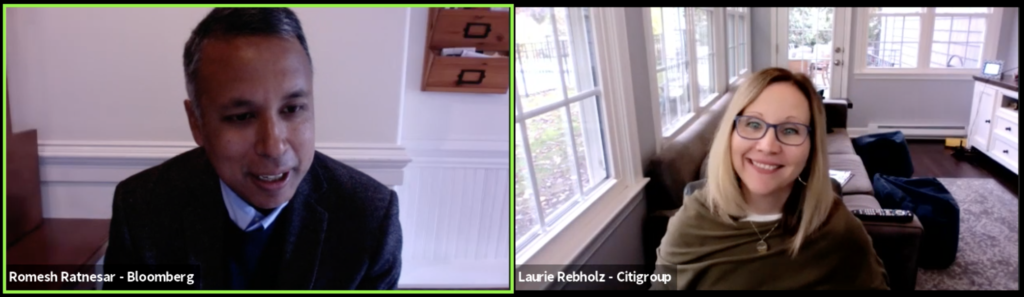
The onset of Covid-19 put Rebholz’s agenda into overdrive, not just because employees were working remotely, but because they had to learn a whole new set of skills, she told Romesh Ratnesar, an editor at Bloomberg Opinion, in a one-on-one conversation at From Day One’s November virtual conference on upskilling, coaching, and recognition.
As of March 13, 2020, stay-at-home orders for Citi workers meant that employees suddenly at a loss about how to conduct themselves in remote work were also being led by leaders and managers who had never led through this kind of crisis before. “We really had to think about how we could, quickly, create learning tools people could use in a practical way” in order to respond to a host of issues, said Rebholz. “How do you facilitate an inclusive meeting? How do you make sure voices are heard? How do you show empathy while still doing your job? How do we give people resources that meet them where they are?”
This meant reassessing the educational program with the learner’s point of view in mind. “In meeting people where they are, we recognized that people in the work environment, unless they choose to go back to school, they don't necessarily want to go back to school.” She likened the way people think of traditional training programs with the way her son approaches his high-school learning environment: the student/trainee sits in the back, while an instructor imparts wisdom unilaterally. Maybe it will stick, maybe it won't. “It's the sage on the stage, facilitating what's important to people,” she said disapprovingly.
Among other changes, Rebholz and her team resolved to democratize the educational process, giving learners a more active role and broader accessibility to courses. Previously, employees tended to know only about the programs to which they were invited. At the same time, Rebholz wanted to retain the best parts of the lab-style classroom experience, even in remote learning. “People learn sitting next to each other, and through experience,” which she said creates “the spark of creativity.”
This happens at Citi with “someone in one of our investment teams meeting with somebody in one of our consumer-products teams, or somebody that happens to sit in legal or audit or HR,” she said. “All of them experience similar leadership challenges, and they deal with them very differently, but they spark a lot of great creativity and learning when they come together.” Rebholz looks forward to a time when learners can gather in physical settings again as workers gradually return to the office, as she started doing gradually over the summer. “We have not come back en masse yet, we're not offering larger groups, we're not there yet,” she said.
As a global company, Citi has to make sure its curriculum befits the workforce across more than 100 countries. The solution is local HR partners who are qualified facilitators and are able to meet the needs of the local culture and language. Even so, she said, “you want that to be consistent. You want the right people to drive the right culture: while we design at the global table, we have representatives from each region, each product, each function, so that as we’re designing, we’re getting input.” It's an approach that is, in Rebholz's words, “as vanilla as it could be,” and it consists of a globally relevant program with different case studies per culture and region.
Whether in-person or remote, one the challenges in learning-and-development programs is quantifying the value these initiatives have within the business organization in terms of impact. “It’s harder to make a direct correlation between the impact to our client or sales numbers and something that’s removed–that somebody took a class six months ago,” Rebholz said. Her team asks for feedback on the programs themselves, and then examines how many people are engaging in what they’ve been taught. “This year, thankfully, the numbers have gone up, so it’s a really good story that, as we transition to a more modularized and democratized approach, we saw more unique consumers of our content than we've ever seen before,” she said. “Again, it’s hard to say that because of the work my team did, our manager effectiveness index went up by X percent,” she reiterated, “But we know that when we pull a certain lever, it contributes to that.”
Angelica Frey is a writer and a translator based in Milan and Brooklyn.


