Talent in Motion: How HR Is Using Tech to Align People, Skills, and Opportunity
BY Emily McCrary-Ruiz-Esparza
|
December 18, 2025

Thanks to the explosive changes in the workplace brought on by the arrival of AI, employees are being asked to learn new skills all the time–often on top of already overfull plates.
That leaves HR leaders facing a difficult question: How do you build skills at the pace the business demands without burning people out? Some HR leaders say the answer lies in shorter, more flexible learning experiences, paired with clear pathways that give employees ownership over their growth.
“We have to have learning experiences that are easily adaptable,” said Nate Beck, SVP of learning and experience at Zions Bancorporation, during a From Day One webinar on how HR is using tech to align people, skills, and opportunity. The company has moved away from eight-hour, weeklong training programs in favor of lighter, more flexible approaches. Targeted development plans now begin with e-learning to cover the basics, followed by a 90-minute discussion focused on behaviors.
“This allows people to leave the classroom with confidence and a plan of action immediately, instead of a full day of theory,” Beck said. The focus is now squarely on specific skills and the behaviors that support them. “It allows us to be quicker at meeting the needs of the organization when things change. If a skill is no longer relevant, that’s no big deal–we can adjust, because we’re not working on three days of content, we’re working on 90 minutes of content.”
“When I started in learning and development, it used to take us months to develop multi-day programs,” said Nikki Slowinski, EVP of talent experience and development at Publicis Digital Experience. “We just don’t have that luxury anymore.”
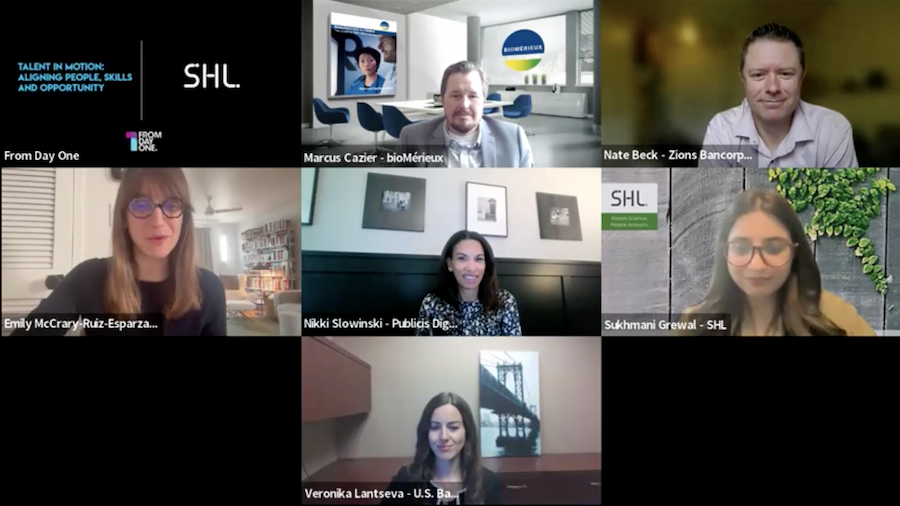
Publicis is now using Microsoft Copilot to help build training programs faster and more responsively, informed by data. “We’re able to meet needs before they become obsolete,” Slowinski said. “There’s still a lot of critical thinking involved to make it effective and high-quality, but I don’t think we couldn’t move at this pace without AI.”
At the same time, leaders emphasized that durable skills–like critical thinking, systems thinking, and problem-solving–remain essential, and may be “even more critical now,” said Veronika Lantseva, SVP of workplace performance at U.S. Bank. “AI is a transformer of the way that we do work. Those skills come into play for a human to be able to say, ‘Here’s how I can connect the dots and leverage AI to drive business outcomes.”
“Adaptability is the foundation for every other growth mindset,” Beck added. The most valuable capabilities remain human ones: “critical thinking, relationship-building, communication—those are things that AI cannot outperform us on.”
With so much change underway, fatigue is a real risk. To embed learning into the culture, companies need to incentivize it, said Marcus Cazier, director of learning and development at bioMérieux. “Make learning a part of core duties. Tie it to performance bonuses.”
Giving employees agency over what they learn helps too. “This starts with a conversation with leaders around long-term goals and the skills needed to get there,” said Lantseva. “Let’s say I’m a project manager in HR, and I’m aspiring to work in finance. The skills-based ecosystem gives me the language to say, ‘Here’s the delta between the skills I have today and what I need in the future.’ Then I can work with my manager to say, ‘How do I close that gap?’”
Internal skills frameworks clarify the skills and proficiency levels required for different roles, giving employees a clear target to aim for. “That gives people leaders and HR language to use when they have future-focused conversations,” Lantseva said.
That clarity can also break down barriers among departments, said Beck. “You get more cross-functional work. People are happier when they can see opportunities that are available. Maybe they don’t leave HR, but they get to participate in something with accounting. It’s such a good and healthy practice to have transparent skill and role frameworks so people can try new things.”
SHL, for example, developed a skills taxonomy of 96 discrete behavioral skills that companies can use to evaluate their talent. Employees can better understand their own capabilities, while the organization can identify internal candidates ready to take on new jobs rather than hiring externally. When a new role opens or a team needs support, leaders can see who already has the relevant skills.
Sukhmani Grewal, a solutions architect at SHL, described working with a client whose senior HR leader wanted to move into a business role–an unusual step in that organization. “We were able to show they have the right skills to be an effective business leader for the opening,” she said. “We were able to connect the dots, and the person is thriving.”
Skills can also be transferred person to person, outside of structured training programs. At bioMérieux, mentorship has been a vital mechanism for skills-sharing, but only when it’s treated as more than a goodwill exercise. The mentorship is short-term and skill-based, says Cazier. It’s distinct from coaching or sponsorship, and sets the expectation that leaders will mentor, supported by systems and tools.
“Adaptability is our foundation, and digital fluency keeps us relevant,” Beck said. “But human skills are what keep us irreplaceable. That’s what people need to remember–focus on how humans interact, and how we can use AI to augment our capacity.”
Editor’s note: From Day One thanks our partner, SHL, for sponsoring this webinar.
Emily McCrary-Ruiz-Esparza is an independent journalist and From Day One contributing editor who writes about business and the world of work. Her work has appeared in the Economist, the BBC, The Washington Post, Inc., and Business Insider, among others. She is the recipient of a Virginia Press Association award for business and financial journalism. She is the host of How to Be Anything, the podcast about people with unusual jobs.
(Photo by courtneyk/iStock)


