Workers Want Better Benefits. What Can Employers Deliver?
BY Angelica Frey
|
June 30, 2021

“If people are stressed on the job, they're unproductive and distracted,” said Lori Lucas succinctly. That cause and effect seem to be very much in play in the Summer of 2021 as workers emerge from the pandemic and venture into a new world of hybrid work. Lucas is the president and CEO of the Employee Benefit Research Institute, which seeks to provide data-driven insight into retirement, health care, and benefits tied to financial security. She continued: “So employers are offering benefit programs because they have bottom-line connotations. The point of view is not just altruistic.”
Indeed, employers seem to be shifting toward more generous policies, especially in the realm of family-friendly benefits. Between 2018 and 2021, Lucas observed, companies offering paid maternity and paternity leave increased from 68% of employers to 73%. Paid leave for elder care rose from 38% of employers to 42%, she said, speaking on the evolving benefits picture as part of From Day One’s June virtual conference, “The New Benefits that Employees Need and Want Today.”
In post-Covid times, benefits have become one of the biggest recruiting and retention challenges. Traditional benefits as we know them, such as two to three weeks of paid vacation and standard health insurance, do not cover the impact Covid had on the American workforce. But change is afoot across the board. “Workers have been remote for 15 months, and now they're navigating how to get back into a regular workforce situation, and that is clearly a moving target," said Lucas.
In her institute’s annual workplace wellness survey, the focus among corporate employees has been on work-life boundaries and mental health. Many feel that their employers are not communicating clearly about the benefits in these areas. The situation is quite different, however, for furloughed employees, who are more interested in emergency funds and savings. “Just how do I make ends meet?” they’re asking themselves, Lucas said. And while student-loan repayment programs have factored prominently in EBRI's reports in recent years, in the latest survey the focus was strongly oriented toward emergency funds, debt-management services, and other ways for employers to help workers manage their financial situations.
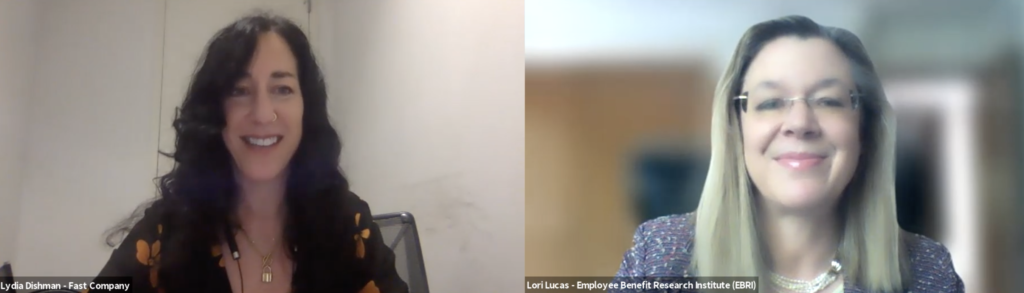
Despite the increased attention from employers, especially in the realm of financial wellness, there has been a disconnect between what the employers think they’re offering and how employees feel about that on the receiving end. “Interestingly, maybe even more alarming from an employer perspective,” Lucas said, “is the fact that while employers report that they see increases in engagement with the financial-wellness initiatives, according to the survey, only three of 10 employees feel that their employer’s efforts to help them manage their overall well-being since Covid-19 has increased,” she said. “So they're not seeing it, even though employers are saying they're doing it.”
Lucas believes that holistic programs are key for effectiveness, along with back-and-forth communication about what’s effective and what workers want. Companies should be “encouraging champions within the organization to help the word out,” followed by “strategies to measure the suggestions in order to calibrate the program according to what's working and what's not working,” Lucas said.
Most employers want their benefits to change employee behavior in ways that helps workers help themselves over the long term. “Especially with financial wellness solutions that they're offering, they want people to do better in their financial lives, they want them to do better with their retirement savings,” Lucas said. “It could be they want to see reduced absenteeism, because of less stress. They want to see reduced turnover,” she said. “So that really speaks to the need for an empirical analysis: What do I see in the data? Am I seeing changes? Am I seeing people contribute more to their 401(k) plan, take fewer loans and withdrawals?” That kind of assessment calls for more than employee surveys. It means “identifying the metrics where you want to see changes, and then measuring them,” Lucas said. “But still, the norm tends to be surveys, because it is challenging to do that kind of detailed analysis.”
Of course, there's a cost to improving benefits. “When we talk to employers, they're realistic about the fact that they have to justify the cost of these programs. The pie is only so big for compensation and benefits,” said Lucas. “They want to help employees from an altruistic sense, but there are also goals they want to see in terms of employee productivity, absenteeism reduction. Some have gone so far as to create an ROI metric.”
Lucas cites the example of a call center affiliated with an organization she was working with, where workers were leaving because they were getting a few extra dollars per hour somewhere else. The company’s response was to implement a student-loan repayment program. “They actually reduced turnover by a measurable number, directly linked to bottom-line costs in recruiting people,” says Lucas. “I think to the extent employers can do more of that, figuring out what the return on investment is that they want, and then being able to measure it, this can help to justify the cost and keep these programs going strong.”
Angelica Frey is a writer and a translator based in Milan and Brooklyn.


