Where to Start: Making the Workplace Inclusive of Neurodiversity
BY Emily McCrary-Ruiz-Esparza
|
March 29, 2024

It’s estimated that 15–20% of the global population is neurodivergent in some way, and growing awareness of diagnoses has people curious. They want to learn more about the term, what it means, and how they can support people who identify that way.
Neurodivergence describes so many different experiences, but generally, people who are neurodivergent process information differently than most individuals. This includes people on the autism spectrum, people with learning disabilities, obsessive-compulsive disorder, and Tourette’s syndrome.
Millette Granville is the VP of diversity, equity, and inclusion (DEI) at digital learning platform 2U. She’s seen the appetite in her company and has been pleasantly surprised by the enthusiasm. “We have over 200 employees that are actively engaged in our abilities resource network. They were really, truly ready to get started building the community. I was not as prepared for the thirst for knowledge from our people, from leaders, as well as our employees about what exactly we need to do to make sure we are supporting our employees.
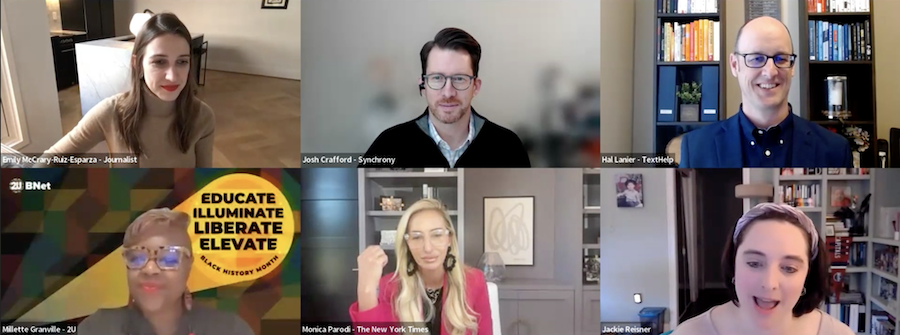
During From Day One’s February virtual conference on getting to the next stage of diversity and belonging, Granville and her industry colleagues gathered for a panel discussion on neurodiversity in the workplace and how they’re changing their organizations to be more inclusive of neurodiverse needs.
Neurodivergence can describe so many different diagnoses, experiences, and needs. It can also be invisible. “Neurodiversity is hidden in plain sight all around us,” said Hal Lanier, client engagement leader at accessible tech company TextHelp. So how does a workplace become inclusive if the needs can be hard to identify?
An Inclusive Interview Process
Some leaders begin with the hiring process. Monica Parodi, VP of talent acquisition at The New York Times, said she’s starting at the beginning, using tools to comb their job descriptions for noninclusive language. They’re also adding details about the hiring process to the company’s career pages so candidates can prepare in advance and avoid uncomfortable surprises.
Once candidates get to the interview stage, they’ll see other changes. “We know that the first 30 seconds [of an interview] are really uncomfortable for a lot of people who are neurodivergent. So we take that space and say, ‘we’re going to ask very structured questions to everyone, and we’re going to limit small talk,’” Parodi said. “We’re also making sure panelists understand neurodivergent behaviors and don’t penalize candidates if they don’t make eye contact, if they’re writing questions down, if they’re pausing, or if they’re asking you to repeat questions.”
Building a reputation as an employer that is supportive of neurodivergent employees doesn’t happen by accident, she said. “There’s not one single place that you focus on; it’s weaved into every single part of your process in business and brand.”
Designing Learning Opportunities with Neurodivergence in Mind
Learning and skill development programs often designed for the neurotypical employee are also getting a revision. Joshua Crafford is the VP of leadership learning and development at financial institution Synchrony. He said that his experience as a person with learning disabilities shapes his work. Crafford uses his personal point of view to design better learning experiences, often asking himself, “how would I have to learn the material?”
For instance, Crafford talks to his audience to understand their learning styles, he teaches concepts, not just rote memorization. “It’s designed to be simplified. It’s built for all learners, divergent and neurotypical. We make sure that people can interact with the information through discussions and gain others’ perspectives.”
At aerospace and defense technology company Northrop Grumman, VP of talent management Jackie Reisner considers use cases when creating and evaluating skill development and training programs. Who’s going to be using it? Can you involve them in the design? Can you ask them what does and doesn’t work about the programs?
Perhaps most importantly, does everyone have to complete the training in exactly the same way? Because neurodivergence represents non-traditional ways of processing information, it represents many different learning styles.
“This is something that we have to be more open-minded about: there’s got to be more than one way to get to the goal,” said Reisner. When and how the training is delivered should be flexible and adaptable by the learner. The goal is that everyone learns, not that everyone completes the training in the same way.
“I know from a compliance perspective, that feels challenging, because you want to just check ‘yes, everyone in my company took ethics training,’ Reisner said. “But if you can get more models, more ways people can get to that end state, then you’re going to see so much more success.”
Don’t Assume, Ask
The challenge for many who are neurodivergent is that they will prefer not to disclose their diagnosis at work–and others may not know they’re not neurotypical. That’s why many leaders are making these changes and accommodations available to all employees–not just those who openly identify as neurodivergent. No one should be forced to disclose neurodivergence if they don’t want to. “An individual should not be required to disclose to get assistive technology,” said Lanier of TextHelp. “There are a lot of organizations that make our product available for everyone.”
The best practice is to simply ask employees what they need, panelists said, and be open to creativity. “Companies come up with all these accommodations, and it looks like a list to choose from. That can be great, but you have to remember to ask people what they need as well,” said Reisner. “At the end of the day, we have to ask, ‘how can we make your life easier? What are you seeing as challenges in the workplace, and what would be the ideal state to make this workplace a great place for you to work regardless of that neurodiversity status?’”
At 2U, Granville leans on the neurodiversity resource networks for ideas and policy review, also considering parents and caregivers who are responsible for neurodivergent family members. “We rely on good communication and connection,” she said. “If leaders have questions, they can lean into our resource groups, myself, or our DEI team and also HR to make sure that we’re guiding people in the right direction, and doing what's best for them, not what we think they need.”
To Lanier, it’s a matter of psychological safety, and high-performing teams feel free to be themselves. “Is it safe to take risks and be vulnerable and be fully known?” he said. A workplace that is psychologically safe is welcoming to all, neurodivergent or not.
Emily McCrary-Ruiz-Esparza is a freelance journalist and From Day One contributing editor who writes about work, the job market, and women’s experiences in the workplace. Her work has appeared in the BBC, the Economist, the Washington Post, Quartz, Fast Company, and Digiday’s Worklife.


