From Recruiting to Communication: How HR Leaders Can Leverage AI to Transform Their Work
BY Jessica Swenson
|
February 24, 2026

“Automation has disrupted work for decades,” said Elise Furlan, president and chief people & legal officer, North America, for SICK Sensor Intelligence. However, with the rapid advent of AI tools in the modern workplace, she says companies need to be aware of them to avoid obsolescence.
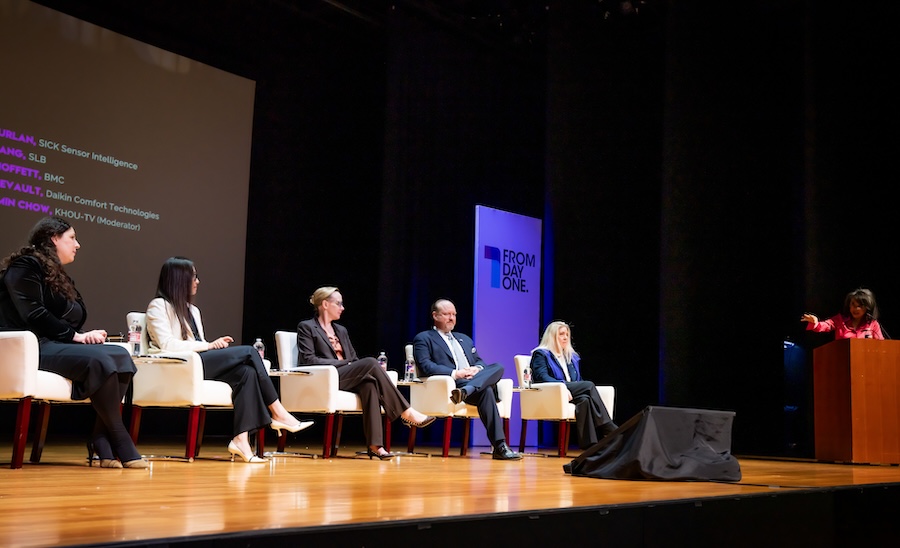
How can HR leaders engage with these technologies and use them to shift focus to higher-value tasks? That was the topic of an executive panel moderated by former KHOU-TV news anchor Shern-Min Chow at From Day One’s Houston conference.
Furlan says that AI transforms the workplace by freeing people from tedious and dangerous tasks—though it can, and likely will, cause turnover.
Good employers will pivot and help elevate their employees through structured development opportunities, but employees also have to engage in the process. “In my opinion, humans are brilliant and sensitive and creative and will not be replaced by AI. But if your job is highly redundant or administrative, you have to upskill, and you have to own it,” she said.
Erinn McMahon, VP of career transition & mobility at LHH, also thinks that individuals need to own their career advancement, with mobility and upskilling support from their employers. Throughout the employee’s lifecycle, she says, companies need to “give them the opportunity to learn new skills, to be able to take what they’ve done and maybe pivot it into something new that will be valuable to the organization.”
While AI-powered robots may reduce issues inherent to human workers in manufacturing, Chris DeVault, VP of HR for Daikin Comfort Technologies, doesn’t believe that they can match human nimbleness and discernment. Employers have a social imperative to “eliminate repetitive jobs and get [employees] to the point where they are doing things that are far more rewarding,” he said.
Governance Protocols
Jill Zhang, global head of total rewards for SLB, spoke about the company’s very deliberate approach to AI adoption, which focuses on protecting employee and client data. All AI tools are pre-trained models connected only to approved data sources and trained on internal databases.
“We want to increase AI literacy across the organization. But we are also quite intentional about doing this responsibly and ethically. So right now, we rely on enterprise-approved tools that are deployed within controlled internal environments for people to use as efficiency tools,” she said.
Echoing the need for proactive AI policies and governance, Lynn Moffett, VP of HR at BMC, cautions that without approved tools, employees may use external tools like ChatGPT. “You need to have your policies in place, and you should also be providing the tools to your employees to be able to utilize your AI,” she said. “It is really important that companies help guide it in the way that they want for that governance structure to hold true.”
Recruiting and Hiring
Moffett’s team uses AI for candidate sourcing, assessment, and interview scheduling. She also partnered with BMC’s IT team to build an in-house tool that detects AI-generated resume content. “It helps with ensuring we’ve got additional authenticity and consistency,” she said.
If a candidate’s resume is flagged for high AI usage, managers can query the company’s interview question banks to help them dig deeper into the candidate’s experience or request guidance on customized interview structures. Using these question banks, Moffett says, allows the company to “know that we’ve got our consistent corporate principles being applied, in terms of our overall leveling from a job perspective.”
Daikin’s new cloud-based ATS easily integrates with AI tools to analyze and process a high volume of resumes, says DeVault, and AI-driven bot interviews are increasingly realistic. However, his staffing teams are not concerned about job loss due to these systems.“This is just the gateway to get the right people to them, so that they can get the right people to the hiring managers. And it’s really simplified their day.”
Internal Communication
Companies use AI tools to streamline internal communication as well, such as analyzing employee survey comments and translating team-to-team language.
“Using AI to help filter and sort through and understand comments, especially when you’ve got a lot of comments coming at you, is a wonderful use of the tool,” said Moffett. HR business partners at BMC use AI search tools to analyze thousands of survey comments, enabling them to better support their partner teams.
With employees across more than 100 countries, Daikin’s use of AI translation tools has transformed internal communications, DeVault says. Not only have these tools helped teams communicate meaningfully, but they have also boosted frontline engagement by allowing Daikin’s interpretation team to “go on the shop floor and actually work hand-in-hand with folks versus sitting on endless [video] calls.”
The Future of Work
DeVault says “We are in a machine learning era, and we have to be better than the machine.” He tries to ensure that his team is upskilled and ready for the next challenge, aided in part by Daikin’s continuous internal development programs and advanced skills training. “There are things that will never be able to be done by machines, even from a machine logic perspective. And for those employees that have an interest, there is an infinite amount of training that we're giving them every day.”
While we don’t yet know precisely how workplaces will change and what the jobs of the future will be, McMahon says it’s essential to promote curiosity and confidence while offering psychological safety. She urges leaders to “create an environment where people are curious enough to want to try something new and feel strong enough about their capabilities to try new things.”
Jessica Swenson is a freelance writer and proofreader based in the Midwest. Learn more about her at jmswensonllc.com.
(Photos by Josh Larson for From Day One)


