Hiring at a Crossroads: Building AI-Ready Teams for Tomorrow’s Workforce
BY Emily McCrary-Ruiz-Esparza
|
October 01, 2026

What makes an AI-ready workforce? This is a question many HR leaders are trying to answer as business leaders hand down mandates with little direction. Companies know they need to move into the future, but how, and with whom, remains unclear.
Talent assessment technology company SHL wanted to find out what makes a worker AI-ready, so they looked at a dataset of one million people to identify the highest performers using AI in their work today. Specific competencies emerged, said Andy Nelesen, SHL’s director of TA solutions, during a From Day One webinar on building AI-ready teams.
The highest-performing HR users understand how to apply their skills to the use of AI, they embrace technology and operate with a trailblazer attitude, they champion AI use, and they openly share their own knowledge. More than just technical capabilities or prompt-engineering skills, SHL found that “these foundational behavioral skills help you evaluate AI outputs critically, apply AI in ways that actually add value, and inspect the outcomes and make them better.”
Yet few companies are ready. Out of one million participants in the survey, only one in three were high performers within this framework.
Developing AI skills Within the HR Function
Panelists suggested that the best way to develop these skills is by doing. At retail sales and marketing partner Advantage Solutions, the HR team has upped their data literacy skills, said VP of talent acquisition Jason Coffey. “Instead of a gut feel in recruiting, it’s backed up with data,” he said. “Now recruiters can look at cycle time charts and turnover breakdown and bring that to the table with a consultative approach.”
In fact, AI has elevated the quality of work at all levels of the HR organization, said Ana Gabriela Alvarez, who leads recruiting for TelevisaUnivision. “Before, we spent hours and hours presenting our candidates with decks and gathering the data about passive candidates and applicants. It took us hours to do that. Now it takes us minutes.” As a result, even junior recruiters are having more sophisticated, data-backed conversations. “I always invite them to be advisors, and that’s something that we just didn’t have time before,” she said.
Recruiting an AI-ready workforce
Thanks to widespread use of AI tools by job applicants who can use it to polish a resume (to the point of inaccuracy), apply to jobs by the hundred, and craft perfect answers to interview questions, recruiters across industries are finding that traditional application packages are no longer the best signal of job qualification and AI-readiness.
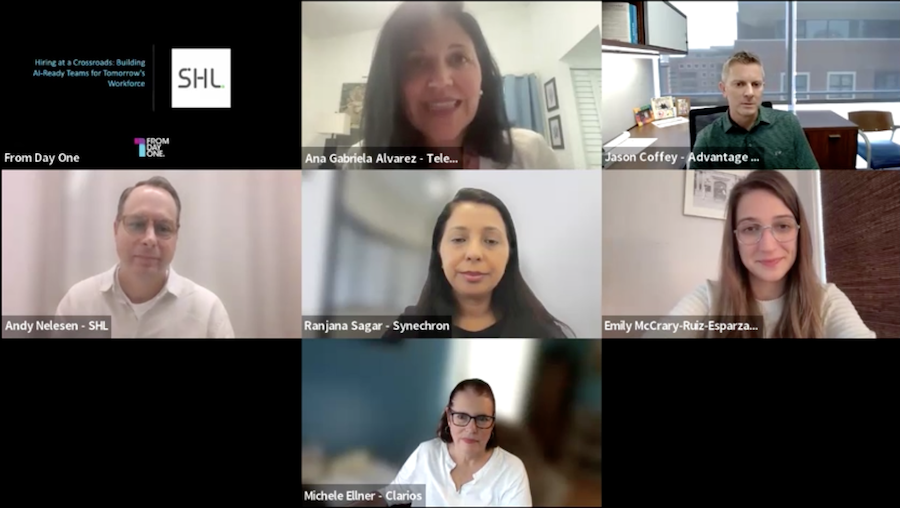
“We can’t rely on [resumes] like we used to,” said Michelle Ellner, global talent acquisition director for pharmaceutical tech and data storage form Clarios. “We have to retrain our hiring managers not to rely on that piece of paper, but trust that recruiter and what they found out about the person, really encouraging them to be that first touchpoint.”
For decades, Ranjana Sagar relied on rigid job descriptions and finding the resumes to match, and leaning on the common assumption that more interview rounds means a better-quality hire. “But things have changed,” said Sagar, the recruitment director at financial services tech provider Synechron. “Candidates, especially, have changed. Technology has changed. The way people demonstrate their capabilities have changed.”
A resume may show you what you want to see in terms of technical skills or professional pedigree, but it doesn’t tell you how a candidate thinks, how they solve problems, or how they collaborate. “Recruiters need to let go of the assumption that a resume is the best starting point of understanding a candidate,” she said.
Understanding who a candidate is and what they’re capable of is more important than ever. Rather than simply finding ways to conduct old processes more quickly, Sagar has found ways to update the process altogether. For instance, in consultative roles, Synechron has job candidates deliver presentations on a topic of their choice—like an industry trend or common problem—related to the job. Then a panel of interviewers asks questions. This single face-to-face interaction eliminates layers of one-on-one behavioral interviews, replacing it instead with a collaborative, candidate-driven discussion.
Nelesen, who regularly works with SHL’s customers, says work samples have become more important than ever as a means of getting to know candidates and their capabilities. Methods that get to the center of an applicant’s qualifications, and especially their soft skills, will be the differentiator in building an AI-ready workforce that can adapt and learn. “It’s easier than ever to be a candidate,” said Nelesen, “and harder than ever to be a recruiter or a hiring manager.”
Editor’s note: From Day One thanks our partner, SHL, for sponsoring this webinar.
Emily McCrary-Ruiz-Esparza is an independent journalist and From Day One contributing editor who writes about business and the world of work. Her work has appeared in the Economist, the BBC, The Washington Post, Inc., and Business Insider, among others. She is the recipient of a Virginia Press Association award for business and financial journalism. She is the host of How to Be Anything, the podcast about people with unusual jobs.
(Photo by tadamichi/iStock)