When AI Becomes Part of Everyone’s Job: How HR Can Help Workers Use It
BY Ade Akin
|
October 02, 2026

Before talking about artificial intelligence, Melissa Garza asked an audience full of HR executives to relax their shoulders.
“If you are wearing your shoulders as earrings, let’s go ahead and bring those down,” she said. Then she turned to another familiar source of tension: the smartphone. “If you’ve got your chin down on your chest as a necklace, let’s bring that up so we can start stress-free today.”
The exercise was more than an icebreaker. As AI becomes increasingly embedded in everyday work, HR leaders are being asked to manage a new source of workplace tension while helping their organizations adopt the technology.
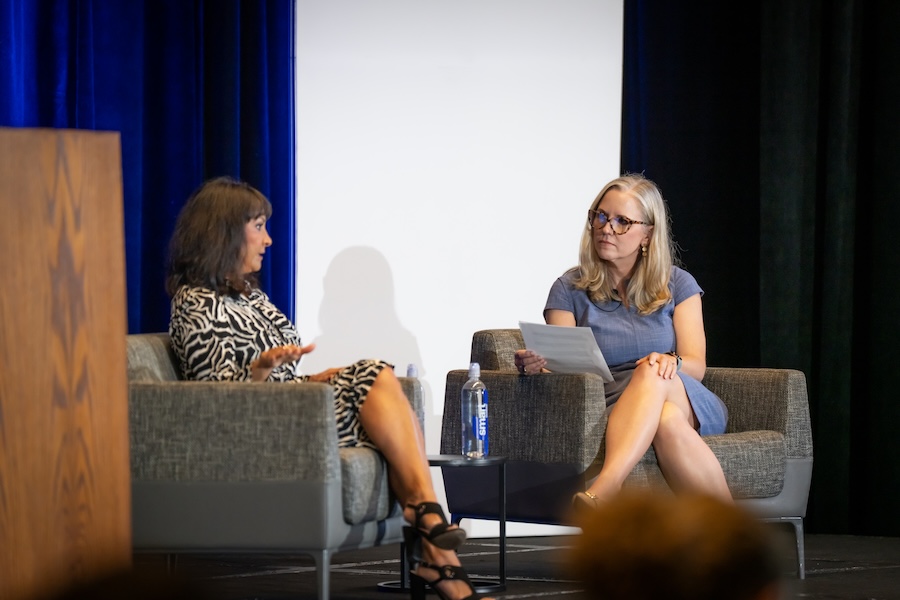
For Garza, chief HR officer at Powerfleet, those two jobs are inseparable: HR can’t help organizations embrace AI without also addressing what it asks of the people using it. Garza explored this topic during a fireside chat at From Day One’s Austin’s conference; the session was moderated by Courtney Sebesta, the editor-in-chief of the Austin American-Statesman.
Start by Naming the Fear
Garza says AI adoption differs from most workplace changes because it can threaten how people see themselves. “AI can absolutely trigger identity-level resistance,” she said. That makes psychological safety the first consideration in any rollout. She recommends asking employees a direct question: “What are you worried about that you haven’t said out loud yet?”
Her second principle is fluency before scale. Powerfleet is rolling out a companywide AI 101 course that covers large language models, hallucinations, and the company’s guardrails. After that, she advises piloting on a small scale and making the results visible, because in change management, “co-creation with people is always better than a decree.”
Executives have homework to do as well. “Leaders who are asking their employees to use AI kind of need to use it themselves,” Garza added. She urges companies to build feedback loops, even anonymous ones.
Sebesta pointed out that public anxiety about AI has grown from fears about job loss to fears about humanity itself, and Garza takes those worries seriously. “I’d be super skeptical of any leader or, quite frankly, any person who tells me that there’s nothing to worry about with AI because that simply just isn’t true,” she said.
She recommends watching The AI Doc: Or How I Became an Apocaloptimist, a 2026 documentary featuring interviews with experts regarding both the potential hazards and benefits of artificial intelligence.
No single company can settle the existential debate, but every organization controls its own practices. Her first rule is to keep a human in the loop. Her second is to give employees clear guidelines and a way to ensure they follow them. That kind of risk mitigation doesn’t have to wait for governments or industry groups to agree on a unified framework.
HR as Co-Architect
Who should decide how AI changes work? That depends on the ambition, Garza says. An AI-first strategy changes hiring, the org chart, and career paths. In that case, “HR needs to be a co-architect at the beginning of that initiative, not just the department that finds out last and implements it,” she said. “We know the employees, we know the career paths, right? We know where the problems are.”
A narrower tool rollout calls for a different role. “Procurement and IT are going to take care of which tool to buy. Our job then is: how does it impact the people?” she added.
Garza’s career traces HR’s digital transformation, starting in a compliance department full of paper files. At USAA, long before anyone called it AI, a team of statisticians practiced early predictive analytics.
“We didn’t have AI, but what we did have was a group of statisticians that could tell me if someone left in one department where I could expect a vacancy in another,” she said. Subsequent work at Freescale (now part of NXP) involved using data analytics and metrics frameworks to assess employee engagement and inform strategic organizational decisions.
AI adds new responsibilities, but it can’t replace judgment about values and organizational culture. “AI can tell you what’s happened in the past. AI can tell you what could potentially happen in the future, but it can’t tell you what you want to do,” she said.
Skills to Prioritize
When it comes to recruitment and expanding skill sets, Garza advocates for a T-shaped candidate model: combining specialized knowledge to meet immediate requirements with the versatile breadth needed to adapt as organizational roles evolve.
At the top of her list is a growth mindset, the idea, developed by Stanford psychologist Carol Dweck, PhD, that people can improve their abilities through effort. Recruiters can test for it by asking, “Has this person ever started over in a completely different way?”
Comfort with uncertainty comes next: “Can I say I don’t know without perceiving it as a weakness?” Sebesta called that a lesson for all leaders, urging them to “be vulnerable, show them [employees] that you don’t have all those answers.” Garza agreed and suggested leaders tell their teams, “We’re building this capability. We’re on this journey together, and we don’t have an end state for you guys.”
Why Humans Still Check the Work
Judgment matters because employees are increasingly reviewing what machines produce. “So we’re now quality checking what’s coming out of AI,” Garza elaborated. She has seen AI mangle formulas, names, and dates. “It just makes things up sometimes, and that’s why you always need a human in the loop to make sure that you’re getting what you bargained for,” she said.
Better prompts help, and Garza compares prompting to giving feedback. “If I tell you to be nicer, what does that even mean?” she asked. Instead, she suggests providing a role, context, and details: “I’m a senior recruiter,” followed by specifics such as “three paragraphs, 150 words, warm but professional.”
Watching for Smoke
What worries Garza most are “effectively irreversible decisions,” such as hiring or firing the wrong person. “Did our AI software inadvertently discriminate against some group of employees?” she asked.
What excites her is prevention. HR used to rush in after the fire started. Now, “we can see a little bit of smoke,” she said, because AI can flag which employees are likely to leave and which managers need training. “It’s proactive HR versus reactive HR.” Automation also pulls practitioners out of “administrivia” and frees them for the human work, “which is coaching, which is building relationships with your leaders, which is having conversations with employees.”
Her parting advice to HR leadership amid workforce changes came full circle. “Never take the human out of the loop,” she said, and make sure your teams check everything AI produces. HR professionals, she reminded the audience, “are the stewards of the entire company,” so AI adoption should never come at the cost of care: “Don’t forget about empathy and psychological safety because everybody is at different levels and a different pace.”
Ade Akin covers artificial intelligence, workplace wellness, HR trends, and digital health solutions.
(Photos by Josh Larson for From Day One)