Recognizing Skills and Potential: Building a More Agile Workforce
BY Katie Chambers
|
October 14, 2026

The way HR analyzes resumes and positions candidates for growth is changing. “When I look at talent evaluation, I’m more looking at culture and what you’ve learned and what you’ve experienced, not necessarily the years of experience or the consistency [with] which you’ve been in a role,” said Bojan Balaban, VP of people operations at Verano.
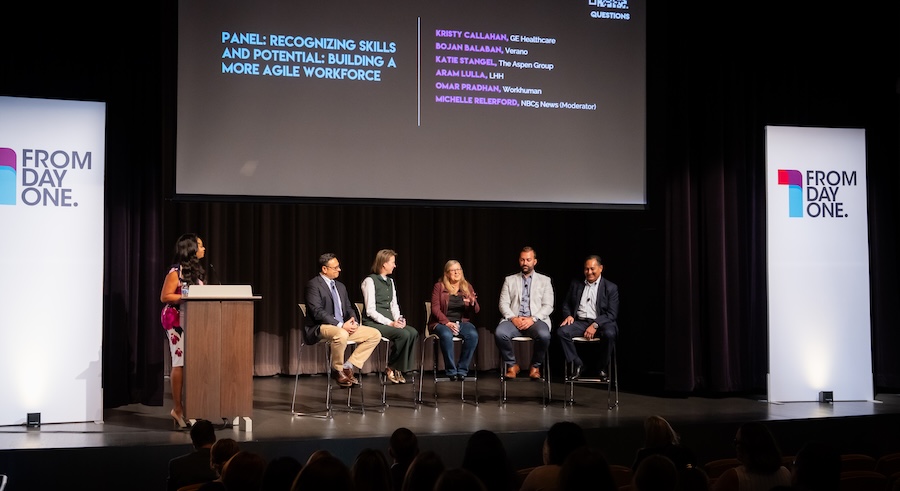
At From Day One’s Chicago HR conference, Balaban and a panel of other HR leaders spoke about “Recognizing Skills and Potential: Building a More Agile Workforce.” Michelle Relerford, weekday morning co-anchor at NBC 5 Chicago, moderated the session.
Building a Skills-first Workforce
As AI becomes integral to the workforce, employee skills are more important than ever for both organizational and personal growth. “You still need the skill set to tell the AI what the output is, and that’s the skill set that we’re trying to build in my organization,” Balaban said. “It’s not replacing the human capital; it’s just changing how we’re using it, and it’s going to make us more efficient as we grow and expand our business.”
To build a skills-first workforce, Balaban says HR needs to meet with leadership to understand the nature of the work and what each role requires. “You need to start with partnering with the right leaders, figuring out what they’re trying to build out, and then you need to think about the workforce that we currently have in place. How do we identify which employees have what skill sets for these roles?” Creating a skills-based model takes time and requires leadership buy-in. “We need managers to be educated to pick up on certain skill sets to be able to identify who’s doing something well, or even more difficult, who has the potential to learn something and grow.”
As the nature of work changes, so does who is qualified. “Are you seeing a meaningful shift away from the traditional qualifications like degrees or job titles or years of experience toward demonstrated skills and capabilities?” asked Relerford.
The answer is complicated. “Particularly at the executive level, those things still matter. The difference now is not just what have you done, but what can you do next?” said Aram Lulla, managing partner, executive search at LHH. Hiring managers are paying even more attention to impact. “Did you lead through change? Did you face a lot of diverse situations? Did you have adverse situations you led through? How did you go about that? And ultimately, what was the net outcome? More and more, what we see now is that the people that are most successful in terms of candidates aren’t always the ones with the most linear resumes.”
Adaptability will also be key for leadership roles, as the workplace, and technology’s role in it, changes rapidly. “You’re looking for them to be able to mobilize teams and work in different project groups, not just be linear in their thought in their line of business,” Lulla said.
To identify these skills, organizations need to invest in technology that tracks and measures them. “You want to look at what is going to be the best fit based on what we need and then find the technology for it. You don’t want to find the technology and then force your business to work on the technology for you,” Balaban said. That includes tailoring workplace communications to your employees' actual lives and workdays, such as providing breakroom signage for frontline workers who might not have constant access to email for updates.
Some of that data might come out of recognition moments, says Omar Pradhan, employee engagement & HR technology strategist at Workhuman. “These are the observed skills that are organically captured in peer-to-peer moments. And so, when you accumulate those over many years, you’re able to then mine that for who might be a good fit for an open role,” he said, noting that agentic search can help comb through the records for a match. “There’s a tremendous opportunity for organizations to not just rely on those self-reported skills that are traditionally captured in those HRS systems, but what are the organic ways in which skills are being displayed in the recognition data.”
Rethinking Learning and Development
Katie Stangel, VP of learning and development at The Aspen Group, and her team have used a combination of AI and in-person conversations to analyze job descriptions and sort each role’s skills into four buckets: ownership, decision-making, hierarchy/timing, and business impact. She finds a skills-based approach has created clarity in conversations around promotions and internal growth. “I actually saw that lattice approach coming to life in the conversations because now people are talking about development and growth in their skills and what that could be in the future, and it might not be that ladder approach to career. It actually might mean moving into a totally different department,” she said.
“Everything that we do from a learning and development perspective has some component of AI in it,” said Kristy Callahan, head of learning & development at GE HealthCare. “We are proud to say it’s about doing more with less.” It may take time to get employees to fully buy-in to AI, given the fears around it, so HR and leaders need to work hard to help workers understand how it can make their jobs better, not take them away.
“You need psychological safety; that tends to get people to lean in more and experiment” with AI, Pradhan said, which ties back to recognition. “They’re not going to do that if they haven’t been seen and appreciated.” Monthly recognition is tied directly to higher reported psychological safety, he says. Change management stories tied to AI adoption, demonstrating and celebrating those who integrated AI into their workflow, can “create a sense of community and shared purpose that becomes this reinforcing mechanism.”
In the face of all this technology, Callahan said, “What we need more than ever is humans. What truly makes us human? Our soft skills, the things that people brushed aside before. Those will become the differentiators.” Discernment and judgment, she says, will matter, especially among young workers who may rely too heavily on AI without thinking critically about its results. And leadership skills will always be a priority.
“It’s distinctly human to actually lead. AI is not going to help set your culture for the organization. AI is not going to help inspire confidence in your teams or get everyone aligned on one mission, vision, or value system proposition,” Lulla said. “And that’s where the future will show in five years that we’re really putting that same premium on those types of skill sets.”
Katie Chambers is a freelance writer and award-winning communications executive with a lifelong commitment to supporting artists and advocating for inclusion. Her work has been seen in HuffPost, Top Think, and several printed essay collections, and she has appeared on Cheddar News, iWomanTV, On New Jersey, and CBS New York.
(Photos by Josh Larson for From Day One)