The New Talent Equation: Hiring Leaders and Building Cultures That Keep Them
BY Carrie Snider
|
October 14, 2026

Employees want to know what a company stands for and whether its actions reflect its values. Courtni Hughes-Bochenek, SVP, head of people & culture at Zeller, says workers increasingly research companies before deciding where to work and whether to stay. “People really dig into the research,” she said. “They want to know: Are you talking about things, and are you also living it?”
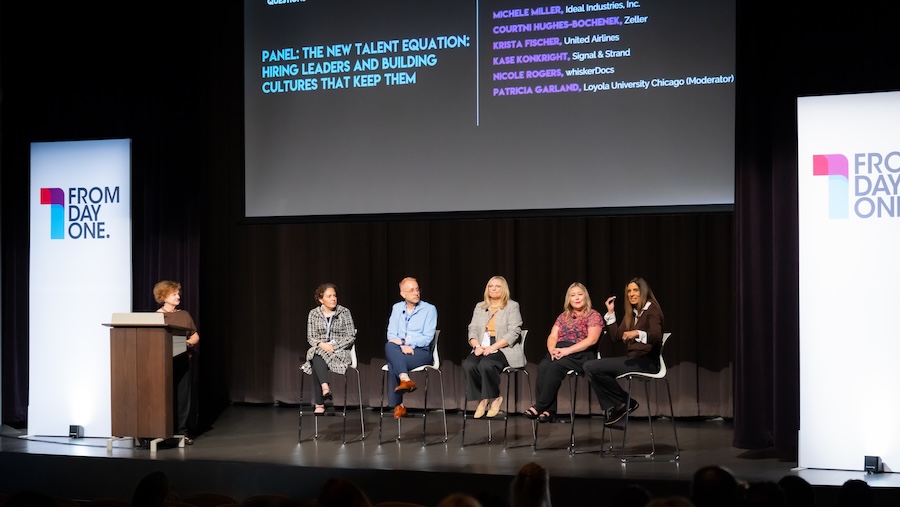
Hiring and retaining great employees takes more than competitive pay and the latest technology. During a panel discussion at From Day One’s Chicago HR conference, Hughes-Bochenek and four other panelists took the stage to discuss building trusting workplace cultures, adopting AI thoughtfully, and keeping people at the center of business decisions.
Build a Culture Employees Can Trust
Culture must go beyond a mission statement, says Hughes-Bochenek. Employees notice whether leaders follow through on promises, recognize contributions and demonstrate genuine care.
That consistency matters even more as organizations introduce AI and employees worry about job security. Workers also expect work-life balance, she added, and recognize when company messaging doesn't match reality. Leaders build trust through honest communication, meaningful engagement and everyday actions that show employees they are valued.
Let AI Adoption Grow Organically
At Ideal Industries Inc., AI adoption has grown through employee curiosity rather than a company-wide mandate. Panelist Michele Miller, SVP and CHRO, says that the company started with about 30 Microsoft Copilot users. Adoption has since grown to 20% of the workforce as employees shared successful use cases with colleagues.
“It was done in a more organic way,” Miller said. “Individuals that were interested in using the tool and creating the adoption, they went and told their friends, ‘Here’s how I’m using this, and we let it grow.’”
AI helps employees reduce repetitive tasks and focus on higher-value work. Miller cited writing job descriptions as one example of a task the technology can speed up. The company also uses AI to help develop The Forge, its gamified leadership training program.
Adoption works best when employees see AI as a way to improve their jobs, she added, not replace them. That human purpose remains central to the company's approach.
Prioritize Human Connection
Panelist Nicole Rogers, COO of whiskerDocs, emphasized that retaining talent means recognizing employees as humans with responsibilities beyond work, including caring for family members and pets.
“The key to that really is building trust, and you do that by looking at them as a whole person,” Rogers said.
Small gestures, such as acknowledging an employee’s pets or children, can strengthen workplace relationships. Rogers cautioned that rapid technological change can undermine those connections if leaders lose sight of the people behind the work.
“We run the risk in a time when things are moving so fast, and we’re deploying so much technology, of forgetting the person on the other end,” she said.
At whiskerDocs, AI supports data analytics and clinical guidelines, but people still handle customer concerns. Genuine care and flexibility can go a long way in helping employees manage life’s challenges and do their best work.
Use AI to Free Employees for Higher-value Work
At United Airlines, AI is a tool for improving work, not eliminating jobs. Panelist Krista Fischer, managing director of HR, says the company is exploring how automation can free employees from repetitive tasks so they can focus on strategic work.
Workers at United don’t worry about AI replacing their often specialized roles. “For us, AI hasn’t been scary,” Fischer said. Instead, the focus is on “how is AI going to make my life easier, and how is it going to free up time for me to think in a different way?”
She experienced those benefits firsthand when she used AI to teach herself Python coding and conduct an employee attrition analysis. A task that might have taken eight hours took about 15 minutes, though she still had to review and validate the results.
As AI makes technical tasks more accessible, United is placing greater emphasis on curiosity, judgment, care and the ability to evaluate AI-generated work responsibly.
Prioritize Education and People-centered Leadership
Panelist Kase Konkright, founder of Signal & Strand, said many organizations need practical AI education before investing in expensive tools or making staffing decisions. His firm helps clients identify useful, ethical, and affordable ways to adopt the technology.
“The best people right now are really just asking the questions of how do we use it to enhance the experience? How do we use it to enhance their jobs and not replace the people in the process?” Konkright asked.
He cautioned that AI-generated information isn’t always accurate and cannot replace human judgment. HR teams can help organizations navigate adoption by educating employees, communicating expectations and keeping workplace culture in mind. “It’s really just people that can lead their people through the journey,” Konkright said.
Konkright also noted that AI can help managers remember important dates and employee needs, strengthening personal connections rather than weakening them.
The new talent equation combines technology with trust, curiosity and human connection, the panelists agreed. Through intentionally focusing on good company culture, organizations can better retain employees. AI can improve efficiency, but leaders determine whether it strengthens workplace culture and helps employees grow.
Carrie Snider is a Phoenix-based journalist and marketing copywriter.
(Photo by Josh Larson for From Day One)