Betting on Existing Talent: Internal Mobility as the Answer to AI Disruption
BY Katie Chambers
|
October 09, 2026

“A lot of companies see AI as something that comes in from the outside, takes over, and takes away jobs,” said moderator Maiken Scott, host and executive producer of WHYY, The Pulse. But TIAA “has made a very conscious effort to approach this topic differently,” Scott said during a fireside chat at From Day One’s Philadelphia conference.
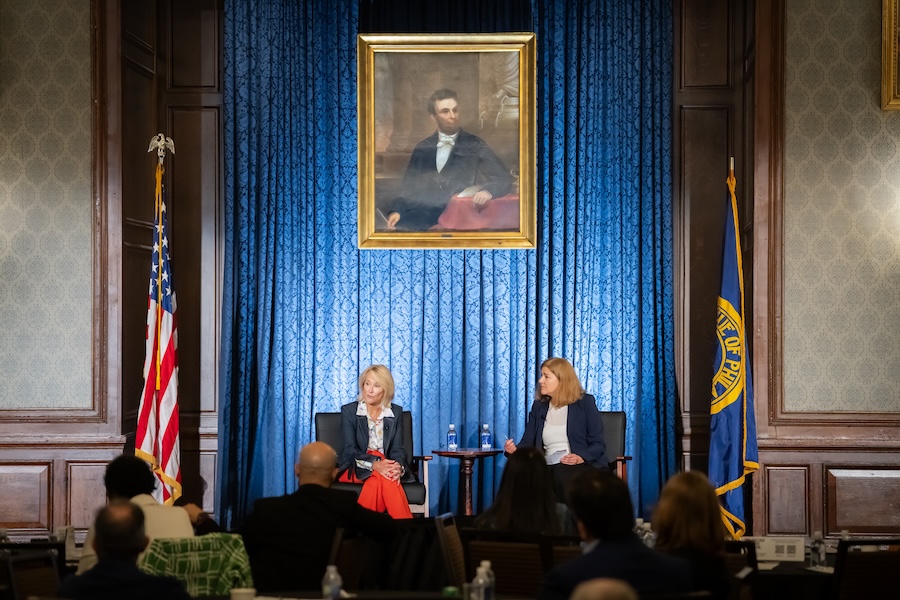
During the fireside chat, Claire Borelli, chief people officer at TIAA, was interviewed by Scott, sharing how the century-old institution is rethinking career development for the AI era and moving away from default external hiring toward a deliberate, internal-first strategy.
The Partnership of HR and Technology
One rule has been the driving force behind TIAA’s strategy: “We knew we didn’t want AI to happen to our associates; we wanted to bring them along,” Borelli said. This meant developing a partnership between the organization’s HR and technology functions. “There was no way we could relegate all the AI transformation work that had to happen to IT. When you think about the impact that it’s going to have on human capital, how jobs are going to be formed, how jobs are going to change, and what jobs might even go away—with that comes the notion of how important internal mobility is,” Borelli said. “Because if we’re going to bring people along, then we need to make sure [that] as we reshape jobs, we’re preparing them how to fit into those new reshaped jobs.”
Borelli and her team were transparent with workers: because of AI, certain roles would change. But with internal mobility as a top priority, they would help employees find new pathways within the company. TIAA launched a program called Elevate, which educated workers on the skills and understanding needed to use AI and made internal mobility part of the company’s core infrastructure. “We pulled recruiters offline and said, ‘You’re going to be completely focused on internal mobility. You’re going to find jobs for those people in our organization as opposed to external [candidates].”
Elevate includes a proprietary AI tool called MyGate, which all employees are encouraged to use and learn from. “We made sure that every associate had the ability to touch AI,” Borelli said.
One of the biggest learning moments for employees has been seeing how they can grow their careers outside their own function. “They don’t necessarily realize that people in a contact center may end up getting a job in internal audit. People in technology may end up getting a job in the people team. Those types of things become uncovered as we use this tool.”
How HR Is Approaching AI
Initially, most organizations saw AI as a tool to make individuals more efficient: writing better emails, creating cleaner slide decks, and more. “Now, what we’re doing is we're realizing AI needs to be leveraged differently in TIAA and all companies. We need operational leverage,” Borelli said. “How are we going to change processes? How are we going to have better revenue opportunities?” Each group within TIAA has AI use cases. For HR, that means “understanding what does that mean to the people in [each department]? What jobs are going to go away? What capabilities are going to be different? And then how do we prepare them?”
While AI might eliminate some job functions, it also creates opportunities for workers to focus on and develop the uniquely human skills AI may never replace. “It’s enabling associates to focus on things like judgment, problem-solving, complexity, and relationship-building,” she said.
In terms of how the job market might change going forward, “I do believe that to some degree corporate structures are not going to look exactly the way they look today,” Borelli said. For one thing, she feels job titles will matter less than they do now, as workers move from one role to another to focus on individual projects rather than staying stuck in certain silos. This is a good thing, she says. “I can now get exposure in things I never would have gotten before, and I can help the organization solve problems that we weren’t able to solve.” This leaves employees feeling empowered and helps to form partnerships between departments rather than friction.
TIAA’s new strategy is working, she says. This year alone, 17% of associations have had an internal mobility opportunity. Overall, the company’s internal mobility rate is 45%, compared to the industry average of 27%. She says this is partly because it’s no longer just an HR initiative. “We put in quarterly mobility targets for our [department] leaders. Now everybody’s paying attention,” she said. They’ve also launched an internal communications strategy around the initiative. “We have a thing called Faces of TIAA, where we focus on the individual that got the job, and then we also focus on the leader that helped them get it.”
This is a very exciting time to be in HR, “I feel as though we’re the leader. At the end of the day, this is not a technology play. It’s a human capital play,” Borelli said.
Katie Chambers is a freelance writer and award-winning communications executive with a lifelong commitment to supporting artists and advocating for inclusion. Her work has been seen in HuffPost, Top Think, and several printed essay collections, and she has appeared on Cheddar News, iWomanTV, On New Jersey, and CBS New York.
(Photos by Josh Larson for From Day One)