Power Moves: The People Side of Transformation
BY Ade Akin
|
October 12, 2026

A drone equipped with AI-powered facial recognition technology flies over a utility pole to detect rot. If the pole is sound, the crew stays on the ground, the truck stays parked, nobody loses power, and the pole gets another look in six months. At Exelon, some of the people writing business cases for that kind of technology are interns.
Jaclyn Trovato, the head of employee experience and analytics at Exelon, shared the example to make a point about AI adoption: it depends on people. “If people don’t adopt AI, the technology is useless,” she said.
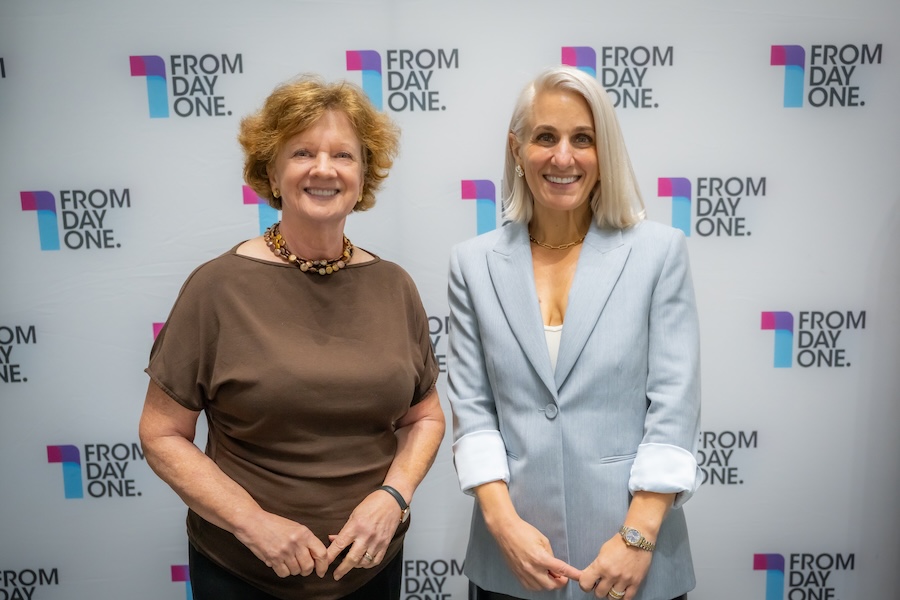
Trovato spoke during a fireside chat at From Day One’s Chicago conference, in a session titled, “Power Moves: The People Side of Transformation,” moderated by Patricia Garland, adjunct instructor at Loyola University Chicago.
Trovato shared insights from her role that combines traditional data sets, AI and analytics, and change management for the energy company’s 20,000 employees, who range from timekeepers and overhead electricians to executives and lawyers. “Putting the human in human resources is something that we try to prioritize at Exelon,” she said.
Use Cases From the Office to the Field
Exelon’s AI use cases include the familiar ones, such as an employee chatbot that answers questions about vacation days and lifts administrative work off HR. “But some of the most exciting use cases are for our employees in the field and for our customers,” Trovato said.
Skipping an unnecessary pole replacement pays off three ways. “We’ve been more efficient in the use of our employees. We’ve made people safer, and we’ve reduced the costs that we have to pass along to our customers,” she said.
Small gains in operational efficiency add up at a regulated utility. Exelon distributes power but doesn’t control its price, Trovato says. Saving a minute or two of an outage, or a few dollars on a repair, multiplies across the millions of customers Exelon serves in Illinois and the millions more served by its five East Coast utilities.
A Chatbot Built on Bad Data
Trovato’s biggest early lesson regarding AI is that bad data turns a time-saver into a liability. When a model pulls from a policy library cluttered with outdated versions, an employee can act on a rule that changed years ago, and a tool meant to speed things up ends up producing an investigation instead. “And that was not the point. The point was to get the information to someone more quickly,” she said.
“One of the biggest mistakes we had in HR was that we launched a chatbot, but we launched it without ensuring that it was guardrailed within the most recent policies and procedures, the most accurate information, and then also that all of the user personas were correct,” Trovato added.
Exelon’s answer was to pause and launch another data governance initiative. “We’re not building anything more until we can tell you the source of all the data, what systems every piece of data feeds in or out of, and what exactly this model is going to pull,” she said. The audit is complicated because Exelon grew through mergers and acquisitions, leaving legacy systems and benefit rules that vary by hire date.
The relaunched chatbot will also route information according to who is logged in, and employees must ask questions for themselves, which Trovato says can take the burden off HR and managers. “Everyone’s information can be personalized based on their persona, and so everyone has to become a user,” she said.
Training for Skills That Stick
Exelon’s AI training borrows from its apprenticeship programs, which qualify construction workers for overhead or underground electrician work. Those programs pushed the company to study adult learning. “If an adult doesn’t use a skill very quickly after learning it, they will not have the ability to retain that information nearly as well as a child will,” Trovato said.
Training is therefore timed to real work. During a current restructuring, HR staff were trained on the tool and format for job descriptions just before they had to redo them with their clients.
For dangerous field work, virtual reality offers a rehearsal. “We’ve used a lot of virtual reality training in order to put people in a position where before they do something dangerous, they are in a sandbox where they can do that thing a lot more safely,” Trovato said.
For workers who worry the technology will take their jobs, the simulations make the opposite case. “This is going to make you better at your job and safer at your job. And then you show them that, and that’s how you gain trust,” she said.
Peer learning does its own trust-building. For a couple of hours a week, employees can drop into a virtual room to trade methods for stubborn tasks. Trovato likes the community practice model because attendance is voluntary. “It’s your peers. You’ve all chosen to come together. No one’s made you come to this room,” she said.
Safety as Step Zero
Exelon’s safety priority shapes how employees respond to AI guidance. “We come from a place of safety is step zero. Nothing happens unless we feel we can execute on it safely,” Trovato said.
Exelon once ran the largest fleet of nuclear power plants in the U.S., she says, and crews there learned a three-part communication protocol: one person gives an instruction, the other repeats it back, and the first confirms before anyone acts. That habit now applies to AI output. “When a system gives you a piece of information, you have to gut check it. You have to make sure it’s right,” she said.
The same rigor makes field employees slower to trust a new tool, while corporate employees are more willing to take risks. Trovato values the tension, with field-based workers reminding office-based colleagues that “job one is still always safety.”
Trust Your Own Culture
Asked what she would tell HR leaders who are just starting out, Trovato cautions against buying tools out of fear of falling behind. “Take a minute to decide what works for your organization,” she said. “As HR practitioners, we know our culture. We know what works for our employees.”
A sound foundation, Trovato says, comes down to “good data governance, employees who understand why you’re investing in this technology, and then responsible guardrails.” Garland added a fourth element: existing trust with employees. Trovato agreed, noting that people won’t embrace a technology pitched as a way to halve the staff. Employees need to understand that “this is an investment in them, not so that you need fewer of them, but so that they can be doing the more interesting work,” she said.
Ade Akin covers artificial intelligence, workplace wellness, HR trends, and digital health solutions.
(Photos by Josh Larson for From Day One)