How Schneider Electric Is Powering a Skills-First Future
BY Grace Turney
|
March 12, 2026

Dina Yorke almost didn’t apply for the job that would help define her career. The role, a finance business partner position, was a perfect fit—except for one puzzling line in the job description: this person will manage HR. “What finance person manages HR?” she remembered thinking. It was her husband who finally pushed her to take the leap. “Put your name in. What do you have to lose?”
Nearly 20 years later, Yorke is the VP of learning excellence at Schneider Electric, a 190-year-old global energy technology company. The unconventional path she took, crossing from finance to operations to global HR, reflects the very argument she now makes for why companies must stop organizing talent around rigid job titles and start building everything around skills.
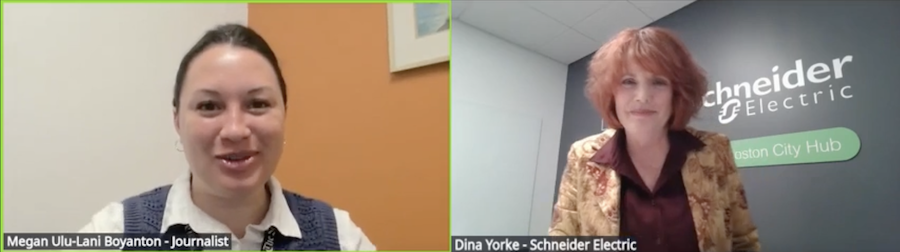
That philosophy took center stage during a fireside chat at a From Day One’s February virtual conference, where Yorke spoke with Megan Ulu-Lani Boyanton, a business reporter at the Seattle Times. Together they explored how AI and skills-based talent strategies are reshaping the future of work, from the shop floor to the executive suite.
Skills as the Foundation
Schneider Electric has made a strategic decision that most companies haven’t yet: skills are no longer just a component of HR; they are the organizing principle for everything the company does with its people, from hiring and development to internal mobility and, eventually, compensation. “We’ve made the decision strategically to put skills as the foundation of everything we’re doing in HR,” Yorke said.
Part of what makes this shift consequential is its scale. Schneider is in the process of expanding its global career architecture from 800 job codes to more than 3,000. This granularity allows the company to see, for instance, that a learning experience architect with two years of experience and one with twenty shouldn’t share the same code. They have different proficiency levels across the same critical skills, and the company needs to be able to track that gap.
Across those 3,000 roles, Schneider has identified approximately 1,150 critical skills. Some, like digital fluency and AI literacy, cut across nearly every job in the company. Others are specific to engineering, sales, or learning and development. The goal is to give both employees and managers a clear map: here is where you are, here is where the business needs you to go, and here is how to get there.
The Urgency Behind the Strategy
Why now? Yorke pointed to data from the World Economic Forum’s Future of Jobs Report 2025 to frame the stakes. One-third of current skills will be obsolete by 2030. More than 60% of business leaders say the shortage of talent and skills is among their most pressing concerns. And nearly 60% of the global workforce will need to be reskilled or upskilled in the coming years.
“We know we’re not going to be able to buy ourselves out of this,” Yorke said. “We’re not going to be able to go hire all the people out there. We have to invest in our people.” The calculus is straightforward: build, don’t just buy. That means creating the internal pathways, tools, and culture that help employees grow into the roles the business will need, before those roles become vacant or critical.
AI as a Career Development Tool
At Schneider, AI is not an abstract future concern; it’s already embedded in the systems employees use every day to manage their careers. The company’s internal talent marketplace, called the Career Hub, allows employees to assess their own skills against their job code, identify gaps, and receive personalized recommendations for jobs, projects, mentors, or learning opportunities.
A newer feature, the coffee chat function, offers something more casual than formal mentorship—a way for an employee to simply connect with someone at a different level or function to understand their career path. Soon, the platform will also generate learning recommendations directly tied to individual skill gaps, meeting employees wherever they are in their development journey.
The company has also piloted and is preparing to roll out an AI coaching tool called Nadia, trained on Schneider’s own HR and management philosophy. Yorke described using it herself to prepare for high-stakes conversations, work through performance management processes, and rehearse presentations, all by talking out loud rather than typing. “I used to say, could I put a USB into my brain?” she said. “Now I just talk to Copilot or I talk to Nadia. They transcribe, and then I can edit.”
Shop Floor to Top Floor
One of the session’s most striking points was Yorke’s insistence that AI capability-building isn’t just for knowledge workers. Schneider operates a global supply chain and manufactures its own products, which means it has to think about AI literacy across an extraordinarily wide range of roles and education levels.
“Think about it: we go from the shop floor, because we do have our own global supply chain, all the way up to the top floors,” she said. The company has set up computer rooms in its manufacturing plants so that shop floor employees can access digital and compliance training. More pointedly, Schneider has built AI governance and ethics into its company-wide compliance curriculum. This training flows from executive leadership down to production workers every year.
Yorke noted that many frontline workers have been using AI in the form of automation for years. “A lot of our employees have been working with AI for years,” she said. “Maybe when some people think AI, they automatically think generative AI. AI is machine learning. It’s automation.”
Enthusiasm for AI at Schneider is matched by a structured approach to managing its risks. The company’s AI strategy is anchored in the National Institute of Standards and Technology AI Risk Management Framework, a set of principles that Yorke said shapes the company’s entire approach. Layered on top of that framework is a global committee overseeing AI strategy, an internal hub of AI experts who consult on both internal and external applications, and an ongoing risk management process.
The company has also updated its trust charter (an internal governance document) to explicitly address data privacy and intellectual property in the context of AI. “We need to make sure it’s well protected,” Yorke said, noting that employees sharing content with AI tools must understand what protections are in place.
For employees who feel nervous about the technology, Yorke’s approach is transparency over pressure. The key, she said, is being clear about what a tool is designed to do and, just as importantly, what it is not for. “We have to recognize that employees are going to be at different stages of comfort.” The company’s response is not to mandate adoption but to build a culture where curiosity is rewarded, experimentation is safe, and the resources to learn are widely available.
The Human Skills Still Matter Most
For all the emphasis on technology, Yorke returned repeatedly to a simpler message: human intelligence is the anchor. The skills she credits most for her own career, critical thinking, communication, empathy, stakeholder management, are the same ones she believes will matter most in a world where AI handles data synthesis and routine tasks.
“It’s our brains that are going to be the ones that help drive the decisions,” she said. The role of a person in an AI-augmented workplace isn’t to compete with the machine, but to apply judgment, context, and interpersonal skill to what the machine surfaces.
Her parting advice to the audience was characteristically direct: invest in your human skills. Build robust governance before rolling out AI tools. Be transparent with employees about why and how the tools are being used. And above all, stay curious. “You don’t have to be the early adopter,” she said, “but get out there and try.”
The internal barriers, she added, are almost always the most dangerous ones. After all, she nearly talked herself out of the job that changed everything.
Grace Turney is a St. Louis-based writer, artist, and former librarian. See more of her work at graceturney17.wixsite.com/mysite.
(Photo by Barks_japan/iStock)