From Organizational Values to Employee Experience: Making Culture Tangible
BY Jessica Swenson
|
March 18, 2026

Creating an experience that your customers want begins with your employees, says Marc Paulenich, CEO at Hart, and it’s necessary to build a strategy that connects the two. Misaligned company values and broken policy promises can erode employee trust—a rising issue in today’s workplace, he says.
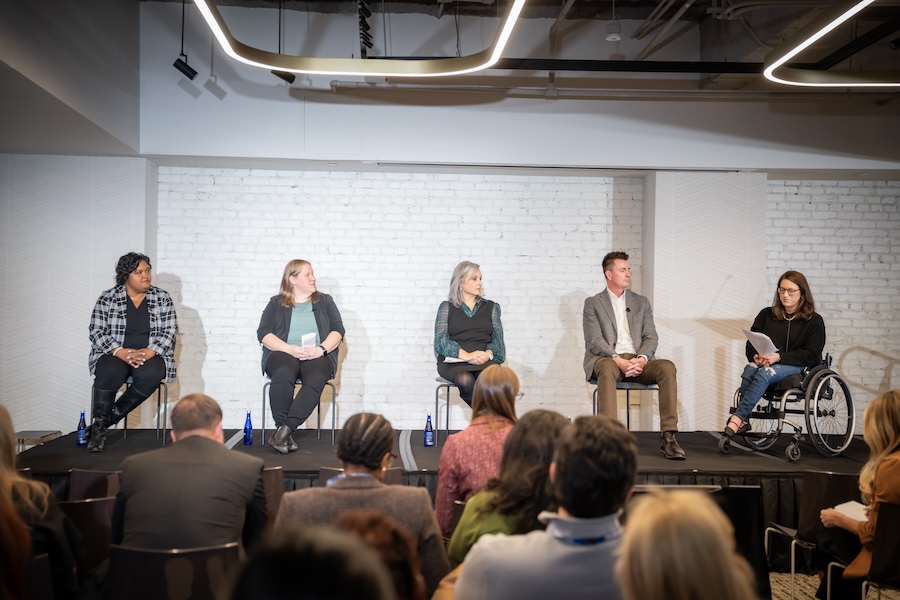
“If you’re going to move an employee along this continuum from apathy to advocacy, you have to demonstrate with real proof, real evidence, those values being lived and ultimately shown, rather than told.” Paulenich said during a panel discussion at From Day One’s Washington D.C. conference moderated by Morning Brew HR reporter Kristen Parisi.
Flexibility and Care for Employees
Some may have the impression that organizational empathy and flexibility so popular during the pandemic has declined in recent years, but panelists agree that those values aren’t gone, they’ve just shifted in response to evolving business needs.
Dr. LaTricia Frederick, global head of executive talent management at Cisco, says that earlier-career employees might not have inherent connection with their peers. Because of this, empathy for these employees needs shows up as intentional connection that rebuilds in-person relationships. “We actually want people to be connected to each other, to know each other, to be able to rely on one another.”
When economic changes force adjustments in business models and financial realities, it can impact established programs and options. So, “what may look like a decrease in empathy is a change in business models,” said Cari Bohley, VP of talent management at Peraton.
This introduces a new question. “Given that’s what is driving organizational behavior, how do we maintain the empathy? How do we meet our employees where they are?” One way that Peraton executed on this value was changing its EAP provider; utilization skyrocketed after the change.
Another key way to demonstrate company values is through flexibility for employees’ unique needs. Carlee Wolfe, AVP of leader development and organizational effectiveness for Hyatt, acknowledged that flexibility options vary based on role and emphasized localized care policies. “How are you understanding your employees differently and meeting them where their needs are? Maybe you have things already at the system level, but also—where can people lean in at the local level?”
Paulenich recommends stewarding your employer brand as you would your external brand. Continued care and consistency during times of employee adversity is one way to do that. “Employees oftentimes aren’t looking for an ideology, they’re just looking for some coherence and consistency between what you say you’re going to do and what you actually did,” he said. “So ground yourself in what those values are going to be, hold true to them, and then reinforce that consistently across the organization.”
Workforce Enablement With AI
AI-generated job insecurity can add a new anxiety for employees, but Hyatt frames AI as a human-centered skill development experience rather than a play for workforce reduction. “AI is a piece of our commitment to care around developing skills, leveraging and inserting it where your role is,” said Wolfe.
Cisco seeks to build AI fluency across the organization so everyone can understand its relevance and build skills. “We wanted to create a curriculum that allowed people to become fluent in AI, to understand what it is and what it offers,” Frederick said. To that end, the company has rolled out a multi-module companywide e-learning that includes baseline AI education along with a prompt library, low-stakes challenges, and function-specific prompt practice opportunities.
Peraton also runs AI literacy academies, one for baseline knowledge and one for advanced technical team members, says Bohley. “We needed to give them access to training so they can understand how AI can enable the work that they do, how it can make their lives easier, and what some of the ethical AI guardrails are.”
Paulenich sees AI training as a values test. To demonstrate investment in AI and commitment to innovation, companies need to make time for employees to learn. “This is a moment to say, are we going to stand behind that? Are we going to carve out the time for people to learn it? Are we going to take away some of the barriers to learning?”
While many companies have structured standalone programs for broader experimentation, like Cisco’s sandbox days and quarterly planned learning time, others integrate AI through short, accessible learning moments that impact daily interactions. Wolfe suggests inserting AI into real workflows, providing ready-to-use prompts, and modeling AI use in live settings.
Resistance to Change
Bohley reframes AI resistance as helpful data. “Resistance is the signal, not the problem. The problem is that we haven’t effectively communicated what the change is, what the value is associated with the change, how the change can improve, what you do.”
Conducting listening sessions and asking real questions can reduce change fatigue by giving employees a sense of co-creating the process, says Paulenich. “By having that dialogue early on, people take ownership; it feels less like something that’s being put on them, and more like something they’re part of.”
Grassroots structures like AI committees and champions can also help neutralize resistance. Cisco leverages early adopters and champions to generate excitement and engagement among team members. Peraton’s Community of Practice provides a place for interested employees to learn via speakers and other programming, and bring that information back to their teams.
Looking forward, Frederick sees AI as a tool to create capacity for greater investment in relationships. “Trust and connection are going to be that much more important, and we have to use AI to help us build capacity so that we have more opportunity to build on the trust and connection that we have.”
Jessica Swenson is a freelance writer and proofreader based in the Midwest. Learn more about her at jmswensonllc.com.
(Photos by Josh Larson for From Day One)