From Jobs to Skills: Inside the Shift Transforming Talent Strategy
BY Emily McCrary-Ruiz-Esparza
|
April 07, 2026

At eBay, which employs 12,000 people globally, senior director of global talent Zeenath Khan is using a pilot based approach to defining skills, which will support hiring and talent mobility—a newer alternative to traditional notions of hiring people for rigidly structured jobs with narrow and singular paths for growth.
Influencing an enterprise of that size to rethink its talent strategy, and then actually execute that change, is a massive undertaking. “So what we wanted to do was start quite small,” she said, focusing on teams already motivated to embrace a skills-based strategy in support of career development or AI transformation.
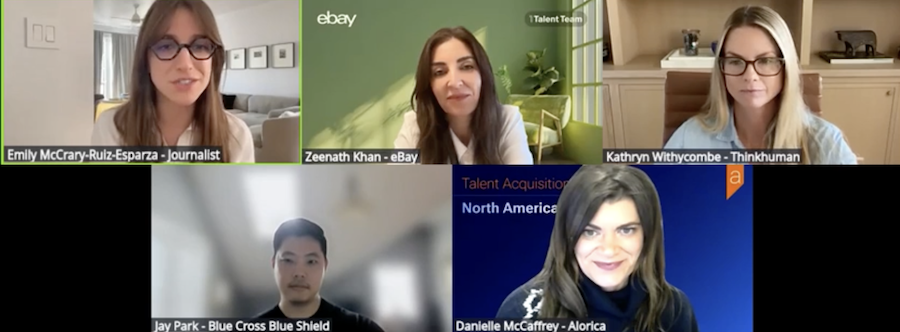
Khan was part of an executive panel on how HR leaders are adopting and experimenting with skills-based thinking, during From Day One’s March virtual conference on talent acquisition.
Her team works as consultants to business units, running workshops and helping leaders identify the skills their segments will need now and in the years ahead. “With all of the fabulous AI tools, we’ve also created research projects on those topics to support those leaders in their thinking.”
As the capabilities of artificial intelligence grow rapidly, some business leaders may be tempted to skip the foundational work and jump straight to replacing roles with AI agents. But Kathryn Withycomb, a senior learning strategist at Thinkhuman, recommends a different approach, starting with business goals, not headcount reduction. Framing the change this way helps keep expectations realistic and ensures that early pilots are focused on measurable, testable outcomes rather than sweeping assumptions about automation.
Skills-based thinking has been discussed in HR for several years now, but outside the field, the concept is still unfamiliar to most. To help employees understand the shift, Alorica’s senior director of talent acquisition, Danielle McCaffrey, encourages people to reverse-engineer their roles, asking questions like: What job do you have, and what skills do you bring to the table?
“The key is making it clear that this approach creates more opportunity for them and not less,” she said. Where traditional, job-based organizations prescribe singular paths from the bottom to the top of an organization with little room for detours, skills-based organizations open up lateral and nonlinear routes—an approach that resonates with a workforce interested in flexibility and adaptability.
“A lot of our positions are entry-level customer service roles, but if they demonstrate, say, analytical skills or training ability or a potential around leadership, we know that we can move them into workforce management, operations, training or even recruiting,” McCaffrey said. “When people realize that their skills are portable and visible across the organization, they start to see a much broader career path than the one that they were hired into.”
The skills-based transformation doesn’t just appeal to the newest arrivals to the workforce. While the pace of change is accelerating, more experienced employees have already navigated major technological transitions. “There wasn’t Google when I started working,” eBay’s Khan noted. “That combination of folks who have lived experience of dramatic technological change plus emerging talent who bring in a fresh mindset and a completely different set of skills remains really important for us.”
Some companies are taking their very first steps toward skills-based planning. Jay Park, the senior director of talent acquisition at Blue Cross Blue Shield of Massachusetts, is focused on building strong relationships with business leaders.
“We’re setting up that foundation as a broader people team,” he said, positioning his function as a strategic partner and building credibility so his team can better understand the skills leaders are missing today and what they’ll need in the future. He’s keen on thinking differently about hiring, moving from traditional ideas of what a resume should include and instead welcoming unconventional candidates who appear equipped for a nonlinear career path.
Finding the skills that don’t always show up on a resume is “where recruiting becomes both an art and a science, said McCaffrey at Alorica. “Resumes tend to show experience, but they really rarely capture the candidate's actual capability or potential.”
To uncover qualities like empathy, resilience, and critical thinking, her team uses behavioral interview questions and situational assessments that require candidates to demonstrate how they would handle real-world scenarios. Yet human judgment remains essential. “A candidate might score a little bit lower on an assessment, but then demonstrates exceptional problem solving and conversation,” she said. “That would be a signal to a recruiter to see if their career path could take a different turn.”
As AI gets smarter, Park added, “it’s going to be that much more important for us to assess candidates for mindset, growth, orientation, adaptability—those things that aren’t obvious on paper are going to require a recruiter.”
Emily McCrary-Ruiz-Esparza is an independent journalist and From Day One contributing editor who writes about business and the world of work. Her work has appeared in the Economist, the BBC, The Washington Post, Inc., and Business Insider, among others. She is the recipient of a Virginia Press Association award for business and financial journalism. She is the host of How to Be Anything, the podcast about people with unusual jobs.
(Photo by Vadym Pastukh/iStock)