Bringing Leadership Closer to the Frontline Experience
BY Emily McCrary-Ruiz-Esparza
|
May 27, 2026

“Most organizations are trying to solve the right problems,” said Courtney White, the head of HR for the North American agricultural solutions arm of BASF. “It’s just that many start in the wrong place.”
For instance, he says, companies might focus on engagement and retention, but those are the reactions from workers to the employee experience—and that’s where companies should start. “People decide pretty quickly if something works, and so the experience has to show up early, not in a promise, but in the reality of what people are living day to day.”
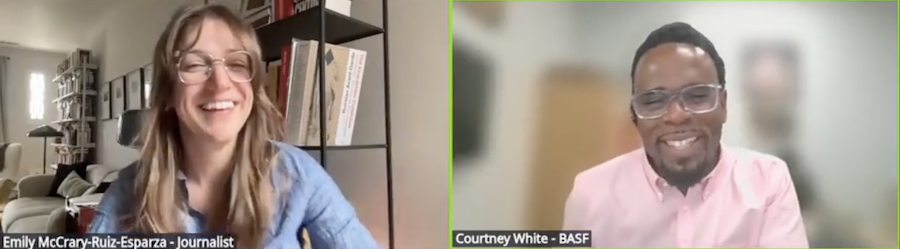
White spoke during a fireside chat at From Day One’s May virtual conference on frontline workers, where he spoke about how companies can bring business leaders closer to the frontline experience.
The goals of the worker and the goals of the business are not mutually exclusive—they seldom are—and companies lose sight of that. “Workers are trying to build something that works for their life. They want stable schedules, they want steady income,” White said. “Companies are trying to run efficient and reliable operations. Both of these things are correct.”
The problem is that when companies design systems for the business, they often do so in their own favor, and don’t always consider the frontline employee experience. And the result is harmful to both—in productivity, efficiency, engagement, retention, and morale. If leaders were to pause and listen to the concerns of the front line, they would find that their goals are concordant.
Both parties must be transparent about what they need. “If the company is worried about reliability, and the workers are worried about maintaining a stable schedule, then transparency between both will hopefully result in fair scheduling practices.”
White said that what many frontline workers want, but don’t often get, is autonomy, which is “less about removing structure and more about being thoughtful about where it matters,” he said. “We hold tight in places that probably don’t need it.” For example, matters of process or safety conditions shouldn’t simply be handed down from on high—those workers and their managers are often the most qualified to address those problems.
Not everything can, or should, be solved in the boardroom. “It typically needs to be solved by the people who are working closest to it, and local problem solving is one of the best forms of empowerment.”
This goes for things like learning and development too. Leadership may mandate universal skills training but fail to tweak its delivery for frontline workers who seldom have the flexibility to spend hours in a classroom, nor do they tend to have regular access to email, “so when learning is long or outside of the flow of work, honestly, it just doesn’t get used,” he said.
At BASF, skills training for frontline workers is delivered in small, 15-minute segments during the workday, and when it’s built into a shift, it doesn’t feel additional or interrupting. The purpose, he said, must also be clear. “People need to understand how what they’re doing is clearly tied to skills, access, or pay. When learning fits the job, people use it, and that’s when it matters the most.”
In many cases, frontline managers are left out of the equation, but that’s exactly where companies should focus. When an email comes from the C-suite, what is the first thing an employee will do? They go to their manager to find out what it means and how it will affect them. That’s a huge amount of power—even more so than the powers that be, he said. “That tells us how important [managers] are.”
White closed by encouraging leadership to loosen the reins, on workers, but also on themselves. “Companies sometimes think that the employees’ expectation is that the company is going to be perfect. I’ve not found any employee who, at the end of the day, really expects the company to be perfect.”
Emily McCrary-Ruiz-Esparza is an independent journalist and From Day One contributing editor who writes about business and the world of work. Her work has appeared in the Economist, the BBC, The Washington Post, Inc., and Business Insider, among others. She is the recipient of a Virginia Press Association award for business and financial journalism. She is the host of How to Be Anything, the podcast about people with unusual jobs.
(Photo by JackF/iStock)