Open Enrollment at a Time of Rising Costs and New Technology
BY Ade Akin
|
September 15, 2026

Kim Duck spent most of her time opening mail and processing papers when she started her career as a benefits analyst at Dow Jones in 2021. Twenty-five years later, she now oversees benefits for a global media empire operating in 44 countries.
What set Duck apart was her curiosity. She asked questions nobody else wanted to ask.
“If you have that question, someone else on your team also probably has that question,” Duck said. “There’s no bad question you can ask other than the one that you don’t ask.”
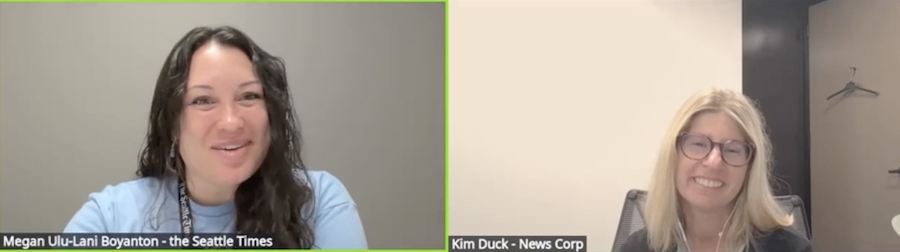
Duck, now the VP of global benefits at News Corp, shared her career-long philosophy during a fireside chat at From Day One's September virtual conference. The session, “Open Enrollment at a Time of Rising Costs and New Technology,” was moderated by Megan Ulu-Lani Boyanton, a business reporter at The Seattle Times.
A Portfolio of Brands, a Universe of Benefits Challenges
News Corp may not be a household name, but many of its brands are. The company owns The Wall Street Journal, HarperCollins Publishing, the New York Post, Barron's, and Realtor.com, among others.
Duck says she leads with three words that define the company’s ethos: passionate, principled, and purposeful.
“You have to be passionate,” she said. “You have to love the ability to jump in with two feet and to help someone. You’re going to get on a call, or you’re going to get an email, and you don’t know what it’s about, but you have to be able to be excited about what you do every day.”
For Duck, being principled means "doing the right thing all the time," especially when benefits teams must fix mistakes that affect employees' lives. For her, being purposeful means having a long-term strategy, such as planning benefits three to five years out with CFOs or entering union negotiations with a clear vision.
The Hardest Renewal Season in Years
This year, News Corp is conducting its first active enrollment in 10 to 12 years. The shift matters because employees have grown accustomed to benefits rolling over automatically. Duck’s team plans to spend weeks educating workers on their options, combating the misconception that paying more always means getting better coverage.
Technology is central to that effort. “The experience you have from a benefits perspective and the experience you have in your shopping and the whole rest of your life; they shouldn’t be different,” she said. That means jargon-free communication.
Additionally, Duck’s long-range planning ability is now colliding with the worst cost cycle she has seen in years. “This is the hardest year that we’ve had in many years,” she said. “Many of us are facing double-digit increases, which wasn’t necessarily the case in the last two to three to five years.”
The increases she’s referring to are the cost of health coverage for employees. Three main forces are driving costs up: employees are using more care benefits post-Covid, healthcare services are more expensive, and new, pricier treatments are entering the market.
Boyanton provided data illustrating the national trend. She cited an Aon projection that U.S. employers will pay almost 10% more per employee for health coverage next year, pushing the average annual cost of covering one worker above $19,000.
Facing these rising costs, benefits teams are reassessing their benefits plans. “We’ve all started looking at our plan designs and reassessing: is this fit for purpose going forward?” Duck added.
Any answer lands on employees in one of two ways. Raising what workers contribute from each paycheck spreads the increase across the whole workforce because everyone pays it. Tightening plan design by raising deductibles, raising copays, and dropping covered services falls mainly on people who actually use care. That tension is the job. “How does this impact us as a company? But what does this actually mean to our employees?”
GLP-1s and Emerging Benefits: Balancing Cost and Care
No conversation about rising costs is complete without addressing GLP-1 medications. Duck acknowledges that the topic is top of mind for every benefits professional. The challenge is twofold: the drugs themselves are expensive, and the eligible population is expanding.
“Employers, for the first time, are having to take a really hard look at whether they can even consider continuing the coverage,” she said. Those that do are exploring lowest net unit pricing, BMI thresholds, and wraparound wellness programs that address nutrition and behavior change.
The numbers tell a story of rapid retreat. The share of employers covering GLP-1 drugs for weight management fell from 72% in 2025 to 60% in 2026, according to Business Group on Health. Just under 15% of employers have already dropped coverage or plan to do so by 2027, up from 10% earlier this year. Pharmacy now accounts for roughly 25% of employers' total healthcare spending, with drug costs projected to rise by 12%.
Like in the case of GLP-1s, employers have often raced to adopt point solutions. Duck loves the innovation of these vendors, working to solve specific health challenges, but foresees a correction coming. Duck describes the shift as a pivot toward intentionality: “If we’re going to spend the money, we want to know that it's the right product at the right time. It’s going to hit the right people.”
Innovations in Health Plans
News Corp has embraced two structural alternatives. The first is Centivo, an alternative healthcare plan that focuses on primary care within hospital systems. Duck compared it to an old-school health maintenance organization (HMO), but with expansive networks such as Mount Sinai in New York and RWJBarnabas in New Jersey.
“Employees really struggle with that,” she said. “They think it must be a worse plan because I can only see these doctors.” But the trade-off includes no deductible, low copays, and some free services, all at a reduced payroll contribution. “It’s kind of a win-win, but it’s a slow burn,” Duck added.
The second innovation involves transparent pharmacy benefit managers (PBMs). News Corp issued a Request for Proposal (RFP) for its prescription carrier, hoping to move from one of the “big three” to a smaller, more transparent option. The numbers didn’t work out this time, but Duck believes the direction is inevitable.
“The black box of prescription coverage and how it determines what your payment is—I think that’s going to be a thing of the past,” she said.
New Tech in Benefits
AI is already transforming Duck’s daily work. She uses Gemini to locate lost emails in seconds rather than spending 15 to 20 minutes digging through her inbox. However, the far greater potential lies in aggregation.
With nearly 20 point solutions under management, Duck’s team conducts dozens of annual reviews. AI can synthesize those conversations and highlight relevant themes.
“The human brain can’t comprehend that and pull it together,” she said. “AI is going to help us have succinct conversations, to bring it to the forefront and be very pointed.” The result, Duck believes, is a more articulate benefits professional walking into leadership meetings.
When asked for a go-to tool she can't work without, Duck didn’t hesitate to mention Slack. News Corp’s brands operate on different technologies, and Slack provides a common channel for benefits teams across Dow Jones, HarperCollins, the New York Post, and News UK.
A Look Ahead
Despite cost pressures, Duck remains optimistic. She compared this moment in time to the Affordable Care Act era, when many predicted benefits would cease to exist. Instead, the profession adapted.
In Duck’s view, artificial intelligence will strengthen decision-making and foster greater vendor accountability. “If you care enough about this and you’re intentional about what you’re doing, you can weather those tough years and still position yourselves as being the employer of choice,” she said. At their core, benefits continue to fulfill two essential roles: attracting top talent and retaining key employees, making distinct offerings critical.
News Corp’s partnership with DoorDash, for example, gives employees a break from cooking on busy days. And GLP-1 coverage itself could become a recruitment tool, Duck suggests, for companies willing to keep it.
“You weather the storm,” she added. “Do it smartly, and do it with heart.”
Ade Akin covers artificial intelligence, workplace wellness, HR trends, and digital health solutions.
(Photo by paripat niyantang/iStock)