How Employers Are Using Data to Optimize Benefits Spend
BY Emily McCrary-Ruiz-Esparza
|
September 29, 2026

In 2027, healthcare benefits are expected to make their biggest year-over-year price jump in more than two decades, and benefits leaders are struggling to make the most of tightening budgets.
Employers told Mercer that, without intervention, the cost of their current plans could increase by an average of 11%. Workers are already paying about 10% more than they did last year, according to Aon.
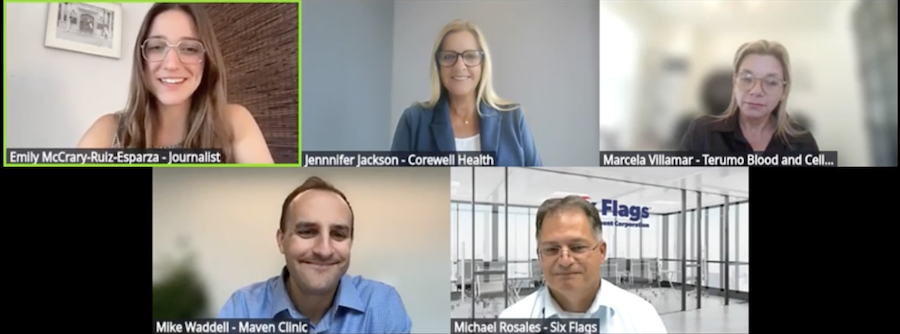
To make every dollar count, some benefits leaders are paying careful attention to data, investing in preventative care, and staying close to employee needs. During a From Day One executive panel discussion at the September virtual conference on employee benefits and well-being, benefits leaders shared their strategies for keeping health and well-being costs in check.
Following the Data
Corewell Health’s employee population is 78% female, so when it comes to benefits, the Michigan-based healthcare system focuses heavily on family building. Most recently, by expanding parental leave and bringing in a health vendor that provides access to reproductive care. But Jennifer Jackson, who leads benefits strategy at Corewell, also pays close attention to data.
While she anticipated uptake in maternal health benefits, “what we didn’t realize,” she said, “was that the number-one reason that our team members would access this new benefit was hormonal and menopause support.” That’s valuable information she’ll use as she optimizes the benefits package in the future.
Marcela Villamar, director of total rewards at Terumo Blood and Cell Technologies, also closely follows claims data to “understand the top conditions of our associates in detail,” she said. Villamar found that 79% of cancer diagnoses in Terumo’s workforce are breast cancer, so she’s launched a campaign on breast cancer awareness, “If you detect cancer in stage one or two, it’s about $200,000 cheaper the treatment than a stage three and four,” she said.
At theme parks company Six Flags, the most common claims are musculoskeletal. “We have a large population of our folks that are in more manual or physical jobs—laborers, carpenters, plumbers, welders—and that was weighing on them pretty heavily,” said director of total rewards Michael Rosales.
When Rosales asked employees why they weren’t getting the care they needed, they told him: time and availability. So, in 2027, the theme parks company will launch a partnership with a digital musculoskeletal therapy provider that will allow employees to seek care when and where they want. “We know if we can get them into therapy, their joints will recover better,” he said. “There will be less repeated claims, and potentially less in the way of larger claims.”
Personalization of benefits has become a differentiator for many employers, but stitching together dozens of benefits and programs for just a handful of employees isn’t cost-efficient, nor is it scalable. “Granularity doesn’t need to mean we’re going to be building 20 different programs,” said Mike Waddell, director of people operations and total rewards at women’s health platform Maven Clinic. “But can you think about layering the coordination and the actual navigation on top of flexible benefits so that the experience feels deeply personal, even when the underlying program is scalable.”
Spreading the Word
Communication is a common problem for benefits providers. Employees can’t use what they don’t know about, but benefits teams can’t promote what they’re unaware of either. Villamar recommended getting familiar with every nook and cranny of your total rewards. Coverage for concerns like perimenopause, menopause, and fertility may already be included in the medical plan, but “if we don’t know it, the associate wouldn’t know it either,” she said.
In some cases, simply increasing limits on what’s already on offer can meet employee needs. Jackson worked with Corewell’s life insurance provider to add grief and bereavement support benefits.
Marketing matters too. “Instead of just adding more and more benefits, it’s about getting creative and getting in front of our team members to showcase the benefits that we offer and make sure that they’re maximizing and using,” said Corewell’s Jackson. The healthcare network recently added paid living donor leave, and to promote it, she’s linking it to the company’s central mission of saving lives. “If a team member wants to donate bone marrow, stem cell, or kidney, or part of their liver—it’s 100% pay. They don’t have to use time off, and it’s not a short-term disability benefit.”
Embedding with the workforce can be a valuable means of advertising—and research. Maven has employee listening circles to keep track of what’s important to workers and what might incentivize them to stay. And at Corewell Health, there’s a clinician who co-leads the well-being strategy with HR. She’s “someone that lives, breathes, and does that occupation,” said Jackson.
Making the Case for ‘Soft Savings’
As costs climb, HR has to justify every dollar it spends. The trouble is that demonstrating ROI can be difficult when the financial value is the high-cost claim avoided.
Rosales calls these “soft savings.” “When you can’t see it, financial folks get a little squirmy,” he said. Panelists argued that in front of the check-writers, even hypotheticals can help.
Take family building, for instance. At women’s health platform Maven Clinic, Waddell starts the budget conversation with potential savings. “We know 30% of fertility members achieve pregnancy without [assisted reproductive technology], and the average IVF cost is $23,000 or more per cycle, which is a lot,” he explained. Framing it this way is worth it, he believes, “if you can even think about making a dent in some of that cost avoidance. Huge numbers add up.”
Emily McCrary-Ruiz-Esparza is an independent journalist and From Day One contributing editor who writes about business and the world of work. Her work has appeared in the Economist, the BBC, The Washington Post, Inc., and Business Insider, among others. She is the recipient of a Virginia Press Association award for business and financial journalism. She is the host of How to Be Anything, the podcast about people with unusual jobs.
(Photo by champpixs/iStock)