Engaging an Increasingly Diverse Early-Career Workforce
BY Emily McCrary-Ruiz-Esparza
|
June 22, 2023

Young people entering the workforce in 2023 tend to be unafraid to ask for the things their predecessors shied away from, or didn’t even know they could ask for. Generation Z applicants typically ask blunt questions when evaluating a potential employer—and they want specifics, said Dexter Davis, VP of HR and diversity, equity, and inclusion (DEI) at water-hygiene company Ecolab.
“It’s not just ‘Do you have a DEI program?’ or ‘Do you have a counselor?’ No. It’s specifically, ‘What are the things you’re doing? How are you ensuring equity and an understanding how soon can they be part of the organization and have a voice?’”
During From Day One’s June virtual conference on expanding the way we think about DEI, I moderated a panel of five senior talent acquisition and DEI professionals—Davis among them—to learn more about the ways employers are attracting young workers to their organizations and keeping them there.
This generation has access to all kinds of resources unavailable in the past, noted Tara Bellevue, the VP of DEI access strategy at NAF, a nonprofit organization that supports career training in high schools. Those resources have shown them what is possible and reachable. “Gen Z and Gen Alpha have student leadership organizations and other community-based organizations that help to elevate their voice and give them unprecedented access to career opportunities that are well beyond our imagination,” Bellevue said.
The boldness of young workers that prompts them to ask for what they want can accelerate company change too. “My clients make the most progress with their DEI and belonging efforts after their summer interns come because they’re asking, and they’re not afraid to say, ‘Well, that’s important to me, and I’ve got choices,’” said Beth Ridley, the CEO of DEI consulting firm Ridley Consulting.
With purpose and social justice top of mind for early-career workers, mission-driven companies are at an advantage in attracting young applicants. For educational publisher McGraw Hill, “the number-one reason why they stay with us is for our mission,” said the company’s VP of talent management and chief DEI officer Heather Wollerman. They found by surveying their employees that workers are also drawn to the company’s innovation: “They love doing cutting edge things. I mean, we’re using AI in some of our products.” The survey also indicated the importance of forming relationships at work, said Wollerman. Young workers need to be able to envision themselves at a company, and for many that means achieving a sense of belonging.
At Sherwin-Williams, VP of DEI Yentil Rawlinson likes to show young applicants what’s possible within the company, using others’ paths as object lessons–like the CEO, who started at the company right after college as a trainee. “They need to look up and see the representation and believe that it’s not just a talking point for DEI, but that we’re actually committed to it in the decision-making,” she said.
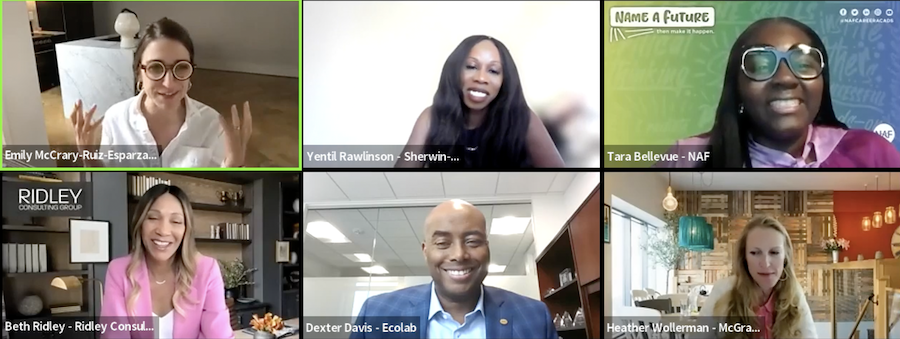
Davis at Ecolab avoids prescribing career tracks as much as possible, preferring to leave that up to workers and their interests. “We want to present options and opportunities for [them] to develop,” he said. When a company starts hemming employees in and spelling out single-track career progression, it becomes a less attractive employer. “Potential sometimes can be really narrow in a corporate environment. We’re trying to broaden that,” said Davis.
Panelists also emphasized the importance of screening candidates for DEI enthusiasm. “I think DEI and belonging are leadership competencies,” said Ridley. “Just like you’re screening for someone with decent communication skills, or a minimum level of business savvy.” She recommended questions like, “How has your previous work or educational experience prepared you to work in a diverse environment?” and “Tell me a time when maybe you had to work with people with different viewpoints or applied an equity lens to your work?”
To engage young workers early, Rawlinson considers the employee experience from application to the first few months of employment. She called these “wraparound services.” The company connects new hires with ERGs and helps them find buddies who proactively reach out to the young worker. It helps them network with leaders and more senior colleagues. “This means not waiting for new hires to come to them, or to say, ‘Hey, I’m interested.’ There’s a constant connectivity and communication they have with people coming into the company. That onboarding experience impacts how likely they are to stay,” she said.
Bellevue underscored the value of investing in the talent pipeline before the prospective candidates even reach your doors. Early-career workers who are familiar with your company and its values before they leave school are more likely to envision a future there. Internships and apprenticeship programs can accomplish this.
“The more that we can do early on, the better off we will be,” said Bellevue. “Having students in the pipeline early on, in high school, tied to the other initiatives that we have–if we’re saying we want to amplify Black and Hispanic males in STEM pathways or females in STEM pathways, this is a great way to be able to do that.”
Emily McCrary-Ruiz-Esparza is a freelance journalist and From Day One contributing editor who writes about work, the job market, and women’s experiences in the workplace. Her work has appeared in The Washington Post, Quartz at Work, Fast Company, Digiday’s Worklife, and Food Technology, among others.


