Bridging the Distance: How Tech Can Boost Engagement and Recognition
BY Katie Chambers
|
August 09, 2023

Imagine attending an all-hands meeting with hundreds of employees, and a team leader singles out a shy, quiet employee to congratulate them on a recent job well done – totally horrifying them in the process! If only the manager had known, they could have rewarded the employee in a way that made them feel comfortable and valued.
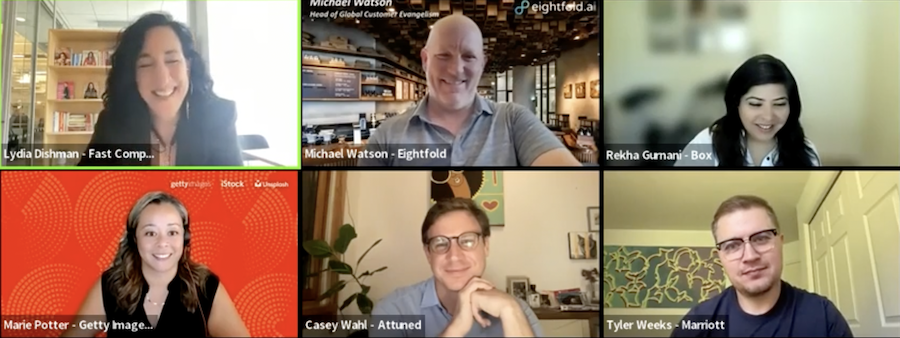
Getting to know employee personalities, preferences, quirks, and demeanors can be a challenge, especially in a large and distributed workforce operating across offices, homes, and even time zones. How can employers promote both team cohesion and making individual employees feel seen by their managers and peers? Employee engagement software can help. During From Day One’s July virtual conference, business leaders gathered for a panel discussion about “Bridging the Distance: How Tech Can Boost Engagement and Recognition,” where they discussed which technologies and practices are most motivational and informative.
The Evolution of Employee Engagement
Engagement software can offer several automated systems to improve the employee experience and outcome including personalization and reminders for busy workers, notes Casey Wahl, CEO of software company Attuned. It’s especially effective for larger workforces and helping leaders see the forest rather than the trees. Wahl says that as software has evolved, it has become more individualized. “You can see personal engagement, and to understand that which motivates or engages each person is different,” Wahl said. Then, automated nudges to team leaders can remind and encourage them to act on the data.
Leadership’s response to the data collected is key, since Chatbots and AI can’t replace human empathy and compassion. “As much as there is great software out there, there is no software that’s figured out how to be your friend,” said Tyler Weeks, VP of talent analytics at Marriott.
Software can also be used to spark personal employee interactions. Marie Potter, senior director of culture and development at Getty Images shares an example of a team Slack channel ‘watercooler conversation’ in which employees were asked to share the rose, thorn, and bud of their day – something for which one is grateful, something stressful, and something that inspires hope or growth.
How Recognition Efforts Inspire Employees
Systematized collection of employee preferences can, if interpreted correctly by a human leader, allow for personalized recognition efforts that inspire employees. Software can, for instance, find out which employees prefer public recognition as opposed to those who would prefer private acknowledgment in a one-on-one meeting.
Potter suggests that HR can partner with the internal communications team to recognize and inspire employees through company newsletters, employee profiles, and even awards. In the Getty Images newsletter, Potter said, “there are deep dives that feature certain employees. And usually, those employees are connecting what they do with how they live our leadership principles, with how they utilize our operating principles, with the fun things they like to do on the weekend.” It’s all geared toward getting to know one another and being inspired to connect with the company mission.
Weeks cites that at Marriott's internal studies supported the power of recognition and reward. Managers were encouraged to give out token rewards to recognize employees who were excelling, small Visa gift cards of $10 or $25. “The teams with the lowest amount of peer recognition were the highest in attrition,” Weeks said. “It was the simplest thing.”
Software can support these efforts. Michael Watson, head of customer success, North America at Eightfold, says his organization uses a program called Nectar to track and distribute employee rewards which they can even redeem themselves. “As a manager, I'm allocated a certain amount of points every month,” Watson said. “I hand those out. And we give them for anniversaries.” Points can be exchanged toward gift cards at major retailers of choice, at wherever is most useful or valuable to the worker, or even donated to a philanthropic cause.
Collecting Data as a Sign of Respect
Rekha Gurnani, senior director of global compensation & people analytics at Box, shares that gathering information about employee preferences can increase productivity through customized workflow and is also simply a sign of personal respect. “I asked everyone to share their preferred mode of communication. Do they want to be sent a Slack? Do they want to text? Do they want an email?” she said. She also finds out what core hours they will be online, to ease scheduling meetings, in addition to how they prefer to be recognized – be it publicly, privately, with an award, monetarily, etc.
Wahl says that gaining insights into how employees are motivated can help managers inspire them to achieve. “I think this is where technology can be a champion,” he said. Potter says Getty Images uses Quantum Workplace to gather that information through biannual surveys of its more than 1,000 employees, including both multiple choice and write-in questions to gather specific suggestions as to how to incentivize a team and gauge how engaged team members feel with the corporate culture.
At Eightfold, Watson says there’s also an emphasis on making sure employees are getting the skills and education they need to succeed at their current workplace and beyond. The organization creates what they call a Project Marketplace, where employees can sign up through internal engagement software for certain projects that will help them develop their skills.
Employers can use engagement software to track employee preferences, schedules, personalities, and desires, and even offer an internal reward system so that all team members can feel recognized and connected to their corporate culture.
Katie Chambers is a freelance writer and award-winning communications executive with a lifelong commitment to supporting artists and advocating for inclusion. Her work has been seen in HuffPost, Honeysuckle Magazine, and several printed essay collections, among others, and she has appeared on Cheddar News, iWomanTV, and CBS New York.


