Evolving HR Systems into Engines of Action: How to Build a More Connected User Experience
BY Emily McCrary-Ruiz-Esparza
|
January 08, 2026

HR teams are under immense pressure to deliver a great employee experience, often with tools and processes that haven’t meaningfully evolved in years.
The challenge of improving the employee experiences is not a lack of data on their employees. In fact, HR has access to more information than ever before, from engagement surveys and performance reviews to benefits uptake and attendance records. The problem is that this information is scattered across incompatible systems. When connections can’t be made, HR leaders miss the patterns forming right in front of them, like the early signs of burnout and disengagement or escalating turnover that could be stopped.
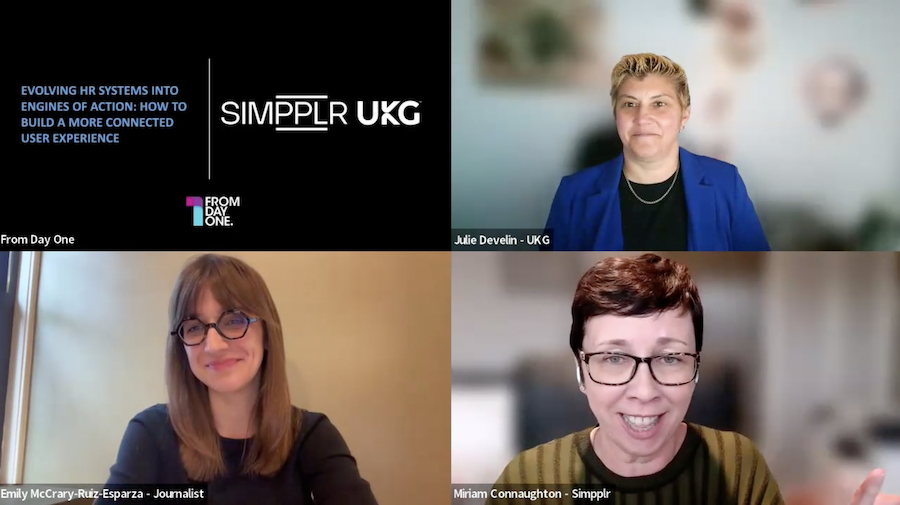
During a From Day One webinar, HR leaders explored how employers are finally beginning to turn their HR systems into engines of action–tools that don’t just store information, but actively connect workers and improve the employee experience in real time.
“We’ve inflicted an awful lot of digital friction on ourselves,” said Miriam Connaughton, chief people and experience officer at Simpplr. Employees must wade through disparate platforms, multiple log-ins, and poorly designed interfaces to find the information and tools they need to carry out basic tasks. “How do you make that user experience more seamless–more simplified–so you’re not forcing them to search through the tech morass to find what they need?”
At the same time, some HR teams try to layer antiquated processes into outdated software, said Julie Develin, a senior partner at UKG. Too often, organizations digitize outdated workflows instead of rethinking how work should actually be done.
If HR were to do one thing in 2026, Connaughton suggested that it should be a radical simplification of the employee tech experience. That means fewer clicks, clearer pathways, and systems that anticipate needs instead of requiring employees to hunt for answers.
Talent acquisition and onboarding have been the most obvious places for HR to focus on process improvement, followed by basic employee fact-finding (like FAQ chatbots), but AI-powered HR tech is now mature enough for the complex task of what Connaughton and Develin call “performance enablement.” This means helping managers become better coaches and employees set goals that align with the company’s. “It’s the whole performance cycle and everything that goes with it.”
This matters because HR technology has long lagged behind consumer technology. Employees aren’t using the same smartphone they had 10 years ago, yet many HR systems feel frozen in time. HR has grown accustomed to stability and wary of experimentation, so instead of trying a new process or new tech, they do nothing at all. “The cost of doing nothing has weighed on a lot of organizations,” Develin said. When HR tech systems don’t work, low adoption is often blamed on employee aptitude or even obstinance, but low usage is seldom a skills problem–it’s usually a design problem. “You know your tech is not good when your HR team is using the gum-and-duct-tape method to make it work,” Connaughton said.
But artificial intelligence is changing HR’s habits. Today, AI has already proved it can automate routine tasks and reduce administrative burden, and leaders are quickly warming to its use. But, the panelists said, we should be thinking bigger: Its greater promise is employee personalization. Great consumer brands learn their customers and tailor the experience accordingly, so why can’t HR tech do the same?
For a frontline worker, that might mean opening an app to instantly see their schedule, request a change, or receive a notification that PTO has been approved. For a manager, it could mean timely nudges about performance management or insights into team workload before burnout sets in. As Develin put it, when the experience works and employees feel cared for, they don’t just do the work–they engage.
Done well, modern HR systems become the engine of the employee experience. Employees don’t have to think about where to go or whom to ask, like the best consumer tech, the experience just works.
Editor’s note: From Day One thanks our partner, Simpplr, for sponsoring this webinar.
Emily McCrary-Ruiz-Esparza is an independent journalist and From Day One contributing editor who writes about business and the world of work. Her work has appeared in the Economist, the BBC, The Washington Post, Inc., and Business Insider, among others. She is the recipient of a Virginia Press Association award for business and financial journalism. She is the host of How to Be Anything, the podcast about people with unusual jobs.
(Photo by A9 STUDIO/Shutterstock)


