Navigating the AI Revolution: Transforming Workforces for the Future
BY Matthew Koehler
|
March 25, 2024

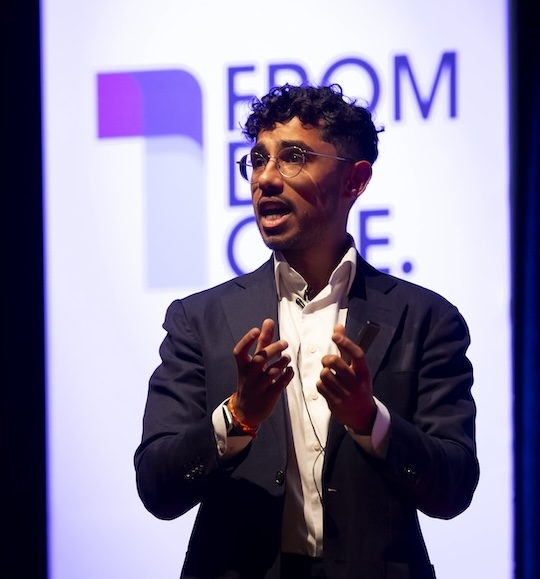
"What we’re going to do is talk through the impact of probably the two scariest letters when it comes to thinking about workforce and transformation: AI. But specifically the impact of these new tools on your workforce," said Akhil Chauhan, senior solution consultant at Orgvue. Chauhan spoke in a thought leadership spotlight at From Day One’s Houston event. Chauhan spoke about how Orgvue helps organizations strategize, prepare, and move towards an AI future.
When people think of automation, they generally have robotics in mind – the sort of technology that can automate physical tasks. But the way society is now thinking about automation is more in terms of knowledge work. Chauhan cited research from Goldman Sachs indicating that 25% of the tasks people do today are at risk of automation in the near future.
“What this tells us is that even though a large number of roles and a large portion of the workforce are going to be affected in some way, it’s actually more likely that small portions of people's day-to-day roles are going to be affected,” Chauhan said.
Strategizing For a More Automated Future
The key to success for any organization that isn’t already looking into these changes, would be to identify where that 25% is, then start building out resiliency from there, says Chauhan. This change, though, isn’t just affecting any one team at an organization, or a professional field, it impacts “everything from office and admin to legal.”
"We’re seeing this as a transformational change across a broad range of your organizations. And that’s good news." Chauhan says companies that can adapt quickly will "see an uptick in productivity uptick in economic output.” Others that can’t adapt quickly, however, will be left behind.
Chauhan laid out ways to prepare an organization’s workforce for the impact of AI.
First is benchmarking, or mapping existing benchmarks to your own data to determine the impact of AI on your organization. To create a benchmark, you would look at similar roles across the industry and look at skill sets, salary, and other attributes.
“There’s loads of different benchmarks that are available. Some focus more on roles, others focus on skills or industry. But there's a lot of information that can give you a very quick insight into what the impact of automation is on your workforce.”
Not all similar benchmarks, like engineers for example, are going to be the same across the board. “A software engineer at Lyondell is going to be very different from a software engineer at Southwest Airlines, which may again be quite different from a role defined in a generic benchmark,” Chauhan said.
Another way is by organization modeling, or modeling your future organization based on work that will be affected by AI. Chauhan says that if you know what role might be needed more in the future (and less of), then you can “build out team structures that can account for that type of change, and build out the different operating models aligned to different processes and technologies that those teams might be using.”
Another is finding skills gaps, or understanding the skills you have today, which will be most impacted by AI, and the gap between the two. You might “have a look at the different skills that we need in the workforce today. What might be less prevalent tomorrow. And then how do we adapt our workforce through re-skilling and upskilling programs to make sure that we have a resilient workforce in the future," Chauhan added.
None of these areas of preparation are prerequisites or contingent on one another. They might be complimentary but every organization has their own jumping off point, he says.
Guiding Principles
To achieve any sort of success with these models, Chauhan offers some guiding principles: rapid assessment, detailed analysis, and design and implementation.
First, you have to have good data. Consolidation of data and keeping it up to date will also help the organization make better informed decisions. “We know that data is messy, it sets in all sorts of different places, and is never going to be 100% accurate,” Chauhan said.
Not every organization goes through all the pillars. Some stop at the assessment and use it as a starting point to start driving some organizational change. Others want to go deeper.
This is where they might go into a detailed analysis, where Orgvue looks at the activities and work being performed by people in an organization to better understand how it can adapt to future change. It might also seek to identify who already has an AI skill set, what the future needs are, and where the skill gaps might be.
The final principle is the design and implementation stage, where you use all the data you’ve gathered in the rapid assessment and the detailed analysis to design future scenarios. At this stage you want to understand the impacts of AI on headcount, cost, and team composition. This is a proactive capability around your organization so that it can adapt to all different kinds of changes.
"We can get all of these things together to then build that future state organization that keeps in mind the current state of the workforce, but also gives you a transition plan into a future state.”
Editor’s note: From Day One thanks our partner, Orgvue, for sponsoring this thought leadership spotlight.
Matthew Koheler is a freelance journalist and licensed real estate agent based in Washington, DC. His work has appeared in Greater Greater Washington, The Washington Post, The Southwester, and Walking Cinema, among others.


