How HR Can Prepare for the Next Era of Work
BY Jessica Swenson
|
October 12, 2026

To ease common anxieties about AI in the workplace, Kathi Moore, SVP of HR at Motorola Solutions, recommends experimenting with the technology personally to build confidence in using it.
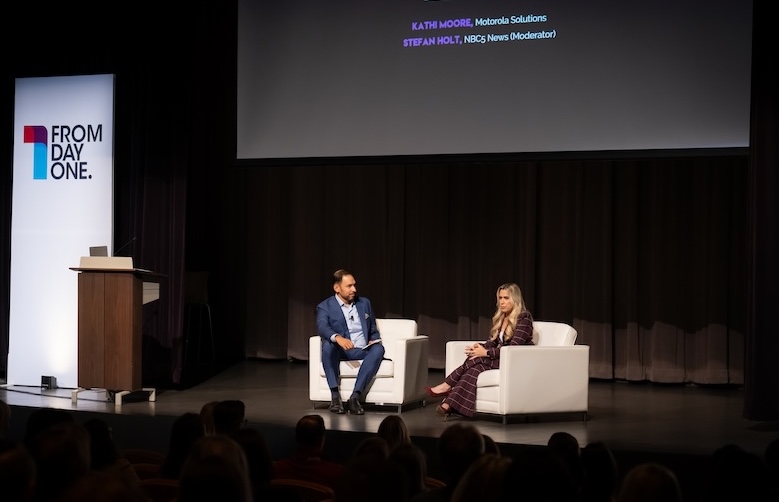
She also used AI to help navigate conversations with physicians while a family member was dealing with an illness. “Since then I’ve seen how [AI] can help me, and that’s always been my attitude. [AI] is not always right, but it’s this iterative tool that I can bounce ideas off of and utilize,” she said during a fireside chat at From Day One’s Chicago conference. Moore discussed this and other best practices for integrating AI into HR capabilities in the session moderated by NBC5 News anchor Stefan Holt.
Motorola Solutions is an offshoot of Motorola’s consumer phone business focused on mission-critical radio, software dispatch, and video security supporting the safety of first responders and communities. The organization uses an AI governance board to oversee AI use across the company, especially with the growth of internal adoption in 2025.
Moore avoided the fear often associated with AI, instead assessing it as an option to support her HR team. “I looked at it from a lens of ‘this is going to help us because we’re asked to do a lot every day, and we’re so lean, and you hear about burnout and anxiety all the time.’ So I took the approach of, ‘let’s learn about this, and how it can help us.’”
To assuage employee fears, she encourages minimizing exposure to the constant flow of news and social media dialogue around AI, and focusing on what aligns with the company’s needs and values. “You’re getting all this information all the time,” she said, “and it’s just increasing anxiety. Every week we hear something new. It’s all over the map, and you have to turn down the noise.”
When determining where AI might fit into an organization, says Moore, leaders must look at whether it aligns with the company’s culture. “You should be questioning, ‘Can AI do this? But then again, even though AI could do it, you have to think about your culture and what makes sense for your company, and that’s going to really drive the decision. Just because everyone else is doing it doesn’t mean you should. It’s not always good to be first.”
Preserving human judgment as a key part of the process is also critical, acknowledging that AI is not always right. “Everyone has a responsibility to not just take it at face value, and still use judgment.”
The company’s external AI products are branded as “AI Assist” because they are designed to assist first responders, not be the first responder. “We still have the person as the first responder because of our culture, and because we have a responsibility out there to our communities,” she said.
Her team uses AI as an internal first responder to answer routine self-service questions for employees. This helps reduce repetitive questions and saves the team’s time and energy for higher-impact critical moments. However, Moore still contends that it is important to know when to prioritize human connection. “We don’t want AI for everything,” she said.
Sharing an example of a Friday after-hours episode involving a new executive order on H-1B visas and employee travel, her team initially considered using an automated platform to communicate the changes but ultimately realized the situation called for a human touch. “People were very emotional and scared, and we weren’t going to point them towards this site. We were on the phone with these folks. I was personally on the phone with them, talking to individuals, calming them down, putting them at ease,” Moore said.
As the influence of AI continues to grow, the next generation’s core professional skills will need to evolve, says Moore. “Emotional intelligence, definitely communication, judgment skills. Being able to question—not look at something and just take it at face value, but be able to challenge it.”
Acknowledging that people are becoming increasingly isolated, Moore emphasized the need for empathy and human connection. “We forget that we are social beings, and that we still need to come together and use these great tools to help us solve the problems,” she said. “If we continue to go out in the workforce, in our communities, in our societies, and we have the attitude of wanting good for the other, I think we’re going to get through this just fine.”
Jessica Swenson is a freelance writer and proofreader based in the Midwest. Learn more about her at jmswensonllc.com.
(Photos by Josh Larson for From Day One)