Designing Leadership Development for a Rapidly Changing Industry
BY Ade Akin
|
March 18, 2026

For Mark Monaghan, the future is something he’s eagerly awaited since he was a child, bonding with his father while watching Star Trek. The popular science-fiction show painted a positive picture of what a technologically advanced future could look like, and Mark couldn’t wait to be a part of it.
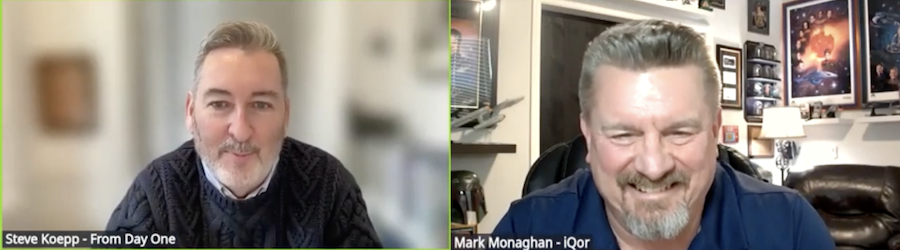
“I remember even my mom, growing up one day, told me, ‘Mark, stop wishing your days away,’” Monaghan said during a fireside chat at From Day One’s February virtual conference. “And now it’s here. The future is here, and it’s happening so fast.”
Monaghan, now the VP of global organizational development at iQor, a global customer experience company with 47,000 employees across 11 countries, is uniquely positioned to help shape that future. He detailed how his lifelong passion for science fiction has informed his real-world mission to use technology to deepen human connections through innovative leadership development during the session.
The Data-Driven Foundation of Coaching
iQor’s journey with advanced technology isn’t a recent pivot. Monaghan says the company purchased a big-data firm called Key Metrics about 12 years ago, long before artificial intelligence (AI) became a boardroom buzzword. This early adoption allowed them to begin analyzing the massive amounts of data generated in their 50-plus call centers, transitioning voice calls into digital data to identify patterns and coaching opportunities.
This data-centric approach became the bedrock of their internal coaching systems. iQor’s technology team built a proprietary coaching database called SCAN, with a new AI-integrated version, Coach IQ, on the horizon. One tool, dubbed “coach to coach,” uses AI to audit recorded coaching sessions between managers and supervisors, pinpointing specific areas for improvement.
“We also learned a lot about AI, learned how the different models learned,” Monaghan said. “It’s just kind of soaked into us. We can use this.”
The iLead Program: Measuring the Immeasurable
The core of Monaghan’s work is the award-winning iLead mentoring program, which has earned 49 learning and development awards, including a gold Brandon Hall Award and a silver Stevie Award.
The program operates on a leadership competency model that categorizes leaders from “leading oneself” to “leading a vision.” Each level is tied to five key competencies.
iLead’s ability to measure development makes it revolutionary. Monaghan partnered with Fidello to build a system where mentors and mentees complete competency assessments. If a mentee rates themselves a five on “managerial courage” but their mentor gives them a two, a dashboard highlights the delta. The mentor can then assign a curated learning journey from iQor’s Skillsoft library that’s tied directly to that competency.
“In Trinidad five years ago, we were able to identify that resolving conflict was the number one competency for our supervisors,” Monaghan elaborated. “We were actually able to move the needle from ‘needs development’ to ‘developed.’ That’s actually the first time I’ve ever been able to measure learning within the work environment that was measurable.”
iQor uses a tool called “iTrack” to ensure these mentoring relationships are productive. iTrack allows mentees to confidentially rate each session. If scores dip, Monaghan’s team can investigate trends and offer gentle course corrections, ensuring conversations remain focused on career growth, instead of solely focusing on daily performance metrics.
The Next Frontier: AI Mentors and Second Nature Simulations
Always looking ahead, Monaghan is now introducing an AI mentor bot into the iLead system. The bot analyzes past session notes, assessment gaps, and learning assets to generate a tailored, 30-minute discussion agenda for mentor-mentee meetings. “As far as I can tell, this platform doesn’t exist anywhere else,” he added.
Similarly, iQor is leveraging a simulation tool called Second Nature to train supervisors. Instead of just listening to calls, new hires can now practice complex conversations with realistic avatars. After the simulation, they receive complete feedback on what they could have done better, which can also be reviewed by trainers. “It’s a completely different level,” Monaghan said.
Despite his passion for technology, Monaghan’s philosophy is firmly rooted in servant leadership. He worries about the loneliness epidemic and the role recent tech advancements have played in pushing people apart. His motivation now, in what he calls the “fourth quarter of his career,” is about legacy.
“If I can help my leaders become servant leaders, help them remove barriers from their own lives, give them the confidence, recognition, and support that they need, you can really, really help people,” he said. “Every few months, I’ll get somebody from somewhere in my career that reaches out, and thanks me for a conversation. I think about that. That’s really what motivates me.” For Monaghan, the future of work isn’t just about using technology like artificial intelligence to build more efficient systems; it’s about using these tools to build more connected, capable, and confident people.
Ade Akin covers artificial intelligence, workplace wellness, HR trends, and digital health solutions.
(Photo by PeopleImages/iStock)