How AI Is Reshaping Talent Acquisition Without Replacing Human Judgment
BY Ade Akin
|
March 09, 2026

Meghan Rhatigan and her team at Marriott International discovered that candidates didn’t mind getting a text message to book their interviews after automating interview scheduling. In fact, many candidates barely noticed.
“We’ve scheduled over 300,000 interviews through an automated process and saved thousands and countless hours,” Rhatigan, VP of global talent acquisition experience at Marriott International, said during a panel discussion at From Day One’s Washington D.C.conference. The impact of that decision has been substantial: the interview process that once took ten days from start to finish now takes only three.
Rhatigan’s findings challenged a common assumption in HR spaces, such as the belief that high-touch hospitality recruiting required human coordination at every step. Instead, automation freed Marriott International’s recruiters to focus on building relationships with candidates and hiring managers.
Rhatigan shared her insights during a panel discussion with three other HR leaders titled “Modernizing Talent Acquisition: Enhancing Efficiency, Outreach, and the Applicant Experience,” as part of a wider discussion on how artificial intelligence is redefining the recruitment process. Adam DeRose, a senior reporter at Morning Brew’s HR Brew, moderated the conversation.
The Case for Keeping Humans in Charge
The panelists agreed there is a firm line between automation and decision-making. Rhatigan says Marriott made an early philosophical decision early on as it started to integrate AI into its system: AI would never get to select which candidates move forward or get hired.
“We’re a hospitality company. We have a business around human connection and travel and experiences, and the last thing that we want is for candidates to go through a hiring process where they never actually talk to a human,” Rhatigan said. “There are companies that are moving in that direction, and that’s fine, but we’re not that company.”
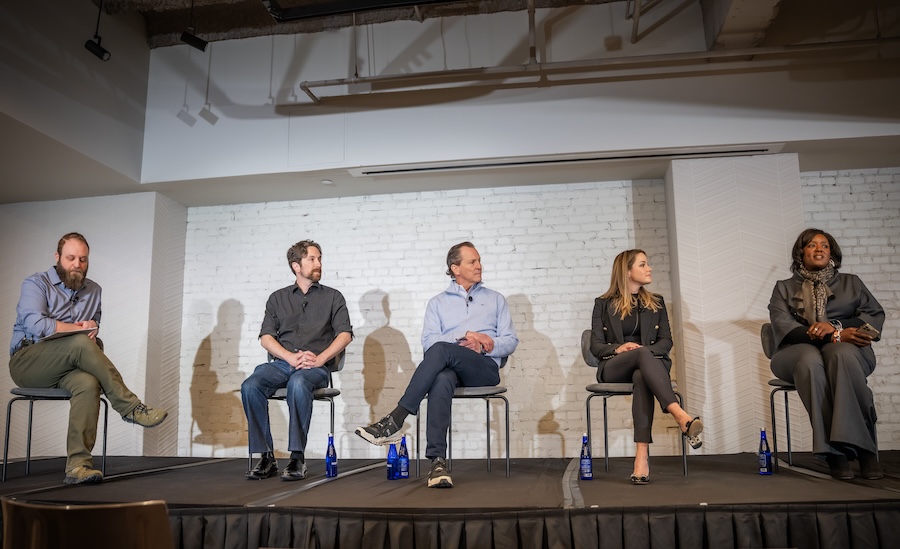
Shabrina Davis, head of manager enablement and inclusive hiring learning at Amazon, offered a counterpoint. She says AI can help identify and reduce bias. It can intervene when recruiters develop unconscious preferences, such as favoring graduates from their alma mater.
“From a learning and development perspective, we can have a pop-up that says, ‘Hey recruiter, we see you have a preference for Arizona State, but have you looked at Utah, or Florida State, or Howard University?’” Davis said. “Instead of 30 days later looking at a report and saying, ‘Oh, these recruiters are only looking here,’ we can do it immediately and have an intervention that rewires the thinking.”
Data-Driven Recruiting
For Bert Hensley, chairman and CEO of Morgan Samuels, AI’s most valuable contribution has been transparency. His firm conducts executive searches with unusual intensity, typically speaking with more than 250 candidates per engagement, and up to 500 for sales roles. The research required to identify the right people once took 20 minutes per company. Now, AI accomplishes the same task in about 25 seconds.
Using AI tools to aggregate data gives recruiters an honest view of their own performances. Hensley cited his wife, a therapist, who observes that “everyone is just hardwired to believe better about themselves than they really are. We live in that myth until you have the data that you’re getting every single day that tells you, no, you’re not quite doing what you thought you were doing.”
Hensley says that reality check has improved performance across the organization while reducing anxiety. “They’re living in reality, and they don’t have to worry about what’s happening. They know what’s happening every single morning,” Hensley said.
Jason Long, senior HRIS analyst at G-P, framed the broader challenge as one of trust. His company encourages employees to experiment with AI tools, and some of those innovations have made their way into G-P’s employer-of-record platform, helping connect professionals with international opportunities.
Long drew a parallel to the early internet. “Pets.com didn’t fail because they didn’t have a good idea. They failed because nobody wanted to put their credit card on the internet in 2000,” he said. “Now we have HTTPS and PayPal and a million ways to do that. So what is that key that will unlock trust and help people actually believe that what they're getting from AI is useful?”
Doing More With Less
External pressures are also reshaping how companies approach the hiring process. Layoffs remain in the headlines, and candidates are asking harder questions. Davis acknowledged that Amazon’s recent workforce reductions come up in conversations.
“We’re transparent,” she said. “Candidates ask about it, and it’s the reality of the industry that we’re in.” For new hires, a mindset of adaptability is essential. “The role that you’re hired for today may not be the role that you’re doing in 30 days. With that mindset, when you walk in the door, that hopefully will allow you to weather the storms.”
Hensley has observed the same trend, noting that search firms now evaluate candidates on agility quotient (AQ), alongside intelligence quotient (IQ) and emotional quotient (EQ). “If they’re afraid of AI, I can’t present them to a client,” he said. “They don’t have to be the master of it, but they need to be embracing it.”
For Rhatigan, the pressure is more immediate. Talent acquisition teams are being asked to do more with less. Marriott recently brought its frontline hiring in-house after two decades of relying on a recruitment process outsourcing (RPO) model. The company hired 50,000 U.S. frontline associates last year, despite having a team of only 20 people. “We would have never been able to do that without AI, ever,” Rhatigan said. “No one is going to be given a pot of money to add people anymore. But we’re all being asked to hire more. So the answer is technology.”
Perhaps the most unexpected win came from Amazon’s learning and development team. Davis says AI has eliminated language barriers in training. A year ago, her team could only produce materials in seven languages due to translation costs. Now there’s effectively no limit. “If you’re in a small country on the continent of Africa, and your language is definitely not in the top seven, you’ll have the same experience as someone who’s in Italy,” she said. “It levels the playing field and makes it fair.”
The lesson, panelists agreed, isn’t to chase grand transformations, but to find the small, repetitive tasks where automation can deliver meaningful impact while allowing humans to do what they do best.
Ade Akin covers artificial intelligence, workplace wellness, HR trends, and digital health solutions.
(Photos by Josh Larson for From Day One)