Using Education Benefits to Attract and Retain a Uniquely-Skilled Workforce
BY Emily McCrary-Ruiz-Esparza
|
November 01, 2024

Collectively, Americans carry about $1.7 trillion in student debt, second only to home loan debt. “So even if you are one of the lucky ones who doesn’t have any student debt attached to your name, you probably know someone who does, and you have probably not been able to escape the chatter around just student debt today,” said Michaela Rubin, VP of operations at financial wellness platform Candidly, during a From Day One webinar on tuition reimbursement and student loan benefits.
Because of the size of loans and the damage such debt can do over time, education assistance is becoming a popular benefit category among employers, says Rubin. “There are a lot of legislative tailwinds, like the CARES Act of 2020 and Secure Act 2.0, that are also feeding into this conversation. While we started primarily as a student debt repayment platform, we’ve seen the importance of combining these newer benefits with traditional benefits like tuition reimbursement. Employers need to set themselves apart and stand out, and this becomes a really big differentiator, especially when there are a lot of eyes on this right now.”
It’s certainly a differentiator for the Hazelden Betty Ford Foundation, says Heather Galvin, the organization’s compensation and benefits analyst, who joined Rubin for the webinar. “Not only is pursuing higher education financially burdensome for the workforce, it can affect mental health too. An offering like this just goes to show employees and workforce members that you’re invested in their whole health and their whole well-being.” The non-profit, headquartered in Center City, Minnesota, operates centers for drug and alcohol treatment as well as mental healthcare.
Though tuition reimbursement is more common than employer contributions to student debt, “participation in tuition reimbursement programs is historically pretty low,” said Rubin. The majority of workers say they want some kind of upskilling or training, but only a small fraction participate, often because they’re not aware it’s available.
Tuition reimbursement requires the employee to put up the money for the training or education, complete the program, and then file for reimbursement from the company. For student loan repayment, the company contributes to paying off an employee’s pre-existing student debt. Both have their tax boons for employees and employers.
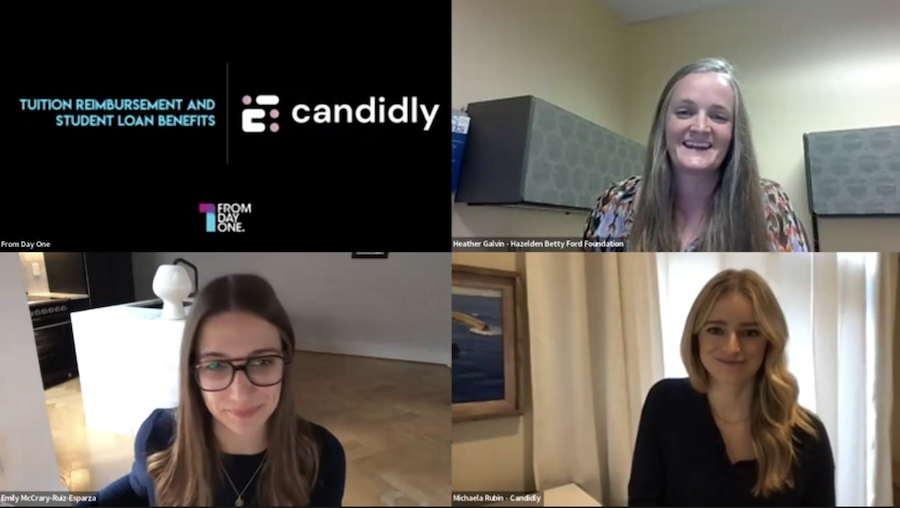
Galvin said the decision to offer tuition reimbursement was an easy one. They want and need uniquely educated employees, and they offer a graduate program of their own, the Hazelden Betty Ford Graduate school, where students can earn master’s degrees in addiction and mental health counseling. “It’s one of our strongest recruitment pipelines,” she said. “Aside from career advancement and professional growth opportunities for our workforce, we saw this as a great opportunity to increase loyalty and job satisfaction. We know we’re creating a more motivated and engaged workforce. We feel that by investing in our workforce and their future, we are simultaneously investing in our own.”
Running a Successful Student Loan Benefit Program
With her clients, Rubin discusses goals, budget, and workforce makeup. The latter is particularly important for employers that require their workers to have secondary or postsecondary degrees to qualify for the job. Those employees likely enter with considerable debt and would benefit from loan repayment benefits. Other employers may be heavily focused on upskilling the workforce they already have and would be wise to explore tuition reimbursement. Some will need both.
Any student loan program requires a carefully prepared communication campaign that builds awareness and clearly outlines expectations. Rejecting reimbursement requests because the student disqualifies on a technicality or mistakenly promotes benefits to ineligible workers, will significantly damage the reputation of the program.
At the Hazelden Betty Ford Foundation, Galvin folds the organization’s education assistance program into its benefits guide and stores it on the intranet. She also likes to promote it in sync with the school calendar when people are typically thinking about their education. Rubin said she likes to promote quick-start user guides and quarterly toolkits. But don’t wait for employees to arrive to advertise your program, they said, make it a part of your recruitment strategy. Tout it on your careers page and in your job postings.
Galvin said the program has been remarkably successful for her organization. Those who have registered and activated their tuition reimbursement have stayed. “This has potentially retained 23 workforce members who may have otherwise left. Said another way, it’s potentially saved us over a million dollars in turnover costs.” Currently, there are 167 graduates from the Hazelden Betty Ford graduate school working at the foundation. “Those are employees who, more than likely, participated in tuition reimbursement and/or are now eligible for student loan repayment.” This, she says demonstrates the organization’s appreciation for those who both further their education and stick with the organization. Plus, it works.
Editor’s note: From Day One thanks our partner, Candidly, for sponsoring this webinar.
Emily McCrary-Ruiz-Esparza is a freelance journalist and From Day One contributing editor who writes about work, the job market, and women’s experiences in the workplace. Her work has appeared in the Economist, the BBC, The Washington Post, Quartz, Business Insider, Fast Company, and Digiday’s Worklife.


