From Claims to Connections: Driving Value Through Proactive Member Engagement
BY Grace Turney
|
February 26, 2026

When Marissa Bloomer talks about a Spanish-speaking client receiving a $78,000-a-month cancer injection administered in a hospital, she pauses for effect. That same medication could be administered by a culturally appropriate oncologist at a nearby office—for just $5,000 a month. “We said, let’s hold the phone here,” recalled Bloomer, VP of population health at Curative. “We’re not paying $78,000 a month for a shot. Where can we find the same drug at a different provider?”
That story captures everything wrong, and everything fixable, about the way most American employers design health benefits. At From Day One’s Washington, D.C. conference, Bloomer led a thought leadership spotlight on a deceptively simple idea: coverage is not the same thing as care, and the gap between the two is costing employers billions of dollars and costing workers their health.
The Trap of the High-Deductible Plan
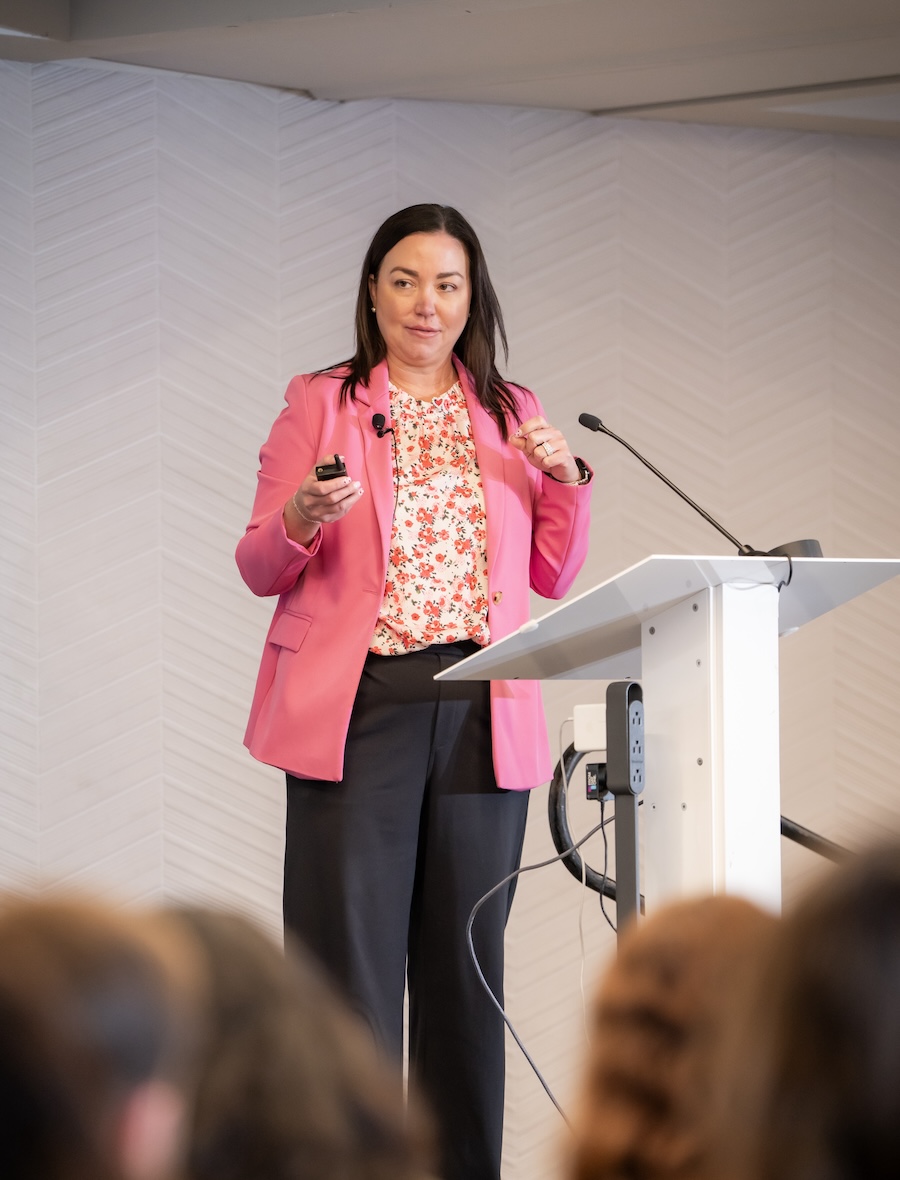
The numbers Bloomer opened with were familiar to most HR leaders in the room, but their implications were stark. Some 27% of covered workers are now enrolled in a high-deductible health plan, and the average deductible for single coverage on an employer-sponsored plan has increased by 47% over the last decade. “These really are not benefits,” Bloomer said. “These are barriers.”
The downstream effects compound fast. Preventable conditions now represent a $1.34 trillion burden in untreated illness, with $55 billion lost annually from missed preventive screenings alone, she says. Workers on high-deductible plans face a 25% higher risk of diabetes complications, not because their plan doesn’t technically cover screenings, but because they can’t afford the initial out-of-pocket cost to find out they need one. “I’ve seen it,” said Bloomer, a registered nurse with 25 years in the health insurance industry. “Missed preventive screenings are the number one cause of people crashing into diabetes.”
The cycle is self-reinforcing: confusion and unaffordability lead to deferred care, deferred care leads to worsened health, worsened health leads to lower productivity and higher costs. And employers respond by raising deductibles again. “We set ourselves up to fail,” Bloomer said. “High-deductible health plans were designed to manage expenses. But we ended up creating the most expensive outcomes, and we’re not treating employees as a whole.”
The $0 Model as a Clinical Strategy
Curative’s answer is structural. Its plan eliminates copays and deductibles entirely for in-network services, and Bloomer emphasized that this isn’t a generous perk; it’s a clinical tool. “A $0 copay and $0 deductible is a clinical strategy intended to keep employees healthy,” she said. Remove the financial hurdle, and utilization rises. Utilization rises, and conditions get caught earlier. Conditions caught earlier cost a fraction of what they cost when they reach the crisis stage.
But Curative’s model adds a layer that most zero-cost plans skip: health literacy. “I truly believe if you teach people how to use their plan in plain language, they get it,” Bloomer said. Her team operationalizes this through what the company calls the baseline visit: a one-hour onboarding appointment every new member completes at the start of their plan year.
The baseline visit unfolds in two back-to-back 30-minute sessions. The first, with a care navigator, is essentially Benefits 101: how to use the member portal, how to find a doctor, how to order a colorectal cancer screening directly through the app. The second is with a clinician (a physician, nurse practitioner, or physician’s assistant) who reviews the member’s health history, flags overdue screenings, and makes personalized recommendations. A member turning 45 with a family history of colon cancer, for instance, gets steered toward a colonoscopy rather than a Cologuard test.
“We’re able to actually physically show and put in the member portal: this is what we want you to do this year,” Bloomer said. That roadmap then drives ongoing outreach, such as calls during Breast Cancer Awareness Month to members who haven’t completed mammograms, or emails during Colorectal Cancer Awareness Month to those who haven’t been screened.
The outcomes are striking. Curative reports a 98% completion rate for the baseline visit. It identifies 94% of chronic conditions during that initial appointment. And in a controlled study, members who engaged with a registered nurse after the baseline visit saw their medical cost spend reduced by 62.5%. “I’ve never seen that in my 25 years in the healthcare industry,” Bloomer said.
Connections, Not Claims
Bloomer was pointedly critical of traditional case management, which she called “dialing for dollars.” Predictive analytics flags a high-risk member; a call center employee asks if they want to enroll in a disease management program. “Those things don’t work,” she said. What works is intervening at the moment of need, with a real clinician who already knows the member’s history.
That philosophy shapes how Curative deploys AI as well. As of November, its care navigation team uses an AI tool to handle first-response emails—currently resolving about 60% of inbound messages, sometimes within minutes. The system is trained to recognize frustration signals (all-caps text, profanity, etc.) and hold those for human review. Thanks to this use of technology, care navigators spend less time on routine queries and more time on the outbound, proactive outreach that actually changes health outcomes.
Bloomer closed with a framework she calls the five principles of a person-first health plan: data-driven decision making, proactive and predictive (rather than reactive) support, scalable innovation and personalization, a human-centric experience, and integrated healthcare ecosystems. The throughline is that benefits should be built around the full human being: financially, clinically, and emotionally.
For HR leaders evaluating their own plans, she offered questions worth sitting with. Does your plan design create financial stress for the employees who need care most? How are people actually engaging with their primary care physicians and chronic care programs? And is your vendor teaching health literacy, or just providing a card?
“Coverage doesn’t equal access,” Bloomer said, returning to where she started. “Connection is really the best ROI.”
Editor’s note: From Day One thanks our partner, Curative, for sponsoring this thought leadership spotlight.
Grace Turney is a St. Louis-based writer, artist, and former librarian. See more of her work at graceturney17.wixsite.com/mysite.


