Hiring You Can Stand Behind: Building Mutual Trust With Candidates
BY Emily McCrary-Ruiz-Esparza
|
October 05, 2026

The ubiquitous use of AI in job applications has made hiring traditional signals less reliable. The AI arms race has driven employers and job seekers alike to greater and greater AI adoption, damaging trust on both sides, but employers need ways to wade through the slop to find great candidates and gain their trust.
“You’ll be amazed by what going back to the basics can actually do,” said Felix Martinez, the director of talent acquisition at GE Appliances, during a From Day One webinar on building mutual trust with candidates when AI and fraud are rampant. “Asking behavioral questions and then doing follow-ups will be able to elicit real answers.”
With today’s AI tools, “candidates are able to apply en masse and make themselves look just like the job posting requirements,” said Adam Vassar, fellow panelist and senior director of talent science at skills assessment platform CodeSignal.
In response, the company has focused on building assessments with “high-fidelity, work-like simulations so people can walk the talk and have an opportunity to showcase their skills, if they have them,” he said. “Employers then have the opportunity to properly evaluate that people may not have those skills if they were inflating or using AI in ways to get themselves to the top in a disingenuous way.”
Using AI Selectively
AI can handle certain parts of the hiring process without replacing human judgment—and that’s how panelists are keen to use it.
While GE Appliances has been experimenting with AI-powered interview bots, what isn’t up for debate is the decision-making. “Every person is either accepted or declined by a human, not a bot,” said Martinez.
The same is true at fintech firm Synechron, where humans continue to make hiring decisions. Director of recruitment Ranjana Sagar has been experimenting with AI for assessments, picking ones that evaluate specific skills, but she’s not fully automating anything.
“We’re moving from thinking of assessments as simply another step in the hiring process to be part of the overall candidate and hiring experience,” said Sagar. “We have also made sure that we have human interaction at every step of the hiring process, right from the first instance where the recruiter tries to bring in the candidate to a video call rather than doing a phone call itself.”
Using AI to Improve the Candidate Experience
So far, candidates haven’t demonstrated a great deal of pushback against AI use by employers. Vassar said he was pleasantly surprised with the results of CodeSignal’s candidate experience survey, which found that candidates who took assessments that were not human proctored—and were instead monitored with AI-powered tools—were more pleased with their experience than those who had a human-proctored assessment.
“What we derived from that was the concept of a level playing field,” he said. Candidates can feel that “‘I’m going to showcase my skills. I feel like I’m good at this. I actually feel reassured that others will be as locked down as I am.’” The assessment becomes about their capabilities, not gaming the system.
Using AI as a human stand-in isn’t inherently dehumanizing. Anecdotally, candidates who interviewed with AI-powered role plays appreciated the “safe space” afforded by an artificial interviewer as opposed to a human role-player, who comes with their own biases and ideas—and may even be the candidate’s potential boss. Others like the asynchronous quality, which made it possible for them to complete assessments on their own time—outside of work hours or after their kids had gone to bed.
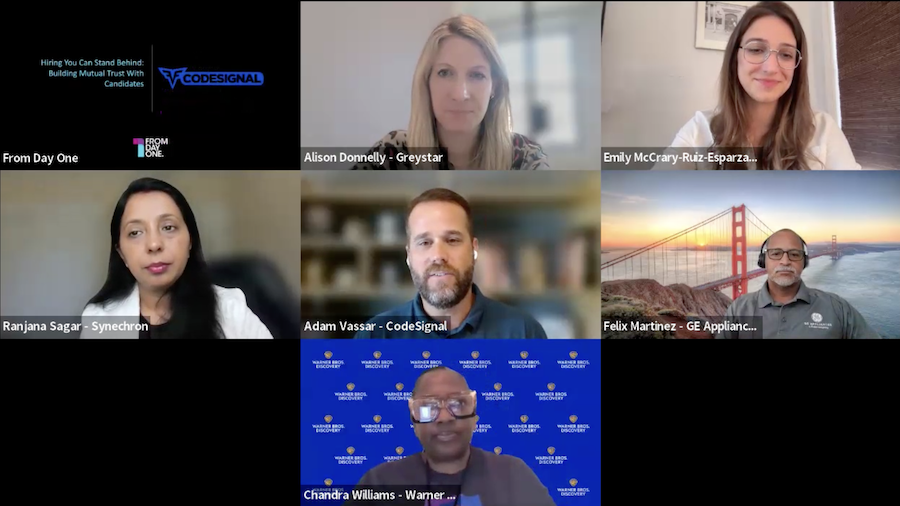
Chandra Williams, who leads tech recruiting at Warner Brothers Discovery, is using transparency to assuage concerns. While she discloses exactly how her team will be using AI, she doesn’t want candidates to feel it’s being used to their disadvantage. “We encourage no use of AI during the interview process unless it is specifically an evaluation or assessment of their AI skills,” she said. “Other than that, we don’t want them to assume it’s okay or not okay. We want to establish that upfront.”
Retaining the Human Touch
Yet as more and more of the hiring process is automated by AI, candidates still need human points of contact.
“One way we’re trying to make sure the candidates we do want are having a very positive experience is that we don’t have any auto-declines,” said Alison Donnelly, who leads talent acquisition at real estate firm Greystar. Except age minimums, nothing will automatically reject a candidate as soon as they submit an application. “That doesn’t feel good for a candidate. It makes it feel like nobody actually looked at their resume.”
“We’re trying to find ways for candidates to interact with us via our LinkedIn page or Indeed or other areas where they can get a sense of who the company is,” she said. For early career roles, Greystar hosts live coffee chats where candidates can ask questions about the company and hiring process. “It doesn’t require my small recruiting team to have one-on-one conversations with every single referral or every single candidate who applies,” Donnelly said, “but it makes candidates feel like they did have a human touch point with someone.”
Like her fellow panelists, Donnelly has found that the best response to widespread use of AI isn’t necessarily more tech—it’s better hiring fundamentals. “We are looking at where we can certainly lean into technology to help, but where we’re trying to make sure that the candidates we do want are having a very positive experience.”
Editor’s note: From Day One thanks our partner, CodeSignal, for sponsoring this webinar.
Emily McCrary-Ruiz-Esparza is an independent journalist and From Day One contributing editor who writes about business and the world of work. Her work has appeared in the Economist, the BBC, The Washington Post, Inc., and Business Insider, among others. She is the recipient of a Virginia Press Association award for business and financial journalism. She is the host of How to Be Anything, the podcast about people with unusual jobs.
(Photo by mixetto/iStock)