Using AI to Make HR Work More Effective and Human
BY Jessica Swenson
|
October 05, 2026

While AI can streamline processes and increase productivity, many HR leaders agree that the human aspect of the HR process remains invaluable.
At From Day One’s Austin conference, an executive panel explored how AI can support HR teams without replacing the human interactions at the heart of the function. Jeet Mukerji, co-founder and CEO of Kinfolk, says that when used well, AI can actually strengthen those interactions by handling routine questions and giving HR professionals more time to focus on people. “AI would make it better because it means you can focus on human work. When you can equip folks to find information and self-serve much quicker, when they come to you, you have a much richer and more helpful conversation,” said Mukerji.
Choosing the Right Tasks for AI
Repeatable, scalable tasks are a key area where AI can have noticeable impact, says William Soares, VP of global HR operations for Circana, especially since AI and automation complement each other. “It gives us time back, which I think every HR professional is always looking for,” said Soares. “We want to make sure that we’re able to do what we need to deliver, but we also want time for innovation.”
Mukerji agreed, citing a study that showed a greater HR benefit in automating transactional tasks than from generative AI use. “Anything that you can do more than once is something potentially quite ripe for AI agents,” he said. He proposes low-consequence, high-frequency activities as an AI entry point for organizations.
Advocating for a broader, yet customized approach, Emily Lewis-Pinnell, head of global workplace GenAI at Experian, suggests building general company-wide AI fluency while exploring a deliberate organization-level strategy. “To get the bigger, more transformational things, that becomes more of like a deep strategy where it’s going beyond what one person can do,” she said, “because it has to look at how the group works across the organization as a whole and how work is flowing through the team.”
Keeping Up With the Pace of Change
Jason Miller, head of people intelligence and AI at Natera, sees the delay of AI discovery as a bigger risk than moving quickly, in part because moving too slowly can cause organizational imposter syndrome.
Anywhere that work directly touches a human, says William Ferro, president, founder, and CEO for Betr Health, is a space worth slowing down and being intentional. “Once you say this is going to maybe affect the member journey and the coaching aspect of it. That’s when you have to pump the brakes and go a little bit slower.”
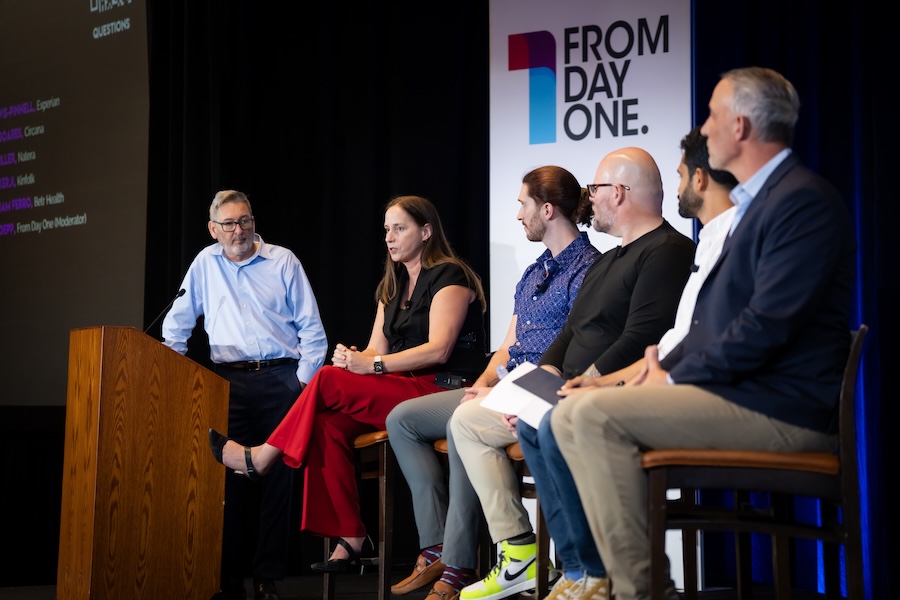
It’s important for leaders to exercise that intentionality as they determine appropriate uses for AI and lead teams into this new era. “You have to think about what good looks like within our organization and be really clear in communicating,” said Lewis-Pinnell. “We want to be fast and innovative, but still be trusted and responsible, and build everything around that.”
Choosing the Right AI Tools and Use Cases
However, not every task has a valid use case for AI; organizations must look at AI integration from a process lens rather than just a technical workflow lens. Miller shared a story about AI exploration at Natera, where 22 meetings surfaced 90 potential use cases. Upon further analysis, only a small fraction of those needed AI intervention. “Not every answer should be or has to be AI,” he said.
Protecting sensitive data is also imperative across all organizations. Mukerji recommends a multi-faceted checklist that identifies which tools and models are being used, their access level, what information may/may not be put into generative AI tools, and whether data leaves the environment. He also advocates for audit logs that show whether changes were made by agentic AI or a human user. “That kind of auditability and governance and structure is going to be really important.”
Lewis-Pinnell asserts that many of today’s leading AI tools are roughly comparable, and encourages leaders to focus more on which model of their chosen tool to use, based on use case, user value creation, and cost.
“Teams are able to decide whether this is someone who is really cranking the usage and driving a ton of value, and we want a really big limit for them, versus the average business user. It’s probably reasonable for them to stay within a certain range, and then you have to spend the time thinking through how you manage what those costs are.”
Soares suggests looking at your existing systems and services for examples to find bolt-on AI tools to test. “There are some AI capabilities that you can leverage in those systems and tools. So, what’s already part of your portfolio that you might be able to expand some value, and it might facilitate some of the work that is a bit painful in today’s world.”
Getting Workers Comfortable With AI
To boost adoption, Lewis-Pinnell believes AI needs to be tied to tangible use cases that make sense to employees, rather than just open-ended experimentation.
Mukerji recommends the use of internal AI champions and hackathons to encourage teams to explore use cases and enable quick a-ha moments that will promote further engagement. Miller agreed, saying that even just a 5% increase in speed can help adoption click into place.
Soares advocates using cross-functional collaboration to create shared scenarios and map real pain points, helping teams collectively identify an AI structure that can support entire processes. “It builds the quick wins, but it also kind of gives that controlled environment of ‘we're going to focus on this’ versus it being too open-ended. That’s where some people just get a little bit stuck.”
Regardless of what AI can do, there will always be human elements that it cannot replicate. “You can have an AI build a manual, but unless somebody cares if that person shows up or not, it’s never going to get there,” said Ferro. “I think that that’s what’s great about AI—it allows you to spend more time being human and more time building community.”
Jessica Swenson is a freelance writer and proofreader based in the Midwest. Learn more about her at jmswensonllc.com.
(Photos by Josh Larson for From Day One)