The AI-Enabled Workforce: Redefining How People and Technology Work Together
BY Jessica Swenson
|
October 08, 2026

There’s no doubt that some elements of business will always need a human touch, regardless of how efficient AI can make us. “In a world where all the popular media is saying, ‘What are we going to automate? What are we going to streamline? What are we going to change?’ I have really had a lot of success flipping that question and saying, what needs to remain radically human and why?” said Christopher Rosett, head of global workforce design at Vanguard.
He encourages companies to reflect on their competitive advantage and their risk tolerance when considering how to integrate AI into their operations. The delicate balance between human and machine was the topic of a panel moderated by Philadelphia Inquirer reporter Ximena Conde at From Day One’s Philadelphia conference.
By embracing a strategy of elevating human potential at the “intersection of human capital and digital capital,” Jonelle Coletta Parker, SVP of the HR, research, development, & commercialization people organization at Bristol Myers Squibb (BMS), said her organization is seeing faster, higher-quality outcomes, including improved patient outcomes.
Parker shared that BMS has “recently launched the equivalent of an augmented GPT, which means that some of the members of that team are in fact digitized.” This method has magnified the teams’ workforce intelligence, she says, “because instead of having one person who represents the medical or the clinical development team, you have this agent who's able to pull from many, many places.”
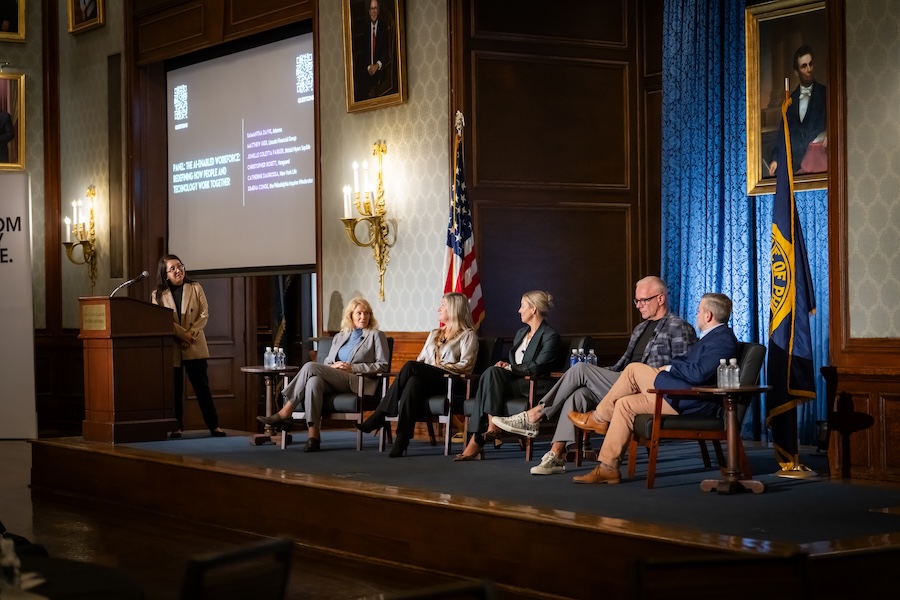
Panelists widely agreed that AI is appropriate for repetitive, continuous work that doesn’t require human nuance and judgment. Catherine DaGrossa, corporate VP of HR for New York Life sees value in using AI to identify, synthesize, and analyze data patterns and create simulations. But since her company is accountable to policy owners over the long term, it is careful about where it fits AI into its processes.
“We have to really think about where we’re willing to put a machine in between us and our customers,” she said, “and the moments that matter most to families, we’re not willing.” That’s why humans are still connected at touchpoints that can create or lose trust, like claim decisions and performance reviews.
That said, New York Life’s most-used AI agent, with 7,000 employee and 9,000 leader hits, was built for performance review season; it helps both employees and leaders prepare for review conversations.
Getting data into the hands of customer-facing operations, increased expertise in actuarial and underwriting, and improved sales data are some key areas Matt Geis, SVP of HR at Lincoln Financial Group cited as ripe for AI integration.
“I think about product manufacturing and being able to more quickly do pricing analysis or product redesign so that we can be faster or nimbler in the marketplace,” said Geis. “Being able to make your sales force that much better with where they're going, and what data they're bringing once they get there—it's invaluable.”
Acknowledging employee fears and the potentially divisive nature of AI, empathy and effective change management emerged as common themes among panelists.
Samantha Davis, CIO, Americas, at Arkema, reflected on a Microsoft CoWork pilot that shortened a monthly FP&A report timeline from 5–7 days to 30–45 seconds. This caused fear among the team historically responsible for this report.
“That’s a really real fear. It’s something they’re feeling. It’s not right or wrong, and it’s real for them at that moment.” Davis said. “So I think when we show things like that, preparing for who the audience is and the possible outcomes of sharing that, so you can anticipate from a point of possible empathy or information, is really important.”
DaGrossa described the challenge as a “change management problem disguised in a technology costume.” She suggests easing up on ambition and speed to ensure adequate training and authentic engagement.
Geis emphasizes that AI use is a journey, comparing it to the advent of electricity and the internet and asserting that humans are resilient and adaptable. “Once you start using the tool and realizing what it can do and how it can make your job easier,” he said, “When employees start to see that, that gives time for people to develop, to learn, and to see how it can make their jobs better.”
As workflows change and AI becomes more ubiquitous, roles and performance evaluation will also shift. Parker says that real-time data is helping provide more clarity on what people are actually measured against. As the volume of curricula production has increased for BMS’s commercial learning group, the team was initially fearful that an AI agent would create all content and eliminate their roles. But it turned out that their human ability to distill science-dense content into user-friendly learning materials is invaluable.
As organizations and employees adjust to these new ways of working, Rosett encourages people to remember that many of the tasks teams are used to doing still need to be done—the focus on how to do them is just changing. “If you’re feeling a little bit intimidated by all this tech stuff, and the terms,” he said, “know that a lot of the really core foundational strategic work that HR has been good at for a really long time is critical to how AI is going to get enabled in your organization. That’s a really important place where we’re focusing energy in upskilling how HR can show up and help.”
Jessica Swenson is a freelance writer and proofreader based in the Midwest. Learn more about her at jmswensonllc.com.
(Photos by Josh Larson for From Day One)