Translating Global Strategy Into Local Impact
BY Emily McCrary-Ruiz-Esparza
|
June 03, 2026

There’s too much lag between strategy and execution of global campaigns, says Kelly Heilpern, chief strategy officer at Ammunition. Organizations can spend months, or even a year, developing a global strategy based on timely data that’s stale by the time campaigns roll out.
“The brands getting it right,” she said, “are the ones who have figured out how to make those decisions faster, without sacrificing strategic integrity,” and that requires collaboration and trust: among marketing, sales, and the agency partner.
The challenge is that truly global campaigns require some degree of tailoring to local markets, and effective localization cannot be handed down from on high. Quick decisions have to be made, with local input.
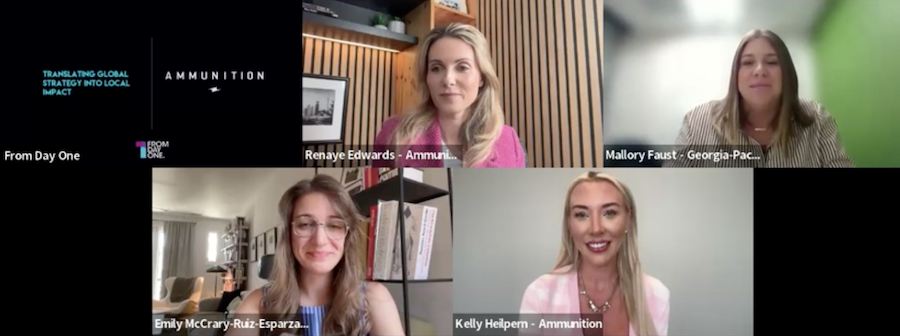
During a From Day One webinar on translating global strategy into local impact, Heilpern and her colleagues discussed how they designed and tested a campaign for one of the world’s largest building products manufacturers across five new markets with unique concerns.
Bringing DensDeck to Europe
Georgia Pacific was ready to bring a stalwart product to a new market.
DensDeck, a roofboard that acts as a fire-resistant thermal barrier, is common across North America—it’s in everything from “airports to stadiums, hotels, and high rises,” said Mallory Faust, the director of brand strategy for Georgia-Pacific Building Products—but it’s relatively new in Europe.
Expansion of solar rooftops and data center construction has developers focused on resilience in building design, “putting more pressure on roofing systems to perform better and be more durable,” and opening a huge market opportunity for Georgia Pacific, she says. They chose five geographies: the Netherlands, Germany, Belgium, the UK, and Spain.
The challenge for Faust is not just introducing a new product within an existing category, “we’re trying to establish the category,” which meant they had to start with education. “We realized pretty quickly that we couldn’t take a North American approach and just drop it into Europe.”
Barriers to adoption vary widely by market: Some buyers need technical proof of performance while others are more price sensitive or prefer a reference from someone they trust. So Georgia Pacific and the Ammunition team brought in local stakeholders “from the outset, so they feel like they have ownership and autonomy,” said Renaye Edwards, Ammunition’s global COO and managing director.
They gathered a coalition across product, technical, and regional teams for a weeklong intensive planning session. “A lot of different perspectives went into identifying where the opportunities existed, as well as what the barriers to adoption would be within each market,” Faust said.
Right away, the collaboration paid off. The first strategy for the UK market was a “Mind the Gap” campaign—the idea being that DensDeck could close the quality “gap” in roofing systems. But in sales conversations, the tagline was being interpreted as not falling through physical gaps during installation. “Testing is such an important part of the process,” Heilpern said. “That would have been a huge miss for us to deploy this campaign that didn’t connect the way we intended it to.”
Pitfalls of Localization, and How to Avoid Them
But how local is too local? After all, time is of the essence. “The overall positioning really shouldn’t change what DensDeck is: a solution that helps protect the contents inside of a building and extend the life of a roof,” said Faust. “But global consistency doesn’t mean that every market should operate the exact same way.”
Some tweaks are simple: Images also have to be localized since roofs in Spain look very different than roofs in the Netherlands. Others require a little more research, like which small proof points to play up—mitigating fire risk might perform better in one area while longevity will perform better in another.
Localization also costs money, which isn’t always abundant. If the budget is slim, don’t roll it out in every market at once, Edwards said, but “identify those markets where you have the right to win” and you’re past the education stage with your market. “Once you’ve done that,” she added, “you can test and learn very quickly,” proving your strategy before going back to the business for more funds.
Winning requires differentiation, which is often made through an emotional appeal. Easier said than done for roofboard, but by no means impossible, said Heilpern. “[Builders] are accountable for the performance of their roof. We can speak to them as consumers who are making very important decisions and make them feel seen, make them feel heard, and make them feel like there’s a product that solves a problem that keeps them up at night.”
Editor’s note: From Day One thanks our partner, Ammunition, for sponsoring this thought leadership spotlight.
Emily McCrary-Ruiz-Esparza is an independent journalist and From Day One contributing editor who writes about business and the world of work. Her work has appeared in the Economist, the BBC, The Washington Post, Inc., and Business Insider, among others. She is the recipient of a Virginia Press Association award for business and financial journalism. She is the host of How to Be Anything, the podcast about people with unusual jobs.
(Photo by Cecilie_Arcurs/iStock)