Reducing Change Fatigue and Building More Adaptable Teams
BY Carrie Snider
|
July 15, 2026

If the past few years have made anything clear, it’s that change is now a constant in business. That reality has left employees at every level grappling with change fatigue. How can leaders help their people adapt while reducing the toll of continual transformation?
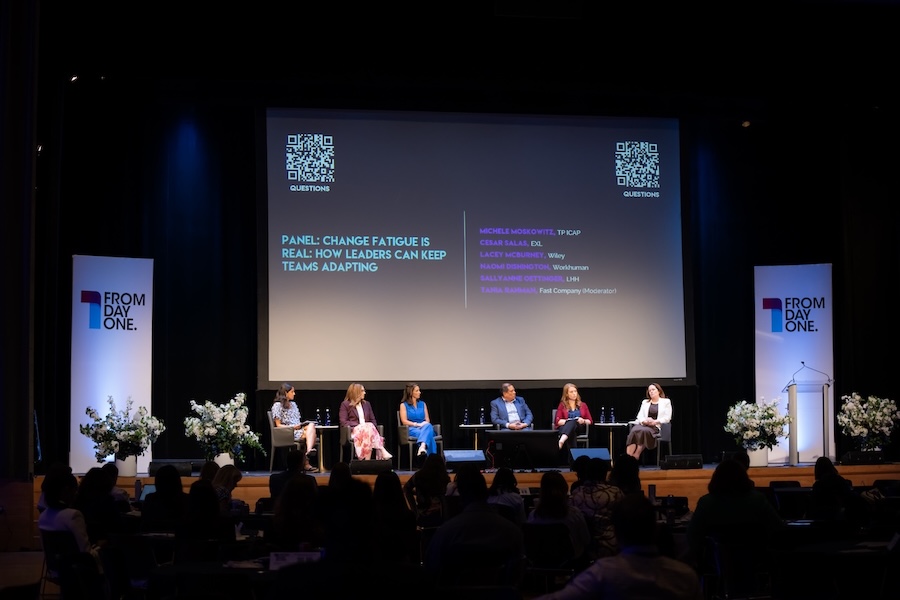
At From Day One’s Manhattan conference, leaders participated in a panel addressing practical approaches for leaders. Moderated by Tania Rahman, social media director at Fast Company, they discussed how organizations can move beyond reactive change management and instead build systems that help employees sustain performance through continuous disruption.
Across the conversation, a clear theme emerged: change fatigue is not simply about the pace of transformation, but about how leaders communicate, support, and structure it.
Reframing Fatigue With Better Communication
When most people think of change fatigue, they think of the volume of change. But it could be more about how that change is communicated. Michele Moskowitz, group head of talent at TP ICAP, emphasized that leaders have more control here than they might think.
“Change fatigue comes when change becomes tiresome,” she said, but added an important distinction: “people are never really fatigued by positive change, by things that are exciting and inspirational.” The difference lies in how the change is framed and reinforced.
At TP ICAP, leaders focus on consistently answering a core question for employees: what’s in it for me? By clearly communicating why a change matters, whether it’s a merger, a new system, or a strategic shift, and repeating that message across channels, organizations can shift change from something imposed to something employees can connect with and even anticipate.
Equally critical is moving beyond one-way communication. Moskowitz described a common failure point that leaders are relying on top-down messaging and expecting alignment to follow. “We have a leader who stands up at a town hall or sends out a big email and kind of expects the world to just follow their lead,” she said. Instead, organizations must invest in dialogue, not just announcements.
That’s where managers play a pivotal role. Moskowitz calls them “meaning makers,” the ones responsible for translating strategy into reality and feeding employee sentiment back up to leadership. Supporting them with the right tools, training, and space to listen is essential to reducing fatigue. Without that middle layer functioning effectively, even well-designed strategies struggle to land.
Acknowledging the Toll, Recognizing the Effort
One of the most overlooked aspects of change fatigue is its psychological weight. Naomi Dishington, director of consulting at Workhuman, pointed out that employees today are living inside a constant loop of change.
“It feels like at least weekly, if not daily, we’re all embarking on that change again every day,” she said, leaving little time to process or recover. The result is a workforce that rarely gets the chance to fully move through the natural emotional cycle of adaptation.
For leaders, the first step is acknowledging it, then they can move to fix it. That simple act of recognition can reduce stress and build trust, signaling to employees that their experience is valid and understood. From there, leaders can make change more manageable by breaking it into smaller, shared steps rather than presenting transformation as a single overwhelming goal, she says.
Equally important is how organizations define recognition itself. In a constantly shifting environment, waiting to celebrate only outcomes is no longer sufficient. Dishington emphasized the importance of rewarding effort, not just success: “Recognize the process, recognize you raised your hand to volunteer, recognize you took a risk and you failed.”
These moments reinforce the behaviors organizations need most right now, including adaptability, initiative, and resilience. Recognition becomes not just a reward system, but a cultural signal about what matters in times of uncertainty.
Adaptability Is Essential
Pointing to the growing importance of what’s often called the adaptability quotient, or AQ, panelist Cesar Salas, VP and head of HR operations, Americas at EXL, says roles are shifting faster than ever.
“What I am doing now in my position is totally different from what I was doing two years ago, or one year ago, or even six months ago,” he said. That pace forces employees and leaders to accept a hard truth: what got you here won’t necessarily move you forward.
At EXL, Salas is focused on turning adaptability into practice rather than theory. He asked his direct reports to identify “five mini projects” where AI could be applied to improve productivity. The key was not immediate execution, but identification and prioritization.
By surfacing opportunities first, then selecting the ones with the highest impact, teams create momentum without overwhelming themselves. This approach builds what Salas describes as a “virtuous circle,” or small wins that reinforce learning, confidence, and continued experimentation.
Adaptability, he says, is no longer optional. It is becoming a baseline requirement for both employees and leaders. Organizations that fail to build this muscle risk falling behind not because of technology itself, but because of how slowly people are able to adjust to it.
Transparency Builds Trust
In times of constant change, employees are looking for more than transparency about what decisions have been made. They also want to understand why those decisions were made, what factors were considered, and the broader business dynamics that shaped them. Lacey McBurney, head of talent and culture at Wiley, emphasized that traditional communication often falls short because it focuses too heavily on outcomes rather than process. “Yes, you have to communicate what the change is, yes, you have to communicate why that change is important,” she said. “But we’ve been really focused on how the decision got made.”
That distinction is critical. When employees understand the reasoning, constraints, and trade-offs behind decisions, they are far more likely to trust them—even when the news is difficult. Without that transparency, gaps are filled with speculation and skepticism.
As McBurney noted, without context, employees often respond with questions like: “Why didn’t they consider this?” or “Why are they doing these things at the same time?”
Wiley has also invested in continuous listening mechanisms, moving away from one-off feedback cycles. Instead of treating communication as an event-driven activity, the organization has embedded ongoing dialogue through leadership forums and smaller group discussions. This helps trust become part of the system, not just part of major announcements.
Create Space for Change
One of the hardest truths for leaders to accept is that you cannot continuously add work without also taking something away. In today’s environment of nonstop transformation, creating space is essential.
“You can’t have a conversation around this sort of change climate today without talking about where we can create slack in the system,” said Sallyanne Oettinger, senior director at LHH. Without that slack, even the best-designed initiatives risk overwhelming employees.
The challenge is that prioritization sounds simple but rarely is. Teams often begin with the intention of streamlining work, only to find that “everything ends up in the urgent and important quadrant, no matter how hard we try.” Real prioritization requires difficult trade-offs, including saying no to initiatives that people value.
That difficulty is amplified by the reality that change is no longer linear. “It’s simply not that anymore,” Oettinger said, describing organizations as “trying to swim to seven beaches at once.” In that environment, constant addition without relief accelerates fatigue.
One solution is increasing employee agency over how those changes are implemented. That involvement reduces disengagement and helps people feel less like passive recipients of disruption. Ultimately, creating space is about resourcing people properly. “Employees need a little bit more slack, so that not everything is a burning priority,” she said. Without that breathing room, even strong strategies fail to land.
In a business landscape where change is no longer episodic but constant, the leaders who succeed will not be the ones who understand and design for change fatigue and actively work to reduce its weight. Change fatigue isn’t going away. But it can be managed. And how organizations choose to manage it will define not just how well they adapt—but how well their people endure what comes next.
Carrie Snider is a Phoenix-based journalist and marketing copywriter.
(Photos by Josh Larson for From Day One)