The Ripple Effect: How Better Manager Hiring Lifts Your Entire Organization
BY Ade Akin
|
August 11, 2026

While many restaurant industry competitors dropped pre-employment screenings during Covid to speed up hiring amid labor shortages, The Cheesecake Factory took a different approach.
“That was a conversation in the hallway,” Wendy Wimmer-Gerrard, the director of talent selection and engagement at The Cheesecake Factory, said. “Our C-suite was very supportive of my mandate. It was a cost for us in a time when everyone was really looking at the pennies. But it was a cost that was well worth it.”
That decision, made during one of the most chaotic periods in modern business history, has since yielded substantial results. The company now boasts industry-leading retention rates for both managers and hourly staff, and The Cheesecake Factory remains the only full-service restaurant company to appear on Fortune’s Best Places to Work list for 13 consecutive years.
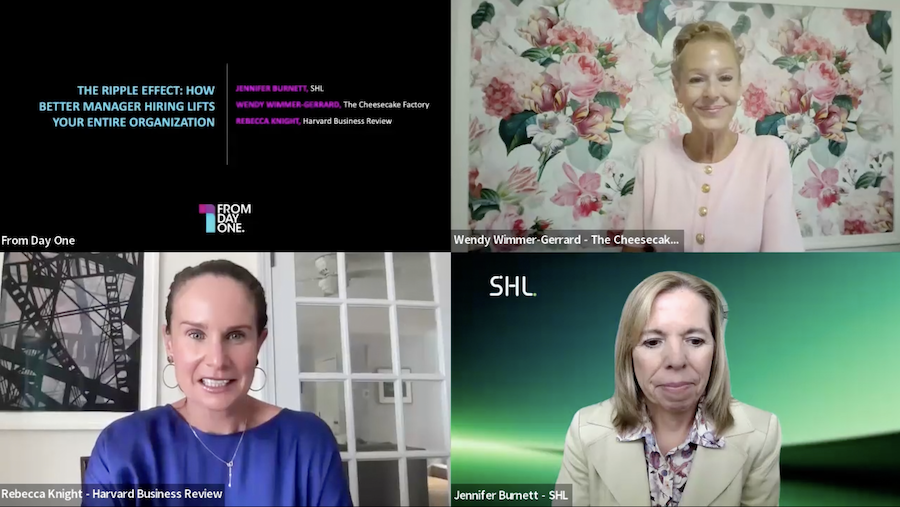
Wimmer-Gerrard and Jennifer Burnett, principal solution architect at SHL, spoke during a From Day One’s webinar titled “The Ripple Effect: How Better Manager Hiring Lifts Your Entire Organization,” to share exactly how The Cheesecake Factory rethought its approach to hiring managers amid major market shifts. The conversation was moderated by Rebecca Knight, a contributing columnist at Harvard Business Review.
The Staggering Cost of Getting It Wrong
The stakes have never been higher regarding manager hiring. According to Gallup research, organizations still choose the wrong candidates for management roles 82% of the time. Burnett notes that the statistic highlights a persistent challenge facing companies that has intensified in recent years.
“Talent shortages really haven’t gone away because we have had a pervasive skill gap for many years, and that really accelerated during what we often refer to now as the pandemic years,” Burnett said. “If you ask HR leaders today, they’re still expecting that hiring for those key roles will get harder, not easier.”
Burnett adds that AI and automation are also changing what many of these jobs look like today. “We may be thinking about hiring for a role that we have well defined today, but that can change very rapidly. So we really are looking for people who can adapt, who can learn, who can embrace change.”
The effects of hiring an unsuitable manager creates ripple effects that extend far beyond the individual. “There’s the immediate effect on the team that they’re leading,” Burnett said. But there is the ripple effect to the team as well. It comes at a cost from an engagement perspective. It comes at a cost from a financial perspective as well.”
Wimmer-Gerrard sees this ripple effect firsthand. The Cheesecake Factory’s restaurants can have as many as 250 staff members in the building at any given time. “That person has to be aligned with culture. They have to be aligned with the mission of the business, and then they need to be able to scale and learn,” she added. “When we are not aligned in that way, we immediately see the impact on our bottom line.”
Gut Feel Isn’t Enough
Hiring managers have relied on unstructured interviews and instinct for decades, but Burnett says that approach is fundamentally flawed.
“We’re human, so we’re often influenced by whether someone interviews well,” she said. “But what we really want to be doing is predicting whether they’ll perform well on the job. Not how they perform in the interview, but how they’ll perform on the job.”
Today’s candidates are more sophisticated than job seekers were a decade ago, and many use AI tools to craft their resumes and prepare for interviews, making it harder to assess their abilities based on traditional screening methods alone.
“It gives more justification to go a little bit further in the rest of the process, so that you can get under that AI level that the candidates are using,” Burnett said. The solution is a structured, data-driven approach that combines qualitative and quantitative assessments, she says.
SHL’s hiring tools evaluate candidates on multiple criteria such as personality, motivation, cognitive ability, and situational judgment to provide a clearer picture of whether any given candidate will succeed in a leadership role.
“The assessment process has evolved significantly,” Burnett elaborated. “It’s not a single test anymore, it’s sort of a list of questions that people might be able to share with their friend or share online. It really is asking them to genuinely demonstrate what those skills and behaviors would be in the type of scenario that they’d be in the organization.”
Building a Pipeline That Works
Today, The Cheesecake Factory’s hiring process starts with a proprietary assessment, built in partnership with SHL, that every management candidate completes. The assessment provides insight into a person’s motivation for work, their behaviors, and their ability to learn and grow.
“It is a knockout for us,” Wimmer-Gerrard said. “We do it with every single applicant, and we know with that profile the range of who can be successful.”
The company maintains a roughly 40/60 external-to-internal hiring split, but that ratio bends depending on market conditions. Some regions skew higher on internal promotions, up to 60%, while others rely more on external talent.
That internal pipeline has produced remarkable success stories. Jay Henson, SVP at The Cheesecake Factory, started as a kitchen manager and worked his way up the ladder, says Wimmer-Gerrard. “It really doesn’t get any better than talking about that,” she said. “I have many area directors in the country who started out as busboys, servers, and hosts who are now managing millions and millions of dollars on the bottom line.”
Promoting from within isn’t always straightforward. “We had to define where our gaps were with our internals and be very honest with ourselves about that,” Wimmer-Gerrard said. “It gave us the opportunity to take a look at our training systems and say, what do we need to develop or what do we need to strengthen in order to close those gaps?”
The data from these assessments, she says, provides the clarity needed to make such decisions. “We then make a U-turn and say, you know what, we have other opportunities for you that we think are more aligned with what motivates you, what naturally excites you, and what you’re interested in learning.”
The Retention Payoff
The results speak for themselves. The Cheesecake Factory has been recognized with best practices awards from Black Box Intelligence for consecutive years. Its retention rates for both managers and hourly staff are near historical highs.
“We execute our menu and our service better than anyone in our industry, and we’re proud of that,” Wimmer-Gerrard said. “But we also execute our culture. The reason why we’re able to do that is because we have aligned people against those behaviors and that data that tells us that they’re going to stay engaged and they’re going to want to stay with us.”
Burnett notes that the benefits of hiring the right managers extend beyond retention. Managers hired using these methods are two to three times more likely to be high performers and 65% more likely to receive strong ratings for their coaching abilities. “Demonstrating it, not just having a good feeling about ‘we think this is working,’ but showing that it’s working is really key,” Burnett said.
A Blueprint for Any Organization
Both speakers provided actionable guidance for businesses facing difficulties recruiting managers. Burnett recommends starting with a core inquiry: Does your company have a clear definition of what constitutes an exceptional manager?
“If your organization hasn’t really defined what a great manager is, what a great leader is, and has alignment on that, that’s a perfect place to start,” she said. “When you have that alignment, then you’re clear on how it comes into play in the hiring process, in the development process, and in that internal mobility and promotion process.”
Wimmer-Gerrard emphasizes the importance of looking inward. “Internal pipelines are great places to take a look and say, where are we missing people that could really be the next leaders?” she said. “Why is it that that person who’s in that individual contributor role does not feel like they can raise their hand and move into the next role with us?”
She says the answer often comes down to either a leadership issue, someone above the employee not investing in their development, or a lack of internal tools to close skill gaps.
The takeaway is clear: relying on instinctual hiring is costly in an age of AI-generated resumes, surging application volumes, and persistent talent shortages. Organizations that dedicate themselves to structured hiring, utilize talent analytics, and cultivate their internal pipeline will experience the ripple effect of enhanced manager hiring elevating the entire company.
Editor’s note: From Day One thanks our partner, SHL, for sponsoring this thought leadership spotlight.
Ade Akin covers artificial intelligence, workplace wellness, HR trends, and digital health solutions.
(Photo by LPETTET/iStock)