Navigating Change and Uncertainty Through the Lens of Organizational DNA
BY Christopher O'Keeffe
|
October 10, 2025

Change has become one of the defining challenges for today’s organizations. From succession planning to mergers to periods of rapid growth, today’s leaders are under pressure to steer strategy while supporting their people in environments that never stop shifting. For Miles Overholt, founder and CEO of Strategia Analytics, the starting point for tackling this complexity came decades ago, during his unusual dual career as both therapist and organizational development consultant.
During a From Day One webinar, Overholt recalled early moments when the workplace itself seemed to be the root of employee distress. He described working with a couple employed in a copper plating factory whose rotating shifts and exposure to toxic substances had taken a toll on their mental health. What struck him most was that the problem wasn’t inside the people, but in the environment around them. “The problem was the work environment,” he said. “How do you get the best out of your people? How do you connect with your people? How do you make it a healthy work environment?”
Dr. David Lopez, SVP of systems research at Strategia Analytics, placed these insights into a broader intellectual lineage. He pointed to the work of psychologist Kurt Lewin, whose framework emphasized the interplay between individuals and their environments. “Kurt Lewin had a very simple idea. He just said, behavior is a function of the person and the environment,” Lopez said during the webinar. “There are things within individuals and there are things outside of individuals, and those two things interact to shape what you do.”
For Lopez, Strategia’s approach has been distinctive because it takes this complexity seriously, rather than reducing behavior to individual traits.
Making Complexity Simple
Managing complexity, Overholt said, is at the heart of organizational change. Leaders face constant variation across teams, departments, and even within the same workweek.
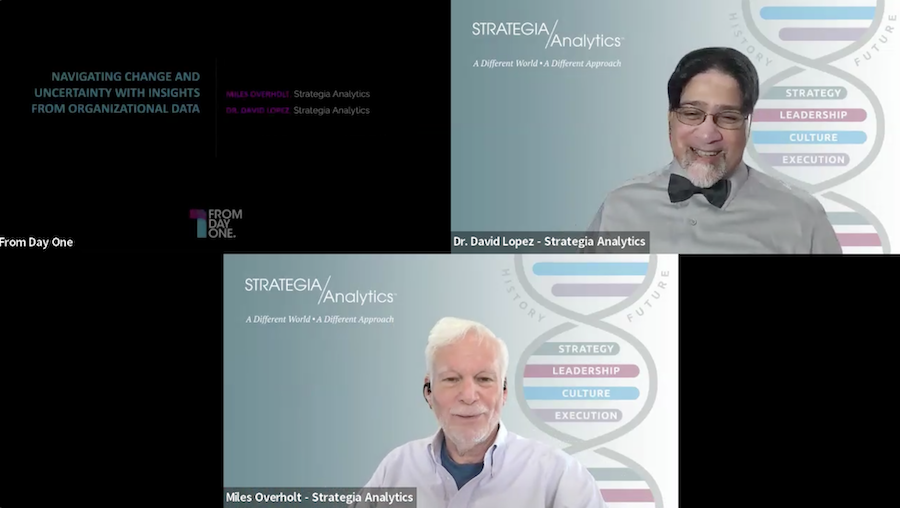
“People are very complex, and you put them together in organizations, and that’s incredibly complex,” he said. “What organizational change is, is trying to figure out the complexity and make it simple.”
Even with the rise of artificial intelligence, he added, the human element remains the most important and most variable factor in organizational life. “People do the work,” Overholt said.
Mapping Organizational DNA
To make sense of that complexity, Strategia Analytics developed its concept of organizational DNA, a framework that measures four strands: strategy, leadership, culture, and execution—and how well they align. Unlike traditional engagement surveys, the model avoids labeling environments as good or bad, instead focusing on fit.
“To be blunt, I think we measure differently,” Overholt said. “Measuring DNA allows us to put it into different buckets and see the different influences that parts of your DNA have, just like an individual, different genes drive different behavior.”
Lopez emphasized that the same environment could be productive for one group and counterproductive for another. “Work environments are not, by definition, either good, bad, or indifferent,” he said. “What we look at is whether the skills, knowledge, behavior, mindsets of the employees match the particular environment they happen to be in.”
Overholt described how Strategia’s tools convert data into clear roadmaps that help organizations understand where people are and how to guide them. “We think we can make it simple,” he said. “We create road maps of how you operate.”
A Case Study in Transition
Overholt pointed to a three-year project with a mid-sized manufacturing company undergoing leadership succession. Employees were anxious, recalling a poorly handled transition 15 years earlier. Strategia’s initial measurements revealed a divided executive team and unclear values.
When the incoming CEO stepped in, she prioritized communication, hosting town hall meetings across the company in multiple languages to connect directly with employees. “Town hall meetings were one of her specialties. She implemented and took it and just took it away,” Overholt said. By the third year, he says, the company’s measurement of how well its strategy and execution were linked “soared.”
The lesson was that there is no single lever for change. Leaders must work with the tools and strengths they have, whether it’s formal performance management systems or face-to-face communication, says Overholt.
HR at the Center of Change
Much of this work depends on HR, which both speakers say plays a pivotal, if varied, role. Overholt emphasized the importance of HR leaders who truly know their companies.
Strategia’s data consistently show HR as one of the top drivers of change. “With every company we have, the relationship between employees and HR is always there at the center of whatever mischief is going on,” said Lopez.
So how can and should HR respond to employees facing existential uncertainty about their jobs? Overholt’s guidance was to resist offering false assurances. “The first thing HR can do is not try to pretend it knows,” he said. “And if you really want to connect with the people, you say, and that’s where we are, too. We’re all in this together. How can we make this better?”
Lopez echoed the importance of honesty. “Focus on acknowledging the emotional impact on the employee,” he said. “Don’t try to explain it away.”
Editor’s note: From Day One thanks our partner, Strategia Analytics, for sponsoring this webinar.
Chris O’Keeffe is a freelance writer with experience across industries. As the founder and creative director of OK Creative: The Language Agency, he has led strategy and storytelling for organizations like MIT, Amazon, and Cirque du Soleil, bringing their stories to life through established and emerging media.


