The Global Playbook for AI-Powered Work: How Pacesetters Win Across Borders
BY Christopher O'Keeffe
|
November 11, 2025

In today’s global economy, the lines between local teams and international strategy have blurred. Yet many companies still struggle to unify their people, systems, and insights across borders. That’s where the next generation of “pacesetter” organizations are pulling ahead—by using AI not just to automate work, but to integrate it.
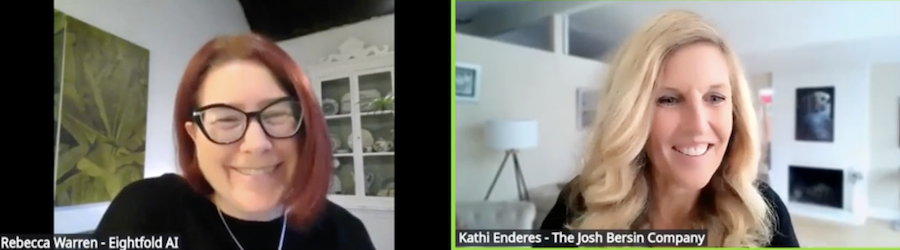
At From Day One’s October virtual conference, Rebecca Warren, director of talent-centered transformation at Eightfold AI spoke with Kathi Enderes, SVP and global industry analyst at the Josh Bersin Company, sharing insights on how leaders are redefining the architecture of global work. Drawing on Bersin’s multi-year Global Workforce Intelligence Project, Enderes and Warren unpacked how companies can align global strategy with local execution, build “superworker” teams, and use AI as a connective force in a fragmented world.
Understanding the Global Workforce Intelligence Project
“The big idea behind this was, let’s look at industry by industry,” Enderes said. “What skills globally does this industry have? What skills are rising, what skills are declining, what roles are emerging, what roles are declining, and what organizational solutions are actually prevalent in this industry to solve the biggest business problems?” Enderes posed.
The project, developed in collaboration with Eightfold, draws insights from a massive dataset, around 1.5 billion worker profiles, says Warren. From healthcare to financial services, the research revealed a unifying principle among top-performing global companies, what Enderes calls skills velocity. “It means always staying on top of changing skills requirements and then recruiting, retaining, developing these critical skills with speed and at scale,” she said. “The talent pool has become increasingly global. A lot of times you actually can’t find talent in your country, in your location. You have to think about a global perspective as well.”
The findings point to a fundamental shift: the best companies are not just digitizing; they are continuously re-skilling—using AI to anticipate change before it hits.
Global Strategy, Local Execution
While AI can unify a global strategy, Enderes says that its success depends on cultural nuance and regional adaptation. “I think it’s critically important actually to have a global strategy and to have local implementation,” she said. “Design and strategy globally, and execution and implementation locally.”
She pointed to the need for what she called a “glocal” mindset, “balancing the global perspective, the global mindset, the global approach, with, of course, how you execute needs to be local.”
That duality is especially vital in an era of regulation and complexity. “You need to be aligned with the laws and with the regulations of your country,” Enderes said, “but with the mindset of all marching into the same direction, all using AI, for example, for what purpose, for what end, how we want to use it.”
For multinational organizations, this balance between centralized strategy and local flexibility defines not only compliance—but agility.
Building Talent Density and “Superworker” Teams
Central to Bersin’s framework is the concept of talent density, a principle borrowed from Netflix’s “keeper test” approach. “They see their company not as a family, but as sports teams, like high-performing Olympic teams,” said Enderes. Every employee, she says, is evaluated on their ability to elevate the team’s collective performance.
But individual skill is only part of the equation. “You can’t just hire high performers,” Warren added. “You’ve got amazing people, and they’re running this way, and somebody else is running that way, but if they’re not complementary, if they don’t work together, that’s a challenge of trying to get the team right.”
AI-powered talent intelligence provides the visibility leaders need to identify complementary skills and “move people around to create that high performance,” said Enderes. Employees often have adjacent or underused skills, hidden strengths that can expand their impact across teams and regions. “Every single one of us has these meandering career paths,” she said. “That’s why talent intelligence is so important.”
Rewiring the Organization With AI
When implemented well, AI becomes the infrastructure that unites global strategy, local execution, and people insight. “The biggest advantage, of course, is you can actually solve the business problems,” Enderes said. “Because when you have AI around it, you’ll get better insights, more connected insights—insights that connect actually the business strategy with your HR strategy and your people strategy.”
“AI is an accelerator to bring together globally and across functions,” she added. “Not just HR functions, but business functions, the entire organization.”
As Warren concluded, the pacesetter companies showcased in the research all share one common trait: agility. “It’s that ability to solve bigger problems, with bigger brains, bigger superworkers, bigger teams,” she said. “AI makes the world even smaller and more manageable, because now it’s easier than ever to get insights from the entire organization and the entire world.”
The new global playbook isn’t just about technology—it’s about orchestration. As Enderes put it, “AI makes the world even smaller and more manageable.” But behind the algorithms, the core challenge remains deeply human: how to design systems that amplify talent rather than fragment it.
In the “superworker” era, the most successful organizations will be those that think globally, act locally, and use AI not as a replacement for people, but as the connective tissue that helps them thrive together, across time zones, cultures, and borders.
Editor’s note: From Day One thanks our partner, Eightfold AI, for sponsoring this thought leadership spotlight.
Chris O’Keeffe is a freelance writer with experience across industries. As the founder and creative director of OK Creative: The Language Agency, he has led strategy and storytelling for organizations like MIT, Amazon, and Cirque du Soleil, bringing their stories to life through established and emerging media.
(Photo by skynesher/iStock)


