Building and Recruiting Leadership for an AI-Ready Future
BY Emily McCrary-Ruiz-Esparza
|
November 02, 2026

The job of a leader is getting harder, and companies aren’t doing enough to prepare them, said Miguel Oliveira, head of culture and leadership at CPG company Danone, during a From Day One webinar on building leadership for an AI-ready future.
“I remember the days when you would have a wave of change, and then things would calm down,” Oliveira said. “What you have right now is a wave over a wave over a wave, and the pace, the intensity is very hard, and there is no time for recovery.” Companies, he says, often forget that leaders are employees too.
Leaders are expected to help employees embrace AI while still figuring out the implications for their own work. And as companies begin redesigning jobs—and entire teams—around AI, durable leadership skills may matter more than technical expertise.
Leading by Example in AI Adoption
One of the biggest challenges facing leaders is addressing employees’ anxiety around artificial intelligence, particularly its long-term implications for their job security.
Robert Foster, who leads workforce strategy and HR operations at Amtrak, is helping his team leads rethink their relationship with AI. Rather than asking how the technology might jeopardize their jobs, Foster encourages them to consider how it might improve them. By identifying opportunities for automation and efficiency, teams can free up time for work that stretches their skills and advances their careers. “As a leader myself, I think it’s my responsibility to help educate others,” he said.
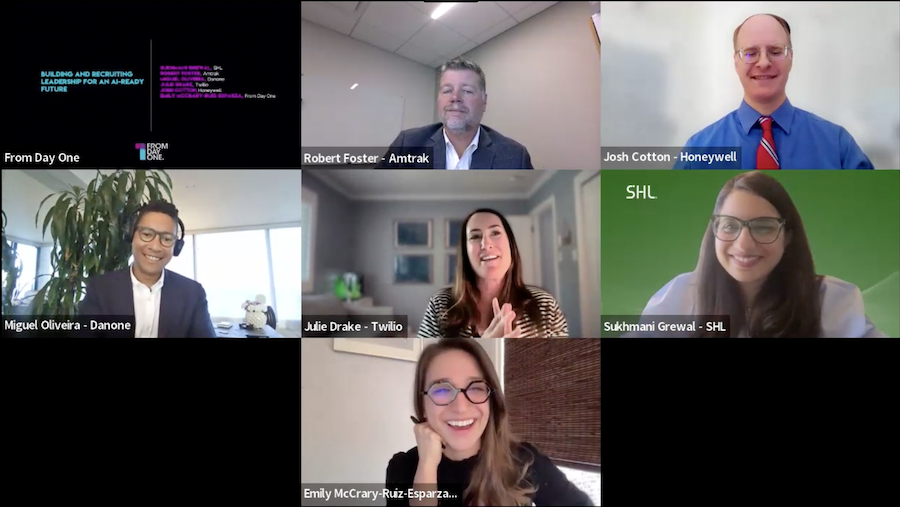
But the walk must match the talk. Leaders also need to demonstrate what working with AI can do. Panelists agreed that leaders can make AI less intimidating by experimenting with it themselves and sharing what they learn. Sukhmani Grewal, principal solution architect at organizational technology platform SHL, said that companies already seeing success with AI are those fostering internal champions who share their knowledge with colleagues, making the benefits both immediate and tangible.
Rethinking Work and Leadership
As employees incorporate AI into their workflows, the responsibilities of leaders are changing.
“I think AI actually elevates the leader’s role,” said Josh Cotton, director of talent assessments and AI at technology manufacturing firm Honeywell. As employees increasingly work alongside AI, leaders will be responsible for managing a new type of workforce, and those who already know how to run effective teams may be best at leading those that blend humans and agents.
“AI collaboration is a key development need,” said SHL’s Grewal. The organizations making the most progress aren’t only investing in new technology, they’re developing their people’s capabilities alongside it, including the ability to experiment, learn, and redesign workflows.
At cloud communications platform Twilio, HR leaders have been working with teams to identify where AI could take over certain tasks, said Julie Drake, SVP of people and programs. They quickly learned that some teams were more AI-ready than others. Rather than push for enterprise-level changes, Drake decided to work with individual teams at their own pace, helping them identify where the technology could be most useful. Twilio has since doubled down on developing skills like critical thinking and AI literacy in its leaders.
“It’s kind of like org design 101,” she said. “You start with the work, not the people.” The exercise has also highlighted the importance of collaboration among HR, IT, operations, finance, and business. Identifying opportunities for AI is of little value if teams don’t have the technology or resources to act on them.
Ultimately, the changing nature of work doesn’t mean leaders must become AI experts themselves. Their responsibility is to create the right conditions. “The leader doesn’t have to be the one who’s most skilled in the room,” said Cotton at Honeywell. “They just have to create the environment where the people who are figuring out how to navigate it are being encouraged, rewarded, promoted, and protected.”
Editor’s note: From Day One thanks our partner, SHL, for sponsoring this webinar.
Emily McCrary-Ruiz-Esparza is an independent journalist and From Day One contributing editor who writes about business and the world of work. Her work has appeared in the Economist, the BBC, The Washington Post, Inc., and Business Insider, among others. She is the recipient of a Virginia Press Association award for business and financial journalism. She is the host of How to Be Anything, the podcast about people with unusual jobs.
(Photo by Parradee Kietsirikul/iStock)