How Coaching Builds Change Fitness in Leaders and Organizations
BY Emily McCrary-Ruiz-Esparza
|
October 30, 2026

Business leaders are well aware of the new paradigm: Change is no longer a discrete event but an ongoing state of being. Yet even as they recognize that the pace of change isn’t slowing, many continue to rely on traditional models of change management.
A few years ago, Michael Hudson was taking a walk with his mentor when he remarked that he couldn’t wait for things to return to normal after the turbulent years of Covid. “She quickly corrected me and said, ‘Michael, wake up. Things are not going back to normal.’”
Leaders need a philosophical shift, said Hudson, CEO of the Hudson Institute of Coaching. “We all have to come to terms with the idea that change is not an event. It’s like the weather. It’s all around us, it’s shifting, it’s perennial.” Treating change as an isolated event rather than a constant condition makes it tempting to resist, reverse, or at least control it.
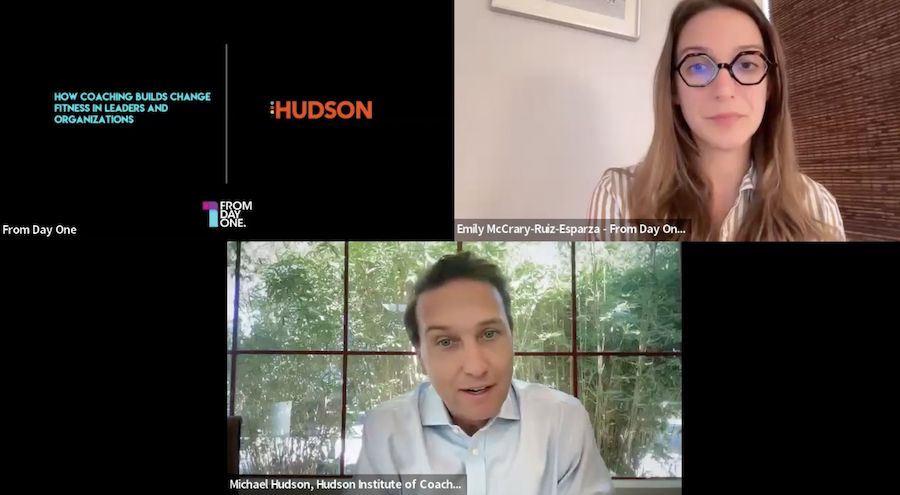
During a From Day One webinar on how coaching can build change fitness in leaders and organizations, Hudson outlined an alternative approach. “I’m interested in metabolizing change,” he said, “working with it, engaging with change in order to turn it into things that are useful to us, like learning and growth and innovation.”
Getting Comfortable with the Unknown
For leaders accustomed to having the answers, admitting they don’t can be uncomfortable. But in the midst of disruption, clarity isn’t always possible, Hudson said. The expectation that leaders should have all the answers is “an outdated model of leadership, and it gets us into trouble. If we’re relying on one person to analyze data, come up with a plan, and execute it through their team, we’re missing the opportunity to engage.”
Rather than striving for certainty, leaders should cultivate confidence in the direction they're taking, “like navigating with a compass instead of a map.”
That requires transparency, even in the absence of information. Leaders should be candid about what they know, what they don't know, and when employees can expect updates. Otherwise, employees will fill the vacuum with their own assumptions and stories.
Updating the Change Paradigm for the a Constantly Changing World
Traditional change-management models treat disruption like an inconvenience to be managed, Hudson said. Leaders make a plan, execute it, and return to business as usual, relying on complex systems of Gantt charts to track progress.
“Missing from this is human beings, the human beings who need to come along with the plan, who need to buy into it, believe in it, be inspired by it,” he said. “The human beings who, if they are not brought along, will undermine the plan without even intending to, because they haven’t been involved or because they’re afraid of it.”
Hudson advocates developing three key leadership capacities: contain, connect, and conduct.
First, leaders must contain, acknowledging and engaging with their employees’ emotional responses to change. Layoffs, for instance, are upsetting, and leaders shouldn’t pretend otherwise. Inviting employees to express their feelings can be uncomfortable, particularly when those feelings are negative. But “by not doing it, those feelings go underground,” Hudson said. “It undermines everything that follows.”
Next, leaders must connect, helping their teams make meaning from change. This begins with what Hudson calls “crowdsourcing information,” though it’s not simply a data-gathering exercise. Rather, it’s to understand the different perspectives within an organization. Leaders may assume their interpretation of the facts is the correct one, overlooking how differently employees can experience and interpret the same circumstances.
Finally, leaders must conduct, helping their teams move forward despite uncertainty. Rather than simply refining old ideas and approaches, leaders should encourage new ways of thinking. As Hudson put it, “what we need in disruption is possibility thinking.” That means abandoning the familiar five- or ten-year plan in favor of a more adaptable approach.
The control that traditional change-management models promise is an illusion. By engaging with uncertainty rather than fighting it, leaders can turn disruption into an opportunity for learning and innovation.
Change is messy, and even leaders committed to a new approach will sometimes fall back on old habits. “So we need to have some grace for ourselves and others around how challenging this is,” Hudson said.
For that reason, he prefers the idea of maturity over mastery. Mastery suggests a finish line at which leaders have learned everything they need to know about navigating change. But maturity recognizes that the work of adapting and growing in the midst of change, it never really ends.
Editor’s note: From Day One thanks our partner, Hudson Institute of Coaching, for sponsoring this webinar.
Emily McCrary-Ruiz-Esparza is an independent journalist and From Day One contributing editor who writes about business and the world of work. Her work has appeared in the Economist, the BBC, The Washington Post, Inc., and Business Insider, among others. She is the recipient of a Virginia Press Association award for business and financial journalism. She is the host of How to Be Anything, the podcast about people with unusual jobs.
(Photo by narvo vexar/iStock)