More Than Efficiency: How Marketers Are Using AI to Deliver the Most Value
BY Emily McCrary-Ruiz-Esparza
|
February 02, 2026

Marketers have graduated from the experimental phase in marketing, moving beyond simple efficiency plays and content generation to embed the tech in processes and cross-departmental collaboration, reinventing the way campaigns are designed, funded, executed, and measured. The question facing marketers in 2026 isn’t whether to use AI, but where it delivers the most value.
During From Day One’s January virtual conference on AI and marketing tech, four marketing leaders discussed ways they’re using AI to transform marketing strategies and outcomes.
The most natural entry point into AI for marketers is content creation, says Honora Handley, VP of global marketing and AI strategy at Thomson Reuters. Drafting emails and crafting messaging are the low-hanging fruit many teams reach for first. But, she said, “a lot of the impact is really around creativity with workflows.” Routine tasks like approvals and ad-buys are all being rebuilt with AI agents that make the process more efficient and effective, especially across departments.
While marketing might have workflow for budget requests, accounting and finance has another to approve requests and disburse funds. Good workflows mean those teams can communicate through their processes without inventing a whole new process. On a daily basis, Handley said, “it’s about carving out the time to think differently about how we’re using AI with the plethora of tools that the company has provided.”
Tailoring campaigns has never been easier and more precise. This is a coup for account-based marketing. “Now there’s really no excuse not to have specific assets for individual people,” said Jeff Coyle, the head of strategy at Siteimprove and co-founder of MarketMuse. “We went from what was a scarce resource to infinite ability. Now it’s all about making sure everything you do is of the highest quality and editorial integrity.”
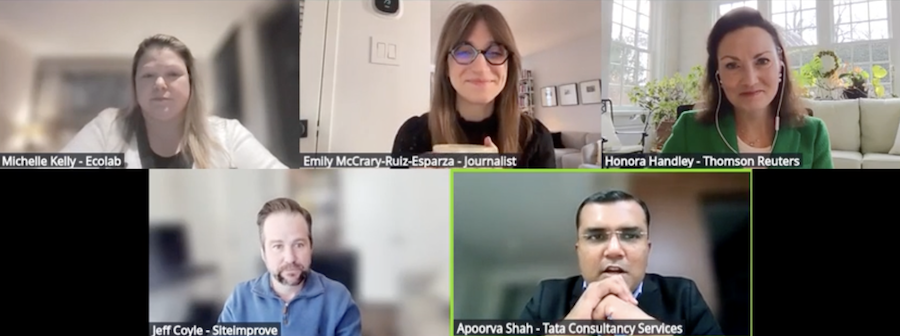
Panelists agreed that AI has helped them make better, faster decisions. They can now spot underperforming ads and reallocate budget, sort leads, and pick the best calls to action, subject lines, and headlines in record time and with laser precision.
There’s no shortage of AI-powered tools for marketers to accomplish these things, but whether a tool is worth the cost is down to business requirements, said Apoorva Shah, who leads marketing at Tata Consultancy Services. The first litmus test is comparing the tool’s capabilities to marketing goals. “Are we trying to improve our pipeline or demand gen? Are we trying to improve our content velocity? Do I want to improve my return on ad spend?”
It also depends on whether the tools can connect to other systems and achieve that cross-departmental flow. “Efficiency and time savings alone aren’t as important as also making sure that we’re getting something meaningful from it,” said Michelle Kelly, the VP of digital marketing at Ecolab.
Though marketing teams are adopting AI tools with increasing speed—and making great use of them—some are still under the impression that being AI ready means starting over. The most common misunderstanding about AI readiness is that marketers have to build something entirely new, says Coyle. A better strategy is to enrich what you already have, including processes for developing marketing assets and updating them.
But make no mistake, every page of the website matters, he says. This is true both substantively (PR content affects product content) and technically (AI engines have to be able to read and interpret your content).
As AI becomes infrastructure rather than novelty, the advantage will go to marketing teams that treat it as a connective tissue, not just a content engine. Panelists agreed: the real value comes from improving workflows across systems and teams. AI isn’t replacing marketing fundamentals. It’s raising the bar for how they’re executed.
Emily McCrary-Ruiz-Esparza is an independent journalist and From Day One contributing editor who writes about business and the world of work. Her work has appeared in the Economist, the BBC, The Washington Post, Inc., and Business Insider, among others. She is the recipient of a Virginia Press Association award for business and financial journalism. She is the host of How to Be Anything, the podcast about people with unusual jobs.
(Photo by pixdeluxe/iStock)


