Putting the Human Back in HR: Balancing AI, Culture, and Care in a Time of Change
BY Grace Turney
|
February 23, 2026

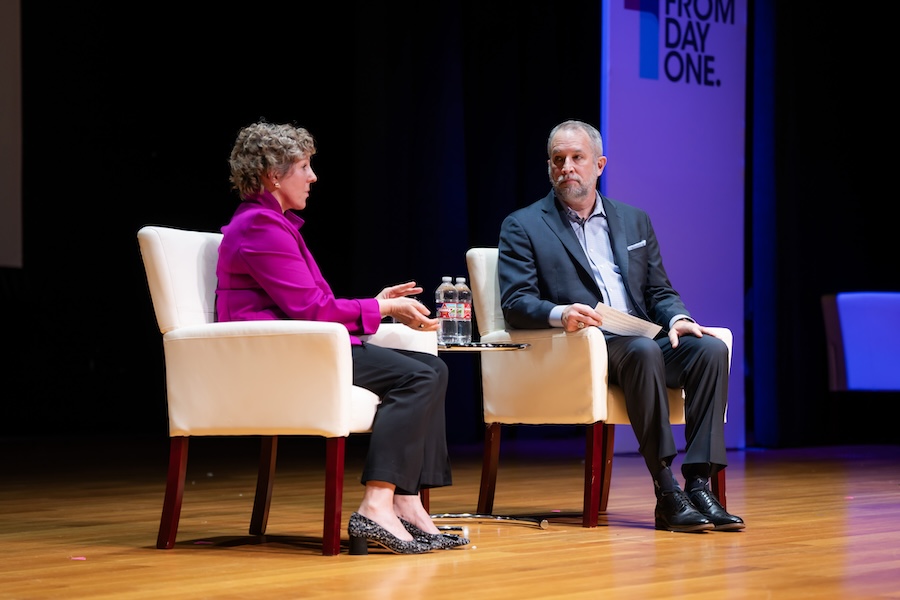
Six weeks after starting a new job, Katy Theroux got a breast cancer diagnosis. A fireside chat at a From Day One’s Houston conference gave her the opportunity to say it plainly, and to draw a direct line between her experience and her philosophy of HR leadership.
“It wasn’t on my bingo card,” said Theroux, CHRO at Westlake, a Fortune 300 specialty chemical and building products company headquartered in Houston. “Nobody puts breast cancer on their bingo card.” She finished treatment just two and a half weeks before the event. The company, she says, had been unwavering in its support; a reflection of the family-owned culture that shapes Westlake even at its considerable scale. The conversation, moderated by Sean McCrory, editor in chief at the Houston Business Journal, covered AI’s role in HR, leadership transitions, and what it really means to build a culture of care.
Resilience as a Core HR Skill
Theroux arrived in Houston in 2002, just as the Enron and Arthur Andersen scandals were reshaping the city’s business identity. When she returned more than a decade later, the city had changed (the Texas Medical Center had nearly doubled in size), but the underlying dynamic had not. “There’s always so much change in Houston,” she said. “Each company has had its share of ups and downs. Having an HR leader who can handle the highs and help navigate the lows is really, really important.”
Resilience isn’t a personality trait, but a practiced skill, and an especially vital one when companies face leadership transitions, she says. Over 18 years at two organizations before joining Westlake, Theroux navigated five CEO changes. She observed that what makes or breaks those transitions isn’t strategy—it’s honesty. “The most important element of a successful onboarding of a new leader is just real honesty about themselves, their background, and what they’re trying to find out,” she said. “Through that honesty, it really builds trust. And trust is key to long-term success.”
AI as an Amplifier, Not a Replacement
At Westlake, the HR team is experimenting with tools including Microsoft Copilot and an internal GPT system, says Theroux. She frames AI as the latest chapter in a longer story about freeing HR professionals to do more meaningful work.
“What we’ve been trying to do for the past 20 to 25 years is take administrative work off our frontline HR leaders so they can spend more time with people,” she said. “I view AI as the next step in that evolution.” One of the most common current uses is drafting job descriptions, by pulling from internal databases, org charts, and historical records to quickly produce relevant drafts. But she was candid about the limits: AI-generated job descriptions are accurate roughly 70-80% of the time, which means careful human review remains essential. “Everyone needs an editor,” McCrory said, “including AI.”
Theroux’s broader advice for implementing AI responsibly was to start small. For example, she observed that pilot programs reduce risk, build trust with business partners, and create the kind of joint ownership that allows successful tools to scale naturally. She also emphasized the need to partner closely with technology leadership to ensure any AI use aligns with company policy. “There has to be a real business need,” she stated. “It’s not about replacing people. It’s about doing work better.”
Culture, One Person at a Time
When asked what Houston’s business leaders should take away to strengthen culture this year, Theroux didn’t reach for a grand framework. Instead, she offered an image: a peony, opening slowly, beautifully, one petal at a time. “My goal with my direct reports is to see them really open and blossom,” she said. “If we can spread that across the organization, that’s really going to change the culture.”
The stakes of getting it wrong are real. If companies embrace AI while losing sight of human judgment and care, Theroux says, the casualty won’t be efficiency; it will be trust. “Once you lose trust, it’s really hard to regain that,” she said. “Customers, shareholders, employees, the community at large.”
Her closing message was equally grounded. Not everyone needs a stage, she told the audience. The power to shift a culture belongs to anyone willing to meet a colleague where they are: to offer help, or to learn how to accept it.
Grace Turney is a St. Louis-based writer, artist, and former librarian. See more of her work at graceturney17.wixsite.com/mysite
(Photos by Josh Larson for From Day One)


