How to Harness the Power of AI to Make Your Life (and Work) Better
BY Kristen Kwiatkowski
|
February 19, 2026

People may use AI for work or personal purposes, but it can also enhance both areas of daily life. As part of a human-machine partnership, it’s important to understand how to use AI effectively in both professional and personal settings.
Celia Quillian, author of AI For Life and director of AI and growth on the innovation team at Greenlight, spoke about just this during a fireside chat at From Day One’s Atlanta marketing conference.
Having worked at Greenlight for the past five years, a company that started off as a debit card for kids but has since expanded to a family tech space, Quillian’s role was primarily in the product marketing landscape but she now works in additional areas, including an innovation space for new products as well as an AI enablement focus.
Her appreciation and interest in AI began in 2022 when she started navigating through AI on her personal time to learn more about this relatively new technology tool, she told moderator Steve Koepp, From Day One co-founder and editor in chief. “I remember thinking, everything is going to change and people have no idea,” Quillian said.
“They’ll be pulling their phone out at parties saying, ‘Have you seen this yet? Try this. Look at what it can do,’” she said. “That inspired me to start my Smart Work AI channel, where I teach people about what I’m learning and what’s happening with AI.” Her devotion to understanding AI and its future implications even prompted her to write her book.
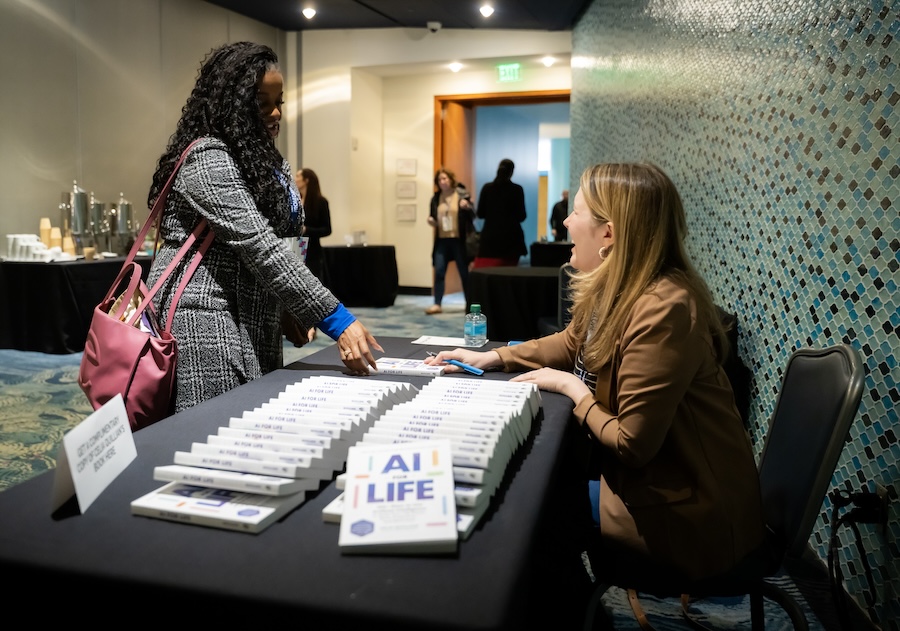
At the time, there were many AI books on the market, but all very technical, she says. “Many of them were only about the business use case, there was nothing for the average everyday consumer or just everyday worker.”
“My thought is that it’s not as motivating to adopt a new tool if it’s just for work and you’re being told to do it. But if you can find personal value in how you can unlock things for yourself using a tool, maybe you’re going to start experimenting with it more,” she said. “Maybe you'll find more use cases. And so, the book, I’m hoping, unlocks that for a lot of people.”
To Quillian, there’s value in using AI in both work and personal circumstances, not just one or the other. “You might learn something at work that it can do and go, hey, I wonder if I can apply this to my home life and vice versa,” she said. “That’s certainly what I did.”
Think of your AI as a collaborator–-just not a human one. Understanding its limitations is key to using it wisely, she says. “Expertise is not going away, and it should not go away in the context of AI. That human experience that you have, the training and knowledge that you have developed over your career, you have more context than it will ever have,” said Quillian. “You can use it as a starting point, but bringing yourself into that human-in-the-loop moment is important.”
The Best Use Cases, So Far
In her personal life, Quillian says ChatGPT has helped her plan a vacation by providing her with ideas as to where she could travel in the United States that had a variety of features she was looking for in a destination. It helped plan the vacation for her and even built out an itinerary. “I was able to plan a vacation that ended up being one of our favorite trips that we've ever done,” she said.
Another AI success for Quillian came when she learned to use Claude and built three applications. The experience left her excited and empowered about AI.
However, it’s important to recognize AI’s limitations, including the risks of hallucinations and generating fanciful or inaccurate content. “Hallucinations is a term when an AI very confidently says something that is not true or includes some information that’s a little lacking in some human logic,” she said. That’s where human logic is essential.
It’s also important to use prompt layering by feeding AI a series of prompts instead of relying on a single question and answer, she says. AI can handle multiple prompts, help with drafts and outlines, and generate several versions of a document. She also recommends using specific words, action verbs, and using AI for brainstorming purposes. You can also use tools to make correspondence sound better, be more diplomatic, and still get the point across to the reader.
You can ask ChatGPT or other AI platforms to rephrase and soften messages so they may be received better by the recipient. You can ask, ‘How do I express myself in a facts-only way and not emotionally?’ “AI can take that and do it for you immediately, without any friction, and over time, you will get better at writing those emails yourself as well, if you collaborate with it that way.”
From a marketing standpoint, Quillian points out ways AI can help boost creativity. It can be used to brainstorm ideas and help with various aspects of the entire campaign. As for where AI is headed in the future, Quillian used her experience with Claude Code as an example and stated we may be moving into a time where people start to build their own personal applications more frequently, relying less on direct-to-consumer apps even. “We’re moving into a world where you’re not just prompting AI. The AI is prompting you.”
Kristen Kwiatkowski is a professional freelance writer covering a wide array of industries, with a focus on food and beverage and business. Her work has been featured in the Bucks County Herald, Eater Philly, Edible Lehigh Valley, Cider Culture, and The Town Dish.


