Stop Adopting AI, Start Building a Hybrid Intelligence Team
BY Christopher O'Keeffe
|
March 24, 2026

“Our attention span is actually down to two seconds now. Not three seconds, sorry to say so,” said Dr. Thomas Zoëga Ramsøy, founder and CEO of Neurons. That constraint is reshaping the fundamentals of marketing. Brands now have only a fleeting moment to capture attention and communicate value, even as the systems around them become more complex and more demanding, he shared during a thought leadership spotlight at From Day One Atlanta Marketing conference.
The pressure is not just about attention. It’s also about time, resources, and decision-making. “We don’t have the luxury of the time or the budgets to actually wait for that data to come in,” he said. As timelines compress, the traditional cycle of testing and refinement becomes harder to sustain, forcing teams to make faster decisions with less certainty.
Against that backdrop, generative AI has been widely adopted as a way to increase speed and output. But Ramsøy pointed to research suggesting that the impact is inconsistent. “The net effect, the net improvement, or the net change of using generative AI as approaches to advertising, is zero, actually doesn’t have an effect,” he said. In other words, while some outputs improve, others decline, and the overall result is often neutral.
That matters because the baseline performance of marketing is already under strain. Ramsøy said that “80% of ads are failing, or at least falling short of their purpose.” Whether the goal is brand building or conversion, most campaigns struggle to deliver meaningful impact, and AI alone is not correcting that problem.
The Gap Between Engagement and Memory
Part of the challenge is a disconnect between attention and memory. Campaigns can generate strong engagement while failing to build brand recognition. Audiences may remember the story or the visual, but not the company behind it. In a landscape defined by overload and shrinking attention, that gap becomes even more costly.
To address this, Ramsøy proposed a more integrated approach to AI—one that moves beyond individual tools and toward a system. His framework organizes AI into three roles: predictive, suggestive, and generative. Predictive systems estimate how audiences will respond to content, suggestive systems interpret those results and recommend improvements, and generative systems create new variations based on those insights.
“We have achieved over 90% accuracy compared to eye tracking,” he said, describing how predictive models can forecast visual attention and other responses. When combined with recommendation and generation, these systems allow teams to iterate more quickly and with greater direction.
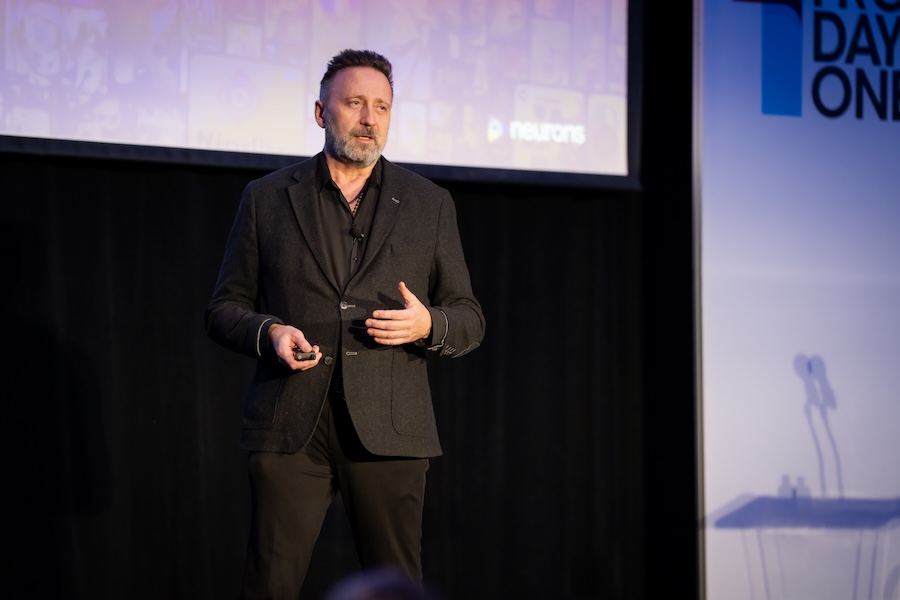
Ramsøy emphasized that this approach is not about replacing human creativity. “We focus on not replacing the creative person, but to inform them and inspire them,” he said. In practice, that means enabling more experimentation and exploration, not less.
“What we see is that people are expanding the space that they are experimenting with even within a short time frame,” he added. “What if we do this? What if we do that?” The ability to test ideas quickly can open up new creative possibilities while grounding decisions in data.
As AI continues to reduce the cost and friction of execution, Ramsøy says that the real shift is happening elsewhere. “Execution is becoming really easy these years,” he said. “But at the same time, judgment and confidence in going to market is becoming the new currency.” In a world where content can be generated instantly, the ability to decide what is worth making becomes the true differentiator.
The future, in his view, is not about adopting more tools, but about building systems that combine human judgment with machine insight. In a landscape where execution is increasingly commoditized, the advantage will belong to organizations that use AI to think more clearly—not just produce more.
Editor’s note: From Day One thanks our partner, Neurons, for sponsoring this thought leadership spotlight.
Chris O’Keeffe is a freelance writer with experience across industries. As the founder and creative director of OK Creative: The Language Agency, he has led strategy and storytelling for organizations like MIT, Amazon, and Cirque du Soleil, bringing their stories to life through established and emerging media.
(Photos by Josh Larson for From Day One)