Building an AI-Ready Workforce: Culture, Skills, and the Human Side of Transformation
BY Ade Akin
|
July 09, 2026

When LexisNexis rolled out its first AI skills assessment, HR leaders expected pushback. The voluntary program, offered to about half the workforce with no mandates, KPIs, or pressure, simply invited employees to gauge their AI skills. Instead of resistance, participation far exceeded expectations, with 91% of employees completing the assessment. The surprise challenge came from an unexpected group: managers.
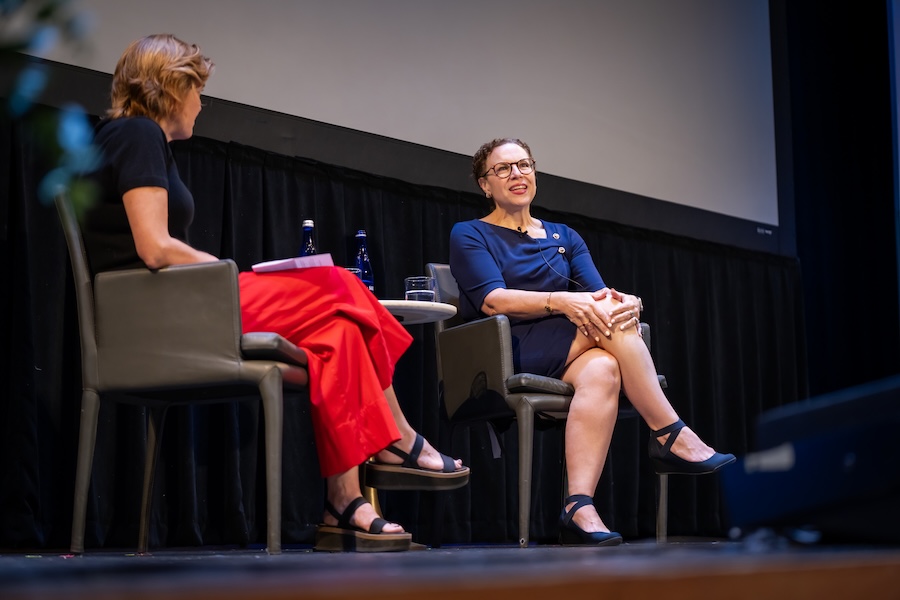
“We had to chase our managers,” Amy Liedke, EVP of HR at LexisNexis, said during a fireside chat at From Day One’s Manhattan conference. “Employees were coming forward in very, very high numbers. Managers were coming forward organically at about 40%,” she said.
The gap revealed something deeper than a simple scheduling conflict. Liedke unpacked what the data exposed about leadership culture, psychological safety, and the surprising resistance from the very people expected to guide others through transformation during the fireside chat moderated by Jessi Hempel, senior editor-at-large at LinkedIn.
The Assessment That Became a Mirror
The introduction of the AI skills matrix at LexisNexis occurred within a broader strategic framework. The company released its first customer-facing AI product called “Lexis+ AI” in early 2023, and its CEO had been discussing AI adoption consistently for three years. The skills assessment was part of an approach to driving AI culture and fluency within the organization. It was paired with a tiered learning program—Explorer, Accelerator, and Transformer—that gave employees a clear path forward.
The true revelation for Liedke wasn’t in the technology’s capabilities; rather, the insight lay in the surprising demographic patterns of its uptake. Employees embraced the opportunity to understand their current AI skills and create a plan for growth.
Managers, however, were slower to participate, often pointing to packed schedules and competing strategic priorities that made it difficult to find the time. “It has a lot more to do with their own comfort and embracing of the tools, and how to change. Some of them, I think, are hanging on to certain old ways of working, and a discomfort with how they play a role in developing others on a skill that they might not yet have fully developed in themselves,” she said.
Building an AI-ready workforce requires a lot more than training programs. It requires confronting employee fear head-on. Liedke acknowledges that the constant barrage of headlines, such as job cuts and apocalyptic predictions about AI eliminating roles, makes the role of HR significantly harder.
Liedke’s response has been to reframe the narrative entirely. Rather than positioning AI as a tool that replaces workers, LexisNexis emphasizes augmentation. The company has increased employee headcount steadily over the past year, using productivity gains from integrating artificial intelligence with existing systems to fund new work that was previously out of reach.
The Evolutionary, Not Revolutionary, Shift
While headlines create fear that AI will upend the job market, Liedke sees a more gradual transformation. Rather than eliminating roles overnight, she expects AI to steadily reshape the tasks that make up individual jobs. To prepare for those changes, LexisNexis has formed a fifth “tiger team” focused on workforce engineering, developing a repeatable process for identifying how roles are evolving and the new skills employees will need.
“A lot of the new skills are competency-based, right? It’s a lot of the more strategic work, it’s a lot of the more human, interpersonal, judgment-based work,” she said.
The old model, writing a job description and leaving it untouched for a decade, no longer works. Liedke now advocates for reviewing job architectures at least once a year, preferably twice. The nature of work is shifting incrementally, and HR teams need a process to track those changes in real time.
Liedke’s experience leading AI initiatives has revealed an unexpected lesson: hiring a single AI-savvy employee rarely changes an organization because the existing culture quickly absorbs them. Instead, she recommends hiring groups of AI talent who can reinforce one another and help sustain change. The AI assessment also gave employees a shared understanding of their skills and ownership of their development, but she says leadership must evolve alongside them.
“Leaders have to be willing to make different types of decisions to move at a different pace and to challenge constantly,” Liedke said. “You can’t just do it with your CEO, and you can’t just do it with the workforce alone.”
Don’t Wait to Be Invited
Liedke advises HR leaders to invite themselves to the table. In her case, she recognized her opening when LexisNexis’s CEO started asking for more AI natives. “I asked him, ‘Okay, I have my own idea around that, but what do you mean when you say AI native? What does that look like for you? What’s the definition of that for you?’” she said.
That moment became the catalyst for the AI skills assessment rollout. Liedke understood that somewhere between a science experiment and “you know it when you see it” lies a space where HR can design practical frameworks that are simple, development-oriented, and safe for honest self-assessment.
Now, she deliberately avoids using the term AI native because it suggests a closed club reserved for people who happened to be at OpenAI or Anthropic five years ago. Instead, she promotes “AI first” as a growth mindset. Everyone has a starting point. Everyone can gain fluency. “We can all have a starting point and say, ‘I’m here today, and I know how to experiment, and I’ve had new technology presented to me before, and that’s what I’m going to do,” she said.
Liedke also points out an unexpected demographic twist: Gen Z and Gen Alpha are some of the most resistant to the AI technology revolution. It’s the first tech evolution where the youngest workers aren’t the early adopters. That’s another invitation for HR to step in to understand the why behind their reluctance, to increase participation, and to keep the conversation surrounding AI integration developmental rather than judgmental. “We have a role to keep this positive and developmental, and that’s one that we can definitely play,” Liedke said.
Ade Akin covers artificial intelligence, workplace wellness, HR trends, and digital health solutions.
(Photos by Josh Larson for From Day One)