How Technology Can Enhance the Full HR Spectrum, from Recruiting to Retirement
BY Katie Chambers
|
December 02, 2025

Love it or fear it, AI is here to stay. In implementing AI and other new tech, leaders need to bring along the entire organization and drive a mindset shift, which includes an appreciation of how agentic AI will boost efficiency and productivity.
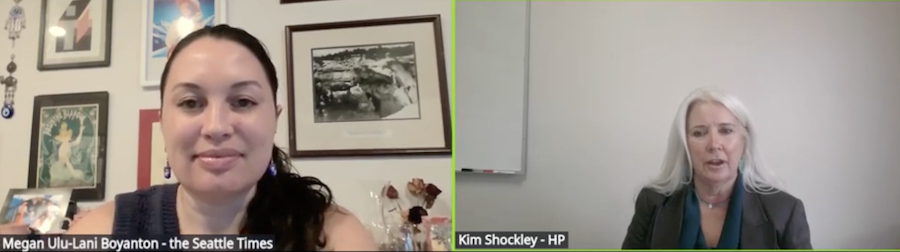
Organizations must also consider the importance of anticipating risks and concerns about bias while utilizing these tools. During a fireside chat at From Day One’s November virtual conference, Kim Shockley, the VP of HR technology & automation at HP, shared how her organization is making the most of emerging technologies.
The Evolution of HR Technology
During her 12 years working in HR technology, Shockley has witnessed rapid changes. Most companies had HR solutions “on prem” (meaning on a server on the premises) but now work mostly with cloud-based technologies. “HCM [human capital management] software vendors [have] become the standard, and companies [are] moving to really focus on an implementation of that across all capabilities” she said. “This huge explosion in the HR tech marketplace [is] focused on innovation and delivering best of breed technologies and really encouraging us to think outside of the box of what can I do beyond the standard of HR deliverables.”
Many workplace software companies like Workday and Success Factors are acquiring and merging with others to provide all-in-one solutions, she says. “What’s happening now has the potential to leapfrog us and shift us significantly in a different direction, and that we in five years may look completely different than what we look today in our technology environments.”
The myriad of options can be overwhelming, so Shockley advises focusing on impact. Many HR tasks are “foundational [and] transactional, it’s the things that we have to do to help to run the business,” she said, referring to tasks like payroll and PTO. “And then there are other things in a business that HR delivers that have potential to deliver competitive advantage or strategic differentiation. A lot of these are in the talent space. They may be related to your employee value proposition,” she said. This is where technology beyond the core HCM can be beneficial in terms of talent support and development.
Implementing Technologies That Promote Growth
“Who do we want to be? We want to be an organization where talent is attracted to come to us, and then we are developing them, providing them the tools and opportunities to learn and grow so that they have choices in the future,” Shockley said.
HP has implemented a talent intelligence platform that helped it become a skills-first organization and allowed employees to find new roles within the organization based on their skill-set, boosting talent retention. The tech also provides career pathing to help employees see how they can grow within HP. “I may see that I can switch functions where I may not have ever considered that before, because I have the skills to go there,” she said. Mentoring matches and stretch projects have all been optimized with AI technology.
The software doesn’t just boost retention. “That same platform serves us on the recruiting side too, and helps us to find the right talent externally. It’s a skills platform. It allows us to find candidates based on AI algorithms and an AI model that does map candidate matching that has been a game changer for us in terms of us finding the right people, finding folks with the right skills, and moving them through the process,” Shockley said.
While AI can certainly help HR leaders, they must be sure to use it responsibly, making sure systems “are designed and deployed in a fair, safe, and aligned manner with human values,” Shockley said. “HP as an enterprise has AI governance principles around trust, safety, security, and accountability. We have, on top of that, commitments for our people organization that take that a step further because of our responsibilities.” One of these is “human in the loop,” ensuring that a human is always involved and that AI is not solely making decisions related to humans. HR partners with employment attorneys and compliance departments to understand and define best use, high risk, and forbidden use cases.
Encouraging the Mindset Shift
Agentic AI offers opportunities to transform and automate business processes. “I can create an end-to-end workflow that drives more productivity into our processes, for both HR and for our employees and it also can impact the employee experience,” Shockley said. This rapid evolution is both exciting and challenging. “I have to be in the mode of executing, because I can’t wait for everything to be perfect. I need to be moving forward and learning and taking advantage… I have a bigger risk in not acting than in acting today,” she said. The information overload can be significant. Leaders need to encourage teams to be ready for AI, which Shockley calls a “mindset shift.”
“With your average person, there’s still a lot of unknowns around AI—a lot of questions, maybe some anxieties and fears,” said moderator Megan Ulu-Lani Boyanton, business reporter at the Seattle Times. Shockley says encouraging experimentation is the best way to get employees comfortable with emerging technologies. “You have to actually put the tools in the hands of your people. It doesn’t have to be complex,” she said.
Starting small with simple tools like Microsoft Copilot can help workers understand the value of AI. From there, you can expand into more complex company-wide technologies, like HP’s career mapping tool that lets employees dream and aspire to an exciting future.
AI implementation is most effective when approached with purpose and clear intent, Shockley says. “It’s easy to say, ‘That’s cool. I want that.’ But if you start going at it that way, you often don’t get the outcome that you were after because you didn’t really define the outcome. And so, we always come back to, ‘What are we trying to accomplish?’ And let’s start there and then let’s figure out what’s the right technology to deliver on that.”
Katie Chambers is a freelance writer and award-winning communications executive with a lifelong commitment to supporting artists and advocating for inclusion. Her work has been seen in HuffPost, Top Think, and several printed essay collections, and she has appeared on Cheddar News, iWomanTV, On New Jersey, and CBS New York.
(Photo by Summit Art Creations/Shutterstock)


