The Practical Power of AI in HR
BY Jessica Swenson
|
December 03, 2025

While human elements of leadership, storytelling, and empathy will always be essential in HR, the rapid evolution of AI technology has placed companies under continual pressure to integrate it into their daily operations—and fast.
Many organizations focus their AI efforts on improving efficiency, which is undoubtedly a valuable approach. Janine Yancey, founder and CEO of Emtrain, uses AI at her organization to reduce the content generation time for its annual workplace culture report from 30 hours to six hours.
Jason Ashlock, Kuehne + Nagel’s global head of organizational development, avoids using AI for conceptual work but has seen it utilized for task-based activities, such as slide design and dashboard updates.
But Piyush Sarode, global head of HR for worldwide markets and pharmaceuticals at Bayer, believes that companies should focus on a broader strategic purpose and business objective than just efficiency. Bayer utilized AI to enhance training for its pharmaceutical sales representatives over the past 18 months, reducing training time by 80% and accelerating sales representatives’ access to potential clients.
“Instead of a few days or a few weeks, [credentialing] can happen in as short a time as one hour,” he said during a panel discussion moderated by technology writer and editor Sage Lazzaro at From Day One’s Midtown Manhattan conference. “Think of the implication of this—it has freed up thousands of internal hours and [created] agility and speed for the business to deliver those outcomes,” said Sarode.
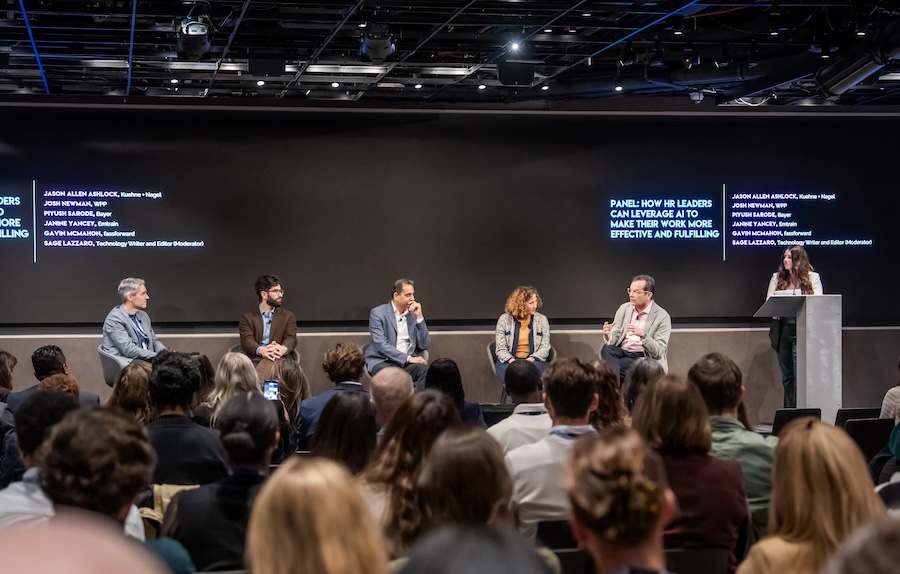
Yancey hopes to see HR leaders take the initiative to recommend where their organization could utilize AI and where humans should continue to lead. “I’d love to see HR leaders be the first to the table with those plans,” she said.
Panelists had differing ideas on the best route to select and integrate AI technology successfully. Ashlock and team have “found the most success when the business, IT, HR, and P&L owners have cooperated around a clear definition of an identifiable use case that solves a known problem.” Then they upskill the associated team on the AI solution.
Josh Newman, WPP’s global head of people strategy and experience, says that HR tends to focus more on training rather than business outcomes; he recommends starting with known deliverables and work architecture.
“If you’re trying to start by identifying use cases for specific roles, you’re probably [not understanding] what the deliverables are and how they are made,” he said. “If you map out the work architecture, you can then pinpoint certain use cases to unlock capacity and give people more time to spend on higher-value work,” said Newman.
Framing AI maturity in three stages—experimentation, productivity, and net-new innovation—fassforward CEO Gavin McMahon cautioned against spending too much time focused on productivity and not enough on innovation. To promote innovation, he suggests that curiosity and adaptability are key traits to cultivate in employees.
“If AI automates some work, and makes us better at [other] pieces of work, it’s going to be really difficult for us to think about that net-new way of doing things,” McMahon said.
According to Sarode, vision-setting and system-level thinking are crucial steps that allow teams to architect and catalyze innovative AI solutions. “It requires that, at some point in time, you really look at the system and ask, ‘What’s a bold vision on how we can be a better version of ourselves?’”
Urging leaders to reflect on how they want their work or organization to be before rushing to implementation, Ashlock emphasized the importance of balancing vision with execution. “We don’t get many chances in a lifetime to be part of an epic, defining technological shift,” he said. Despite being at such an inflection point right now, many organizations are operating at top speed under enormous pressure without considering what they are creating for the future.
On the topic of AI risk, governance, and guardrails, Yancey drew parallels to the early bring your own device model, which led to cybersecurity issues on corporate systems, and stated that this needs to be a major area of focus over the next couple of years. The average person doesn’t “think like an owner,” she said, “so they don’t think twice when they’re putting customer information, product information, and sales information” into AI systems that the enterprise may not even have approved.
Panelists agreed that AI has a place in talent acquisition—primarily to streamline transactional, task-based actions—but, as Sarode said, human oversight remains vital to the recruiting and hiring process.
“Thinking about AI as a replacement for a person is dead wrong,” said McMahon. “Thinking about it as something that can do some tasks intelligently for you is dead right.”
Ashlock offered a closing piece of advice to HR professionals: “Ask [yourselves] three questions about any potential AI intervention, application, or implementation: does it build capability? Does it build clarity? And does it build care?”
McMahon recommends using your anxiety as motivation to learn “as much as you can, as quick as you can.” You don’t need to be an expert, he says; the key is to start learning and experimenting now.
Jessica Swenson is a freelance writer and proofreader based in the Midwest. Learn more about her at jmswensonllc.com.
(Photos by Josh Larson for From Day One)


