Brand Authenticity and Purpose: Aligning Values With Marketing Strategy
BY Grace Turney
|
October 20, 2026

Web traffic to seed brand Golden Harvest has dropped about 80 percent, but its marketing chief says that’s not a crisis. Younger farmers are increasingly turning to AI tools to diagnose struggling crops from photos rather than clicking through to company articles. And those who do visit the site are filling out “learn more” forms at higher rates than ever.
“We’re still getting more output from the website,” said Eddie Kahle, head of marketing for Golden Harvest at Syngenta. “We’re just getting a lot less traffic to the website.”
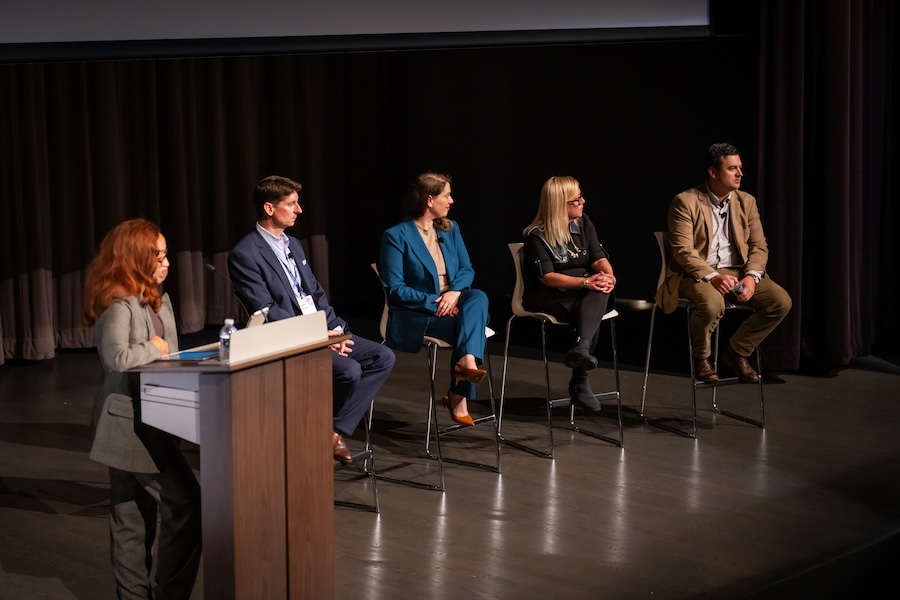
Kahle discussed this shift during a panel discussion at From Day One’s Chicago marketing conference. Mariah Rush, a staff reporter at the Chicago Sun-Times, moderated the conversation among four marketing leaders from very different industries on the topic of “Brand Authenticity and Purpose: Aligning Values With Marketing Strategy.”
Trust Looks Different Everywhere
For Golden Harvest, which sells corn and soybean seeds to Midwest farmers, trust starts with weather no one can control. Kahle says the company’s seeds outperform competitors only about half the time, depending on when rain falls. So Golden Harvest focuses on helping farmers manage risk. “It’s about backing up your products when things go well or go poorly,” he said. The company uses AI models to track rainfall, sunlight, and wind, then alerts field sales teams when something happens in a farmer’s fields.
Heidi Sullivan, VP of marketing at Equity LifeStyle Properties, manages more than 400 brands, one for each RV resort, marina and manufactured housing community. She divides the work into what stays fixed and what bends. The community feel and brand promise stay constant, while a campground near Yosemite can look nothing like a retirement community in Florida, she says.
At Aparium, an independent hotel company, authenticity is simpler and harder. Dina Fenili Niekamp, the company’s SVP of brand marketing, says the marketing has to match what a guest finds when they check in at 11 p.m. after a long day of travel.
For Benjamin Svarczkopf, SVP of global marketing at Biocartis, a molecular diagnostics company focused on cancer, trust looks different. “We’re in a business where you can’t be wrong,” he said.
Let Customers Do the Talking
Aparium found a stronger approach by shifting its marketing strategy. Rather than relying on in-house campaigns built around road trips and family vacations, Niekamp’s team launched “As Told By,” a program that spotlights local makers, artists and contributors in each hotel’s city. “Nobody really wants to hear from a brand,” she said. “They want to hear from the partners, the customers, the people that made that brand.” The program has performed roughly 25 times better than the earlier campaigns, she says.
Regulation pushes Svarczkopf toward the same approach. Pharmaceutical advertising to patients is illegal in the European Union, where most of his business sits, so Biocartis relies on pathologists and laboratory directors to carry its message. His budget goes mostly to case studies. “A really good day is finding a customer that is super excited, and they start putting out LinkedIn posts,” he said.
The content that works also varies from industry to industry. Scientists don’t want polish. Svarczkopf says pathologists skip the slick slides and head straight to the footnotes and peer-reviewed evidence, so Biocartis leads with data and adds style afterward.
Kahle faces a similar bar from a different direction. Golden Harvest’s products take decades to develop, and university studies often need five or more years to confirm that a product works. His team then boils the findings down into pieces a busy farmer will read.
Though farms run on business-sized budgets, Kahle says the decisions often come down to one person in a family operation. That’s why consumer tactics tend to beat business-to-business ones. Golden Harvest borrowed the idea of a rewards program from the hotel industry.
Community Is the Product
ELS focuses on creating a community for guests, says Sullivan. “We don’t manufacture those relationships; we just facilitate the conditions that allow that to happen,” she said. Pickleball tournaments, campfire s’mores and golf cart parades give people reasons to return. The company’s annual “100 Days of Camping” campaign, which runs from Memorial Day to Labor Day and hands out collectible rally towels, now draws more than 100 million social media engagements, Sullivan says. The first year drew only a few million views.
Niekamp described Aparium’s version: a hotel lobby built around a bar and restaurant rather than a check-in desk. She called it the “blue flame,” after the hottest part of a fire, because it draws locals and travelers to the same place. Her team teaches the idea to new hires alongside “the fifth meatball,” a story about staff who noticed a table of five has been served an appetizer of four and fixed it without asking permission.
The panelists measure success by what customers say back to them. Sullivan tracks reviews, referrals and surveys. Niekamp watches direct bookings, since commissions from online travel agencies cut deeply into revenue, along with repeat guests. Svarczkopf’s favorite sign is a customer who “repeats your value message back better than you can.”
All four said marketing can’t sit apart from finance and operations. “Marketing is not a cost center; it is a revenue driver and a growth driver,” Sullivan said.
Listen Before You Speak
Each panelist shared a lesson that customers taught them this year, and each one changed how the company talks. Sullivan had always pictured RV guests as travelers. Then she met the annual guests who park for the season and build decks and tiki bars around their rigs, and she began marketing those sites as second homes.
Kahle’s lesson came in his first year leading Golden Harvest. His bosses assumed the brand was fading, but surveys showed the opposite. The problem was reach, not reputation. Golden Harvest needs to get onto more farms so new customers can see for themselves.
The four panelists, representing vastly different industries, all seemed to reach the same conclusion. Authentic marketing means talking less, listening more, and letting the people you serve tell the story.
Grace Turney is a St. Louis-based writer, editor, artist, and former journalist and librarian. She holds a Master of Library & Information Science (MLIS) and has nearly a decade of experience writing both full time and as a freelancer. See more of her work at graceturney17.wixsite.com/mysite.
(Photos by Josh Larson for From Day One)