Beyond the All-Hands: How to Reach Every Employee, Every Time
BY Emily McCrary-Ruiz-Esparza
|
October 22, 2026

It’s easy to send a company-wide email. Getting employees to read it, and then do something with the information, is another matter entirely.
As workforces become more dispersed, HR and communications leaders are finding that the traditional all-hands meeting is no longer enough. Reaching employees means understanding how they work and adapting communications accordingly. During a From Day One webinar on going beyond the traditional all-hands meeting, panelists share their strategies for reaching every employee effectively.
“To avoid fragmentation, I focus mainly on a consistent message, multiple delivery methods, and strong governance,” said Jessica Mason, North American director of HR for printer manufacturer Heidelberg. “In HR, we partner with communications and business leaders, and we try to stay aligned. The ultimate part of doing that is to respect all regions.”
That’s no small task. Mexico, the U.S., and Canada, which fall under her purview, use different systems. Teams in Mexico prefer WhatsApp, while the U.S. favors on-site TVs and the intranet, and Canada prefers email. To further complicate matters, each site is run by a different president, so Mason has to work within their preferences, too. And the company is headquartered in Germany.
“It’s mainly about ensuring consistency of the message, timing, ownership, and expectations,” she said. “As long as employees are familiar with the outlet it’s coming from, they’ll read it, or they’ll listen to it, or they’ll watch it.”
Yet companies should beware of channel sprawl, said Vincent Garcia, of employee communications platform LumApps. Fragmentation can create a “two-tier company culture gap” between desk workers and those on the front line. Garcia recommends having a single digital front door to deliver those messages across workforces and regions, which can save HR and comms teams time and energy, and keep workers from feeling inundated with information.
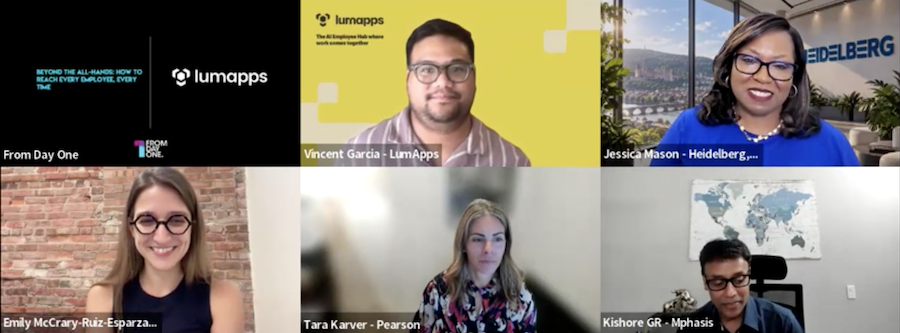
The message should ultimately dictate the channel, said Kishore GR, the head of HR at IT services firm Mphasis. During emergencies, like hurricanes, text messages allow leadership to quickly reach their teams, and vice versa. Broader announcements can be shared through email, digital signage, or leadership memos, while employees who can’t access their phones at work may need printed materials.
The most consequential announcements require a heavy hand. “If it’s a change in business direction, if we are moving from an A way of selling to a B way of selling, then that has to be a little more intense after the traditional all-hands or top-down approach,” GR said. Smaller working groups can help contextualize those big changes for employees.
Repetition is essential to getting messages across, said Tara Karver, who leads HR at educational publisher Pearson. For every seven messages, only one or two might stick. Employees may need to hear the same information through Slack, email, and directly from their managers. But repetition alone isn’t enough. “The best way for people to retain information is through storytelling—the story of why we have to do this or why this is so important.”
Timing matters, too. “Even if I’m hitting you in the flow of work, do you have the headspace to actually think through what I’m trying to tell you?” Karver said. “That’s why these multifaceted approaches are so important, because you never know.”
I see the front line managers as the translators, even though the senior leaders bring the message to the workers,” said Mason of Heidelberg. “They’re the ones that build the trust in whatever we’re trying to convey, but comms isn’t always seen as part of a manager’s role,” she said, so “we have to keep instilling it in them.” For particularly complex or consequential messages, Mason hosts sessions with leaders across locations so they can ask questions of HR and senior leaders before they have to take the message to employees.
Communications plans are often designed for desk workers, with frontline employees treated as a secondary audience. But different segments of the workforce need different platforms and approaches, said Garcia of LumApps. Especially as more Gen Zers enter the frontline workforce, employers should prioritize mobile-first communication. “We need to meet them more at the place where they look the most, which is their mobile device,” he said.
Mason said Heidelberg’s frontline employees have made their preferences clear. “I asked ‘Okay, how can I best communicate with you?’ And they’re like, ‘Just give us the Cliff’s Notes version because we’re moving, we’re reading it, and we’re getting back to work.’”
Communicating with remote employees presents a different challenge. At Pearson, where much of the workforce works remotely, traditional workplace channels aren’t always an option. “It’s not like I can put something in the snack room,” Karver said. Instead, Pearson uses virtual forums where employees can ask questions and hear directly from leadership. After a recent Q&A with the CEO, company leaders held their own sessions to directly field employee questions. “It’s one thing if it’s happening at the company level, but what is my manager saying?” Karver said. “Because that’s probably what I’m going to react to first.”
Reaching employees is only half the challenge. How can HR leaders know if their messages are actually getting through?
“Page views and open rates are purely vanity metrics, especially if the majority of your workforce is on the front line,” said Garcia. “If they just viewed a safety protocol or open enrollment updates, it tells you zero about what they actually understood and whether or not they complied with it.”
Rather than measuring how many employees open or read a message, organizations should focus on behavior: Did they complete the requested task? Did they make the required change? Tracking those outcomes, Garcia said, gives employers a clearer picture of whether their communications are landing.
Just as important is establishing feedback loops at every level of the organization to assess whether employees understand messages, adopt new tools, and benefit from changes, said GR of Mphasis. As technology evolves rapidly, keeping employees informed and gathering meaningful feedback is an ongoing challenge, but one that organizations can’t afford to overlook.
Editor’s note: From Day One thanks our partner, LumApps, for sponsoring this webinar.
Emily McCrary-Ruiz-Esparza is an independent journalist and From Day One contributing editor who writes about business and the world of work. Her work has appeared in the Economist, the BBC, The Washington Post, Inc., and Business Insider, among others. She is the recipient of a Virginia Press Association award for business and financial journalism. She is the host of How to Be Anything, the podcast about people with unusual jobs.
(Photo by Nuthawut Somsuk/iStock)