Rethinking Early Career Hiring: Turning High Volume Into High Confidence
BY Emily McCrary-Ruiz-Esparza
|
October 22, 2026

As recruiters sift through mountains of applications, often for a single job opening, hiring teams are finding it tough to preserve quality in a process that has become more and more about quantity.
But high-volume recruiting doesn’t have to be impersonal recruiting. Especially when it comes to filling early career roles—where there is no shortage of interested applicants—finding capable, coachable hires can feel like an impossible task. Some recruiting experts are advocating for more meaningful assessments, long-term candidate relationships, and clear expectations around AI.
Looking Beyond the Resume
“Anybody can look good on paper, and there are so many tools that can help us do that,” said Jena Brown, director of global talent management at tech services firm Concentrix, during a From Day One webinar about rethinking high-volume early career hiring. She has reviewed candidates who’ve used AI to build their resumes, complete work samples, even respond to basic interview questions. “We have to be better with our human skills to distinguish what’s presentation and what’s capability.”
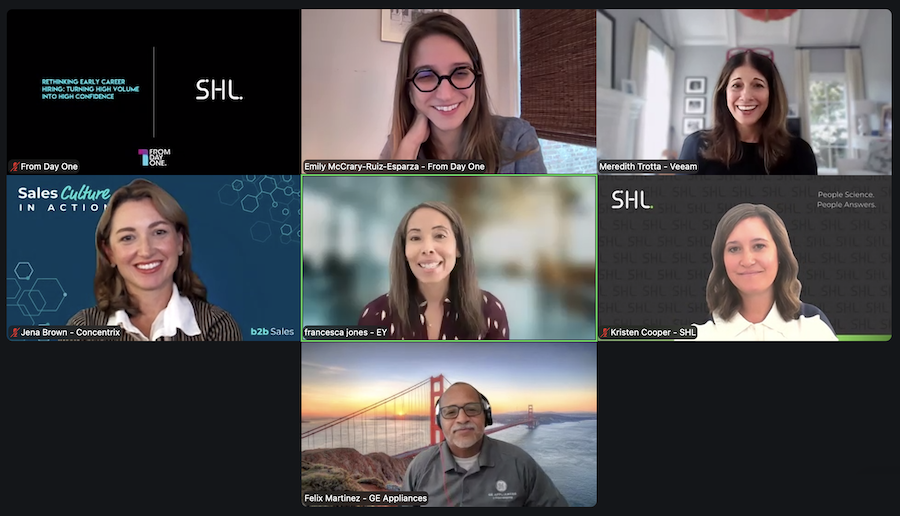
Because early career hires come with short resumes, recruiters have to probe for “how someone is thinking, how they learn, how they problem-solve, how they adapt, and how they communicate—and AI tooling cannot answer those questions for us always,” said Brown. Aside from reviewing a CV, her team uses behavioral and situational interview questions, virtual assessments, and face-to-face contact, pressing candidates for concrete examples and working through their thought processes.
Keeping Hiring Human
“I’ve been in university recruiting a long time, and as much as things have changed, they’ve really, in a lot of ways, stayed the same. We’re still going to campuses,” said Meredith Trotta, global director of university recruitment at cyber security company Veeam. “In the age of AI, authenticity is going to rule supreme.”
Trotta said she’s more interested in having good conversations with serious candidates and forging long-term relationships than casting a wide net to catch as many applicants as possible.
“I could name three students I met yesterday by their first names, and one of them’s already reached out,” said Trotta. “We’re really interested in quality over quantity because the quantity will come.”
Volume threatens speed, and candidates are quickly frustrated by radio silence from employers. That’s where hiring teams can stand out. “We don’t want this to just be a moment in time,” said Francesca Jones, who leads talent acquisition at professional services firm EY. “This is a moment where they get to engage with us and think about our brand, even if it’s not at this moment, we want them to think about us in the future as well. That continues to be a reason why we spend so much time in this space. We just want to make sure that our direction of travel is clear and timely for them as soon as possible.”
Jones uses virtual events to cover the basics about the company before meeting students on campus, freeing up on-campus time to focus on culture and the candidate experience rather than company presentations.
Looking for Potential, Not Just Experience
Early career candidates want face-to-face interactions with employers, but they’re also comfortable using AI to prepare their applications. That makes it especially important for employers to establish clear rules around acceptable AI use during the hiring process, says Kristen Cooper, director of solution architecture at SHL.
Employers often send mixed signals when they prohibit applicants from using AI in the application process while requiring proficiency for the job itself. Fellow panelist Felix Martinez, GE Appliance’s director of talent acquisition, noted that “we know for a fact that they’re using AI in one way, shape, or form in the process. We also want them to use AI, because this is one of the things that we are going to be required to do at work. We are also very clear at any point in time in our process if there’s AI involved, we let them know prior to them actually engaging.”
“Everything you’re measuring through the selection process certainly needs to be job-related,” said Cooper from SHL. Employees will have to invest in their learning and development, yes, but they do need to be trainable, coachable, and open to developing new skills.
“I don’t want to meet someone who's on a straight path,” Trotta said. “I want to meet somebody who’s on an interesting path.”
Editor’s note: From Day One thanks our partner, SHL, for sponsoring this webinar.
Emily McCrary-Ruiz-Esparza is an independent journalist and From Day One contributing editor who writes about business and the world of work. Her work has appeared in the Economist, the BBC, The Washington Post, Inc., and Business Insider, among others. She is the recipient of a Virginia Press Association award for business and financial journalism. She is the host of How to Be Anything, the podcast about people with unusual jobs.
(Photo by Courtney Hale/iStock)