Getting Cancer Care Right: A New Lens on Total Cost
BY Kristen Kwiatkowski
|
November 03, 2026

Cancer remains one of the fastest-growing and most unpredictable drivers of healthcare spending. Managing these costs requires more than simply reducing expenses. It also means ensuring patients receive the right care from the start.
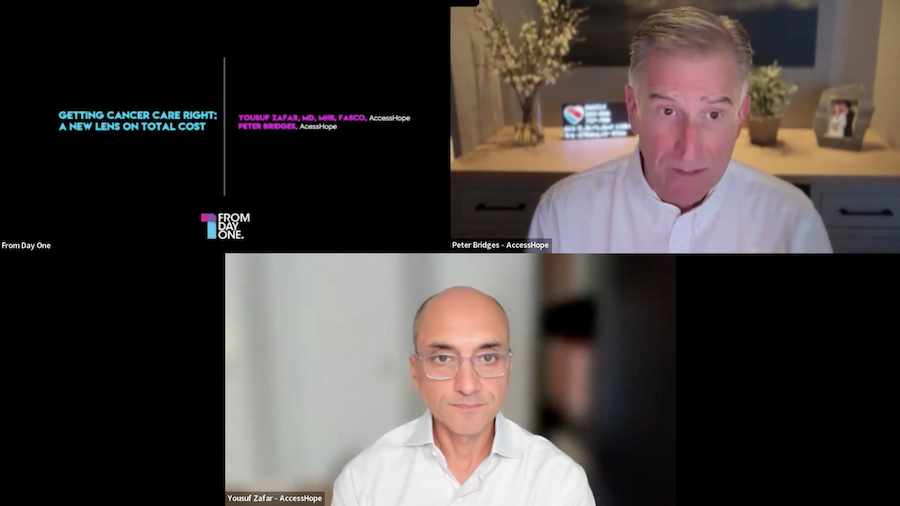
This was the topic of discussion during a From Day One webinar featuring Yousuf Zafar, MD, MHS, FASCO, chief medical officer at AccessHope, and Peter Bridges, chief strategy and corporate development officer at AccessHope, who discussed how to get cancer care right. AccessHope, as an employer-sponsored cancer support benefit, connects employees as well as their local oncologists with subspecialist expertise from various National Cancer Institute-designated cancer centers.
“As many of you probably know, 80% of cancer care is delivered in the community by local treating oncologists,” said Bridges. “AccessHope exists to give people access to that incredible subspecialist expertise from individuals working on the main campuses of some of the most prestigious and elite institutions in the cancer world,” he continued.
AccessHope wants to make sure cancer care is delivered correctly. In fact, in 8 out of 10 cases that are reviewed by AccessHope, there is an evidence-based, more effective treatment approach identified, says Bridges.
As for how cancer care is currently showing up in the benefits strategy of organizations, a poll held during the webinar showed that a large majority, about 40%, have it on their radar but not yet a priority and the other majority.
Why Cancer Is an Expensive and Complex Disease
Before employers can gain visibility into cancer spending, they first need to understand why cancer is one of the most expensive and complex conditions in a benefits portfolio.
Zafar had some thoughts on this. He stated the cancer population is changing and it’s getting younger. There is an increasing incidence, colorectal cancer is the leading cause of cancer death among individuals 50 and younger, and the cancer in younger patients is also more biologically aggressive.
There’s a hidden risk in the workforce: “45% of cancer occurs in working-age adults,” said Zafar. This relates to individuals with an approximate age range of 20 to 64. The reasons for this statistic have been related to the workforce aging, the rise of early-onset cancers, and survivorship extending the cost tail.
Another factor contributing to the complexity and expense of cancer care is the knowledge gap around treatment. The pace of innovation, new treatment options, care management challenges, and secondary impacts can all create gaps in care. When a webinar attendee asked why a single cycle of outpatient chemotherapy could cost $85,000, Zafar explained that the expense can reflect both the drug itself and the costs associated with administering it, including infrastructure, staffing, facility fees, and professional fees.
Diagnostic testing is another factor driving the cost and complexity of cancer care. Newer drugs often require companion diagnostic tests, adding to the overall cost and complexity of treatment. Genomic testing, meanwhile, is both overused and underused, with only one-third of cancer patients receiving appropriate testing. Community oncologists may also lack the guidance or expertise needed to interpret and apply these newer tests effectively.
As a result, the gaps lead to care inequities. For example, 60% of cancer treatment is guideline-concordant, there’s different care quality based on where this care is delivered, and studies have shown that NCI-CCC’s have better outcomes, but only 20% of such cancer care is delivered there. “This is really what we do at AccessHope is we bring the care from these ivory tower centers into the community without the patient having to move,” said Zafar.
As for what contributes to the cost and complexity in cancer care, Zafar stated inequity is a significant contributor. “We conducted a study that was peer reviewed and published last year that looked at the kind of recommendations we were making and who we were making those recommendations to and where that member lived, and what we found was members who were most likely to receive a change in care recommendation from us were most likely to live in areas of greatest socioeconomic deprivation,” said Zafar. “And what we do in our model is try to alleviate that inequity to the greatest extent possible.”
AI also entered the conversation. In an NBC News poll, results showed that Americans believe AI could have a positive impact on healthcare. “I firmly believe that AI by itself, particularly in cancer, is insufficient because what cancer requires is not just that molecular knowledge that AI is going to give us way better than I can any day, but it requires judgment, it requires application of values for the patient, and it requires accountability,” said Zafar. “And that’s what cancer care requires today.”
“AI is not able to give that, but when you have a human working alongside AI, you get those three characteristics, which lead to relationships, and that's what's so important in cancer care today,” he said.
The AccessHope Process
The AccessHope team follows a defined process to support individuals with cancer. It begins by identifying patients who may benefit from a review through claims data, either by reaching out to the member directly or having the member contact them, though the latter is less common. After applying initial eligibility criteria, the team obtains the patient’s medical records for review by an NCI subspecialist. The subspecialist then prepares a report for the AccessHope team, which shares the findings with the patient’s local oncologist.
So, how does AccessHope measure outcome impact? The company follows the claims record to determine whether or not a recommendation was adopted and only applies the savings in their financial model once they have validated evidence of recommendation adoption.
To determine whether a change in costs resulted from AccessHope or another factor, the team evaluates two things: whether its recommendation was implemented and the economic value of that implementation. The team establishes a timeframe for adoption and reviews medical notes to verify whether the recommendation was followed. To assess the financial impact, independent actuarial partners use a model that evaluates what portion of the cost change can be attributed to the recommendation and assigns an economic value to that change.
So, how can employee benefits leaders stay current with the emerging trends discussed here? Zafar says as an oncologist at AccessHope, he always wants to serve as a resource for their clients with questions and feels that employee benefit leaders may find answers they seek from the partners and vendors they work with to better understand the cancer space.
Editor’s note: From Day One thanks our partner, AccessHope, for sponsoring this webinar.
Kristen Kwiatkowski is a professional freelance writer covering a wide array of industries, with a focus on food and beverage and business. Her work has been featured in the Bucks County Herald, Eater Philly, Edible Lehigh Valley, Cider Culture, and The Town Dish.
(Photo by Anon Pitipong/iStock)